

Fiberglass pool shells cost you $15,000 to $60,000, depending on size, with small 10×20-foot shells starting around $15,000 and extra-large 20×40-foot custom shapes reaching $60,000. You’ll also need to budget for essential equipment, pumps and filtration run $1,200 to $4,500, while heaters add another $2,100 to $4,500. When you factor in installation labor of $10,000 to $50,000, total project costs typically land between $40,000 and $100,000. Breaking down each expense category reveals where your budget goes.
Fiberglass Pool Shell Price Ranges by Size
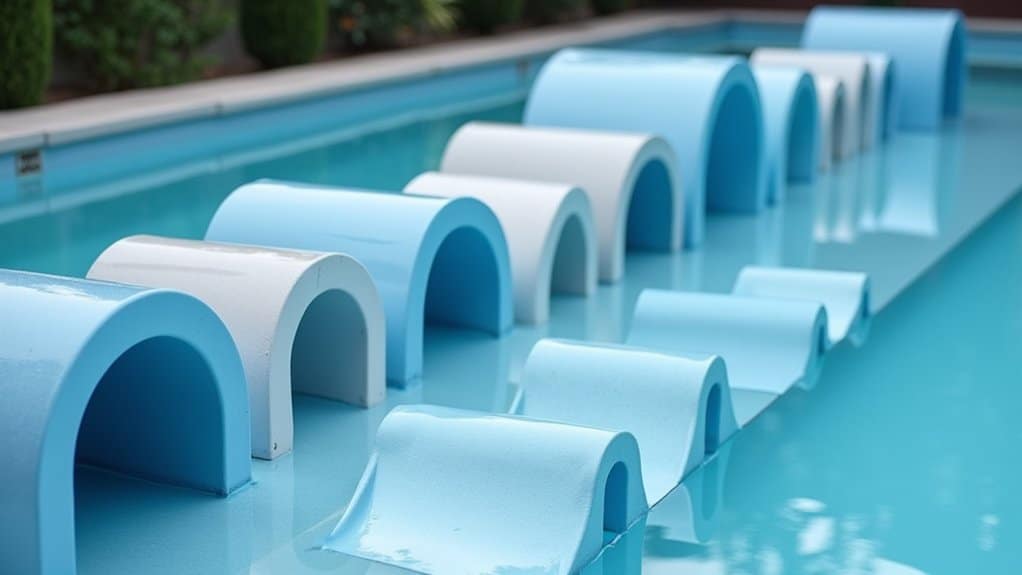
When you’re budgeting for a fiberglass pool, the shell represents your largest single material expense, typically ranging from $4,500 for basic small designs to $60,000 for intricate large-scale configurations.
Small pools (10×20 ft) run $15,000, $25,000 for compact or plunge shells. Medium pools (12×24 to 14×28 ft) cost $20,000, $30,000, while larger shells (15×30 to 16×32 ft) reach $30,000 for custom kidney or freeform shapes. Extra-large configurations (16×40 to 20×40 ft) command $30,000, $60,000. With proper maintenance, these durable shells last 25 years or more, making them a sound long-term investment. Compared to other pool types, fiberglass offers significant savings over time, with 10-year maintenance costs of approximately $3,800 versus $11,500 for vinyl liner pools.
You’ll calculate costs at $150, $250 per square foot. Don’t overlook material transportation expenses, which increase substantially for oversized shells requiring specialized hauling. Pool site preparation costs also scale with dimensions, larger excavations demand more equipment time and labor. Challenging site conditions such as ledge rock or high water tables can add $10,000 to $15,000 to your overall project expenses. Factor these variables into your total project budget before committing to shell specifications.
Labor and Installation Expenses for Fiberglass Pools
Beyond the shell itself, labor and installation expenses represent 30-40% of your total fiberglass pool investment, a substantial budget category that demands careful analysis.
Nationwide installation labor ranges from $10,000 to $20,000, while extensive installation covering excavation, plumbing, electrical, and placement runs $15,000 to $50,000. Licensed electricians charge $3,000 to $7,000 for power connections, GFCI protection, and lighting circuits.
Regional variations extensively impact your budget. Northeast installations in Massachusetts and New Hampshire cost $45,000 to $85,000 due to smaller contractor workforces. Southern states like Texas and Arizona offer lower labor rates. Florida installations average $45,000 to $85,000 with 2-3 week completion times. Backyards with narrow gates or limited crane access can increase installation costs significantly, particularly in Florida’s dense neighborhoods where compact equipment may be required. Additionally, gravel pricing and transportation can fluctuate significantly based on your location, adding unexpected costs to your installation budget.
When evaluating financing options, factor in warranty considerations tied to professional installation. Off-season scheduling in fall or winter reduces costs where weather permits. Despite the higher upfront labor investment, fiberglass pools offer long-term maintenance savings because their non-porous surface resists algae growth and reduces chemical expenses over the pool’s lifetime.
Essential Equipment and System Costs

Although labor represents a significant portion of your budget, essential equipment and system costs add another $5,000 to $15,000 to your fiberglass pool project.
Your core equipment package typically includes:
- Pump and filtration systems: $1,200 to $4,500 based on pool size and efficiency ratings
- Heater and cooling pumps: $2,100 to $4,500 for temperature control
- Water treatment options: Nature2 sanitizer systems included in premium bundles
- Lighting and automation: Additional costs within complete equipment packages ranging $3,000 to $7,000
Energy-efficient models command higher upfront costs but reduce long-term operating expenses. You’ll also need water delivery services, typically $60 to $120 for 15,000 to 30,000-gallon fills. Most fiberglass pool kits include an automatic chlorinator or saltwater chlorinator to simplify ongoing water maintenance. These systems are bundled into turn-key packages priced between $135,000 and $150,000, which often include automatic pool covers as part of the standard equipment setup.
Additional Features and Add-On Pricing
Customizing your fiberglass pool with add-on features typically increases your project budget by $3,000 to $15,000 or more, depending on the upgrades you select.
Lighting installations range from $700 to $1,800 for underwater LED systems, while heating and cooling pumps cost $2,100 to $4,500. These equipment upgrades directly impact your long-term maintenance requirements and energy consumption.
Safety features demand careful budgeting. Pool covers run $760 to $2,500, and fencing adds $600 to $1,000 overall, with glass options reaching $100 to $300 per linear foot. Automatic pool covers offer the highest level of protection and convenience, costing $8,000 to $20,000 installed.
Water features like bubblers and waterfalls cost $1,000 to $3,000, while decking ranges from $6 to $30 per square foot. Rails ($100, $500) and ladders ($100, $2,000) complete your accessibility needs. Each selection compounds your total investment while enhancing functionality.
Total Project Cost Breakdown by Pool Type

When you’re budgeting for a fiberglass pool, the total project cost varies considerably based on the pool type you select, ranging from $20,000 for basic above-ground installations to $100,000 for premium inground configurations.
Here’s what you’ll spend by category:
- Above-ground fiberglass: $20,000, $75,000, offering 30%, 50% savings over inground options
- Inground fiberglass: $40,000, $100,000, including $15,000, $50,000 for installation
- Lap pools: $30,000, $65,000 for 40×8-foot configurations
- Saltwater systems: $20,000, $60,000 with compatible equipment
Each type delivers different poolscape flexibility for your backyard environment. Above-ground models require additional support structures, while inground installations demand excavation, plumbing, and electrical work totaling $15,000, $50,000. Labor costs run $10,000, $20,000 regardless of configuration, representing 160 crew hours for standard projects. For inground fiberglass pools specifically, the shell alone costs $30,000 to $60,000 before factoring in site preparation and utility connections. If you want to add a standalone fiberglass spa to complement your pool, expect to pay an additional $4,000, $7,000 for the shell.
Frequently Asked Questions
How Long Does a Fiberglass Pool Shell Typically Last Before Needing Replacement?
Your fiberglass pool shell typically lasts 25 to 50 years before needing replacement. The material durability comes from multiple layers of fiberglass and resin, creating a flexible yet strong structure that resists cracking. You’ll maintain structural integrity by keeping proper water chemistry and avoiding unnecessary draining. While you may need gelcoat refinishing after 20 to 30 years, that’s considerably more cost-effective than the frequent resurfacing concrete pools require.
Can Fiberglass Pools Be Installed in Cold Climates With Freezing Temperatures?
Yes, you can install fiberglass pools in cold climates with freezing temperatures. The flexible material handles freeze-thaw cycles better than concrete or vinyl alternatives. You’ll need proper insulation requirements, including crushed stone backfill and perimeter insulation boards to protect against frost heave. Cold weather maintenance involves lowering water levels, winterizing lines, and using quality covers. Budget for additional installation costs if you’re building during winter, including heating equipment and potential weather delays.
What Permits Are Required Before Installing a Fiberglass Pool?
You’ll need several permits before installing your fiberglass pool. Start by obtaining installation permits from your local building department, including electrical permits for wiring and GFCI protection, plumbing permits for backflow prevention, and fence permits for required enclosures. Your local building code requirements mandate compliance with International Building, Plumbing, and Electrical Codes. Submit site plans showing pool location, setbacks, and equipment placement. Budget for permit fees and potential re-inspection costs to avoid project delays.
How Does Soil Type Affect Fiberglass Pool Installation Feasibility?
Your soil type directly impacts installation complexity and costs. Clay soil requires extensive drainage systems and reinforced bases due to poor soil stability and expansion issues. Sandy soil needs compaction and structural supports to prevent shifting. Rocky terrain demands specialized excavation equipment, increasing labor expenses. You’ll also need to assess water table depth, as high groundwater creates pressure against the shell. Loamy soil offers the most cost-effective installation with minimal additional infrastructure requirements.
Are Fiberglass Pool Materials Covered Under Manufacturer Warranties?
Yes, your fiberglass pool materials receive manufacturer warranty coverage protecting the shell against defects, cracking, and structural failure, typically ranging from 25 years to lifetime. Surface warranties cover gelcoat issues like blistering and fading for 7-15 years. However, you’ll need to meet pool shell maintenance requirements, including proper water chemistry testing and using certified installers. Keep detailed documentation of installation and maintenance logs to guarantee valid claims.