You’ll spend between $30,000 and $173,000 on an indoor pool addition, with most mid-size projects landing in the $150,000, $250,000 range once you factor in the pool shell, enclosure, and mechanical systems. HVAC and dehumidification alone run $20,000, $60,000, and labor accounts for 25%, 50% of your total spend. Your budget tier determines whether you’re getting a compact setup or a fully finished installation, and the hidden mechanical costs below explain exactly where most estimates fall short.
What an Indoor Pool Addition Actually Costs
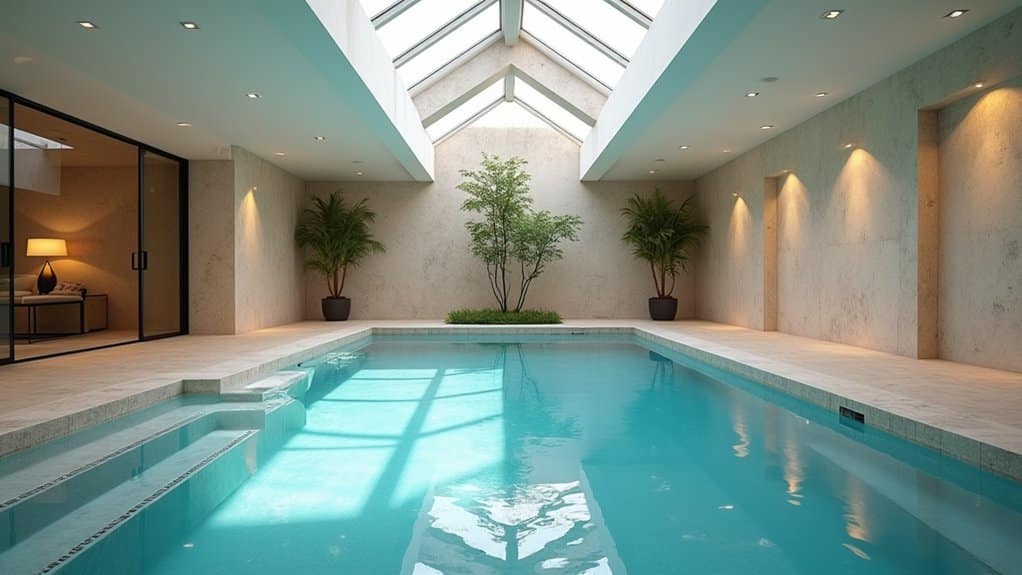
Because indoor pool additions combine pool construction, structural buildout, and specialized mechanical systems into a single project, total costs run considerably higher than most homeowners initially expect. The average indoor pool addition cost falls between $100,000 and $500,000, with mid-size projects typically landing in the $150,000 to $250,000 range. Your indoor pool construction cost breaks down across several major categories: the pool shell ($25,000, $100,000+), enclosure structure ($50,000, $200,000+), HVAC and dehumidification ($20,000, $60,000), and electrical, plumbing, and permits ($10,000, $40,000). When evaluating home pool addition pricing, expect $70 to $315 per square foot depending on complexity. Labor alone accounts for 25%, 50% of total spend. Understanding full residential natatorium cost requires budgeting beyond the pool itself, the enclosure and mechanical systems often exceed the shell investment.
What Drives Indoor Pool Addition Pricing the Most
Climate-controlled pool costs add $20,000, $30,000 for dehumidification alone, with air handling running £175, £250 per m³ of building volume. Total indoor pool installation expenses escalate further with excavation complexity, regional labor rates averaging $55/hour, and material specification choices that affect both upfront and long-term maintenance budgets. Soil tests before installation are essential to avoid unexpected expenses from unsuitable ground conditions or groundwater presence that can significantly inflate excavation and foundation costs.
Indoor Pool Costs at $30K, $50K, and $100K+ Budgets
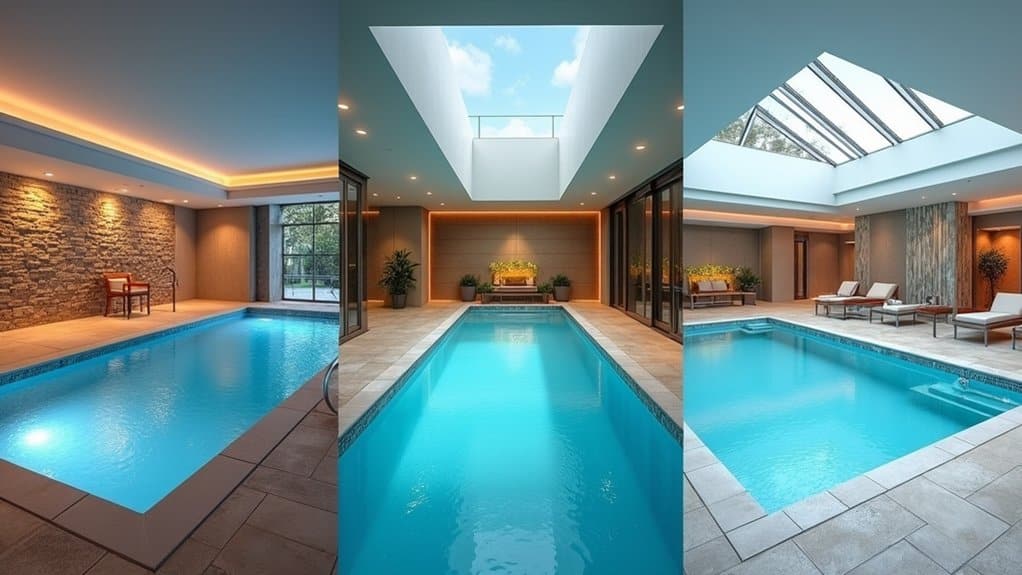
Understanding what drives costs is useful, but most homeowners start from a fixed number, so it’s worth mapping what $30K, $50K, and $100K+ actually buy when the goal is an indoor pool.
At $30K, you’re limited to a compact, entry-level pool structure, typically under 30 feet long, without enclosure, HVAC, or finished surroundings. Permits and electrical alone can push your indoor pool addition price toward $50K. At that range, you’ll absorb basic site restoration and utility connections but still face a constrained scope. A custom pool enclosure cost isn’t realistic here. Unique indoor pool layouts offer a range of aesthetic and functional options. Consider designs that incorporate space-saving features to maximize your enjoyment while staying within budget.
The cost to build indoor swimming pool projects properly starts at $100K+, where you can cover larger dimensions, mechanical systems, and structural enclosure without extreme trade-offs. Keep in mind that labor averages $30,000 to $54,000 for concrete pool installation alone, which explains why comprehensive indoor builds demand six-figure budgets. A luxury indoor pool budget exceeding $150K positions you for complete, finished installations with dehumidification, quality finishes, and proper engineering.
Hidden Mechanical Costs Most Pool Budgets Miss
Most indoor pool budgets account for the shell, decking, and basic equipment, but miss the mechanical infrastructure that makes the space functional. Your mechanical room and equipment pad need dedicated floor space, ventilation, and service clearance for pumps, filters, and controls. HVAC and dehumidification alone run $20,000 to $60,000, with standalone dehumidifiers adding $15,000 to $40,000 installed.
Electrical, plumbing, and permit work typically falls $10,000 to $40,000, often billed separately from your base pool quote. Panel upgrades, gas service verification, and long equipment runs increase costs fast. Indoor pool excavation cost also rises when confined spaces limit equipment access or require foundation reinforcement.
These aren’t optional extras. They’re load-bearing budget items. Missing them during planning creates the gap between your initial estimate and your actual project total.
How to Get a Reliable Indoor Pool Estimate
- Define pool style, size, materials, and mechanical requirements before requesting bids
- Confirm indoor pool building permits with your municipal office early
- Request line-item breakdowns for enclosure, HVAC, electrical, plumbing, and finishes
- Evaluate whether an existing structure reduces enclosure costs versus a new build
- Use contractor quotes to validate or adjust your initial calculator estimate
Call Today and Plan a Pool Built for Every Season
Indoor pools deliver year-round enjoyment, but only when built with the right design, ventilation, and finishes. At Cristallo Pools in Jupiter, FL, our skilled team delivers dependable Design and Planning built around your space, lifestyle, and luxury standards. Call +1 (561) 766-0353 today and turn your indoor pool dream into a reality.
Frequently Asked Questions
Does an Indoor Pool Addition Increase Homeowner Insurance Premiums?
Yes, adding an indoor pool typically increases your homeowner’s insurance premiums. Insurers view pools as higher-liability features due to accident and attractive-nuisance risks. You can expect annual increases ranging from $50 to $2,000+, depending on your insurer, coverage limits, and pool features. You’ll likely need to raise your liability limits, often from $100,000 to $500,000, and may want umbrella coverage. Installing safety measures like fencing, alarms, and covers can help reduce premium increases.
How Much Does an Indoor Pool Cost Monthly to Operate?
You’ll typically spend $600 to $1,900+ per month operating an indoor pool when you combine energy and routine maintenance. Heating and dehumidification drive the largest share, running $500 to $1,500 monthly in energy alone. Chemical supplies add $80 to $150 per month, and professional cleaning services range from $100 to $400 monthly. Annually, you should budget $8,000 to $20,000+, depending on pool size, climate, and equipment efficiency.
Will an Indoor Pool Addition Increase My Home’s Resale Value?
An indoor pool addition can increase your home’s resale value by roughly 5% to 10% under favorable conditions, but you’ll rarely recoup the full construction cost. Expect a return of about 40% to 50% of your build investment. You’ll strengthen your resale position in luxury markets, colder climates, and neighborhoods where pools are common. Well-maintained, professionally designed installations that complement your home’s overall style yield the strongest returns.
Can Indoor Pool Construction Be Completed in Phases to Manage Costs?
Yes, you can phase your indoor pool construction to spread costs across multiple stages. You’d typically break the project into design/permitting, excavation/shell, plumbing/electrical rough-ins, finish work, and equipment commissioning. Each phase aligns with natural inspection milestones, letting you fund discrete contractor packages sequentially. Keep in mind that pausing between phases can increase re-mobilization costs and extend timelines, and you can’t defer core structural or mechanical work without delaying functionality.
What Permits Are Required Before Building an Indoor Pool Addition?
You’ll typically need a building permit for the structural addition, a plumbing permit for drainage and backwash connections, and an electrical permit for pumps, lighting, and heaters. Most jurisdictions also require barrier compliance review covering fencing, gates, and alarms. You’ll need to submit scaled site plans and engineering drawings for plan review before construction begins. Some areas require separate health department approval, and final inspections must pass before you can operate the pool.