Building an indoor residential pool typically runs $95,000, $200,000+ once you account for the shell, enclosure, and mechanical systems. You’ll need a dedicated dehumidification system ($20,000, $30,000) since your existing HVAC can’t handle the moisture load. Shell materials range from $40,000 for vinyl liner to $120,000+ for concrete, each with different long-term ownership costs. Annual operating expenses include heating, chemicals, and continuous dehumidification. The full cost breakdown below covers every line item you’ll encounter.
What Does an Indoor Pool Actually Cost?
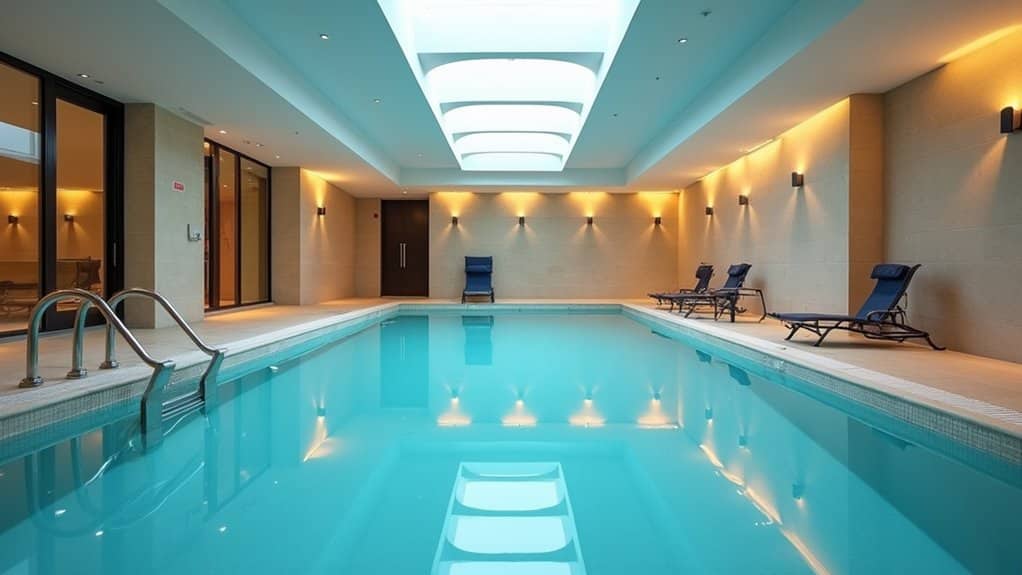
An indoor pool installation typically ranges from $10,000 to $470,000, with most projects landing near $95,000. Your final figure depends on whether you’re installing the pool alone or building the full enclosure. A pool-only in-ground installation runs $20,000 to $200,000, while prefabricated systems cost $20,000 to $90,000. Custom builds start at $30,000 and exceed $110,000.
The full indoor build, pool, room structure, and mechanical systems, pushes costs upward of $200,000. Expect $70 to $315 per square foot based on pool size. Labor accounts for $22,800 to $60,700, and materials range from $17,200 to $139,300. If your home lacks a suitable space, retrofitting alone adds $40,000 to $200,000. High-end projects with extensive customization reach $350,000 to $470,000.
Above-Ground vs. In-Ground Indoor Pool Prices
You’ll find the gap stems from structural demands, in-ground builds require excavation, coordinated site preparation, and heavier permitting. Indoor applications magnify these differences, since enclosure and climate-control integration compounds the complexity of in-ground installations while above-ground systems require less permanent structural commitment. Above-ground pools typically cost $4,000, $12,000 installed without decking, making them a significantly more accessible entry point compared to in-ground options that can reach $60,000, $120,000 or more.
Concrete, Fiberglass, or Vinyl Liner Indoors?
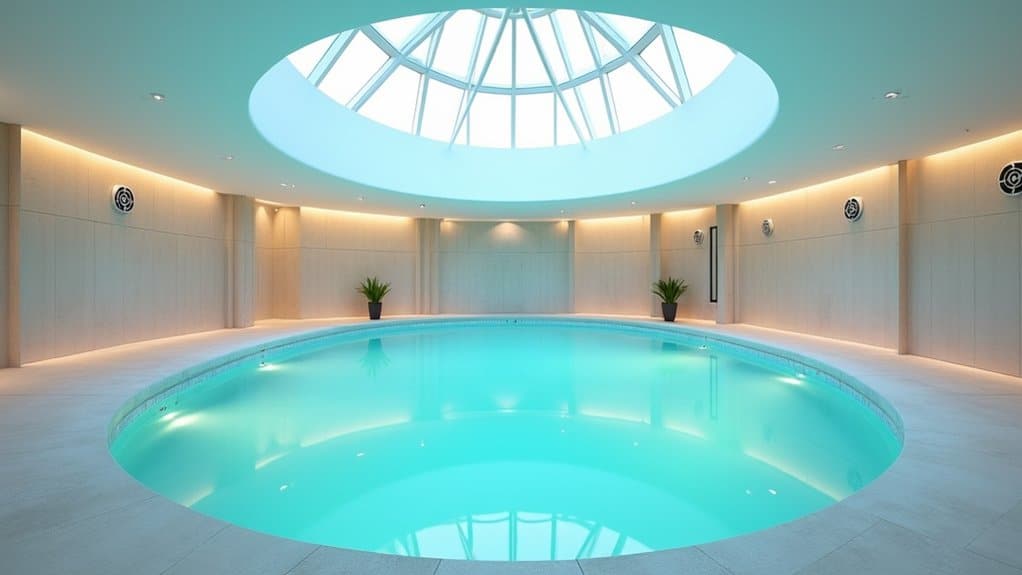
When you’re selecting a pool shell for an indoor installation, material costs vary markedly: vinyl liner systems start around $40,000, $70,000, fiberglass runs from approximately $50,000, and concrete ranges from $80,000, $120,000+. Beyond upfront pricing, you’ll need to factor in long-term durability, vinyl liners require replacement every 5, 10 years, while fiberglass and concrete shells offer substantially longer service life without recurring shell expenses. Each material also performs differently in the controlled indoor environment, where humidity exposure and maintenance demands directly affect your total cost of ownership. Fiberglass pools also benefit from a non-abrasive surface that prevents injury and requires less maintenance than concrete in indoor settings.
Material Cost Differences
Because the pool shell material you select directly impacts both upfront investment and long-term ownership costs, understanding the price differences between concrete, fiberglass, and vinyl liner pools is critical before committing to an indoor build.
Vinyl liner pools carry the lowest initial cost at $25,000, $110,000, though you’ll face liner replacement every 8, 10 years at $3,000, $7,500. Fiberglass shells fall mid-range at $30,000, $100,000, with the lowest annual maintenance burden, approximately $800, $1,200. Concrete commands the highest install price at $50,000, $300,000+, plus $1,800, $2,500 in yearly upkeep and resurfacing costs of $6,000, $15,000+ every 10, 15 years.
Over 10 years, total ownership costs reflect these differences sharply: vinyl runs $58,000, $94,000, fiberglass $63,000, $112,000, and concrete $99,500, $147,500. You’ll want to weigh customization flexibility against cumulative spending.
Indoor Durability Comparison
Three pool shell types, concrete, fiberglass, and vinyl liner, perform very differently once enclosed in a climate-controlled indoor environment, where constant humidity, reduced UV exposure, and stable temperatures shift durability priorities away from weather resistance and toward surface porosity, maintenance frequency, and long-term structural integrity.
Fiberglass delivers the strongest indoor performance: its non-porous gelcoat resists algae attachment, eliminates periodic resurfacing, and maintains structural integrity for the home’s lifetime. Concrete offers robust shell durability but demands acid washing every 3, 5 years and resurfacing every 7, 15 years, its porous surface increases chemical consumption and cleaning frequency indoors. Vinyl liner pools present the shortest service cycle, requiring liner replacement every 5, 10 years, with seam areas prone to debris accumulation and algae colonization. You’ll find fiberglass consistently requires the least intervention in enclosed aquatic environments.
Can You Retrofit an Indoor Pool Into Your Home?
Retrofitting an indoor pool into an existing home requires you to budget well beyond the pool shell itself, with full projects often exceeding $200,000 once you account for enclosure construction, dehumidification systems averaging $20,000 to $30,000, and structural modifications. You’ll need a licensed structural engineer to verify that your foundation, floor slabs, and load-bearing walls can handle the sustained weight of the pool, water volume, decking, and mechanical equipment. Climate system integration is equally critical, you must spec a dedicated dehumidification and ventilation system sized to your pool room’s volume and expected evaporation rate to prevent condensation damage throughout the surrounding structure.
Retrofit Cost Expectations
| Cost Component | Estimated Range | Notes |
|---|---|---|
| Dehumidification system | $20,000, $30,000 | Required for moisture protection |
| Pool shell (in-ground) | $20,000, $200,000 | Varies by material and size |
| Enclosure/structure | $1,000, $30,000 | Avg. ~$13,000 |
| Labor | $23,000, $60,000 | 25%, 50% of total cost |
| Full project total | $10,000, $470,000 | Depends on scope |
You should budget $70 to $315 per square foot for the pool itself. A 25′ x 45′ enclosure at $100/sq ft adds approximately $112,500 for the room structure alone. Total installed costs for full-size projects frequently exceed $200,000.
Structural Modification Needs
Before you commit to converting an existing room into an indoor pool, you’ll need a structural engineer to evaluate your home’s load-bearing capacity and foundation system. Existing floor assemblies rarely support the concentrated load of a filled pool without reinforcement, new footings, grade beams, or slab thickening may be required.
You’ll face demolition of flooring, subflooring, and potentially structural joists to create the basin. Room dimensions must accommodate the pool shell plus perimeter access, equipment clearance, and service chases. Utility line location is critical before any slab cutting or excavation.
Moisture barrier detailing demands exterior-side insulation and vapor membranes to prevent condensation damage at envelope interfaces. Mechanical rough-in must be sequenced around framing modifications so plumbing penetrations, electrical bonding, and filtration routing don’t conflict with structural work.
Climate System Integration
Most existing HVAC systems can’t handle the heightened temperature and dew point conditions an indoor pool generates, but you can retrofit a dedicated pool dehumidifier system into your home’s existing mechanical infrastructure. Direct supply air toward exterior windows and doors to prevent condensation. Position return ducts to optimize airflow patterns without short-circuiting. House all electrical components in a separate mechanical vestibule to shield them from corrosive pool air.
| Feature | Retrofit Benefit | Impact |
|---|---|---|
| Exhaust-Air Heat Recovery | Cuts heating costs 50%, 75% | Year-round savings |
| Compressor Hot-Gas Reclaim | Heats pool water via waste heat | Reduced energy bills |
| Ductless Mini-Splits | Flexible zone control | Precise climate management |
Integrate outdoor air at factory-provided intakes and pair with supplemental dehumidification rated for 50% relative humidity in winter conditions.
How Big Should Your Indoor Pool Building Be?
How large should your indoor pool building actually be? Start with your water dimensions, 90% of residential indoor pools use a 30 ft × 15 ft footprint, while 16 × 32 ft remains the standard vinyl-liner format. Then add perimeter clearance: you’ll need a minimum of 6 ft of clear deck space around the entire basin for safe circulation, seating, and equipment access.
A 25 ft × 45 ft enclosure (1,125 sq ft) represents a modest baseline. Don’t position the pool directly against building walls, you’ll increase structural stress and moisture damage risk. Factor in a dedicated plant room for mechanical equipment, plus storage and entry zones. For lap swimming, plan at least 30 ft of uninterrupted length; serious fitness use demands 40 ft minimum with an 8 ft lane width.
Climate Control and Dehumidification Costs
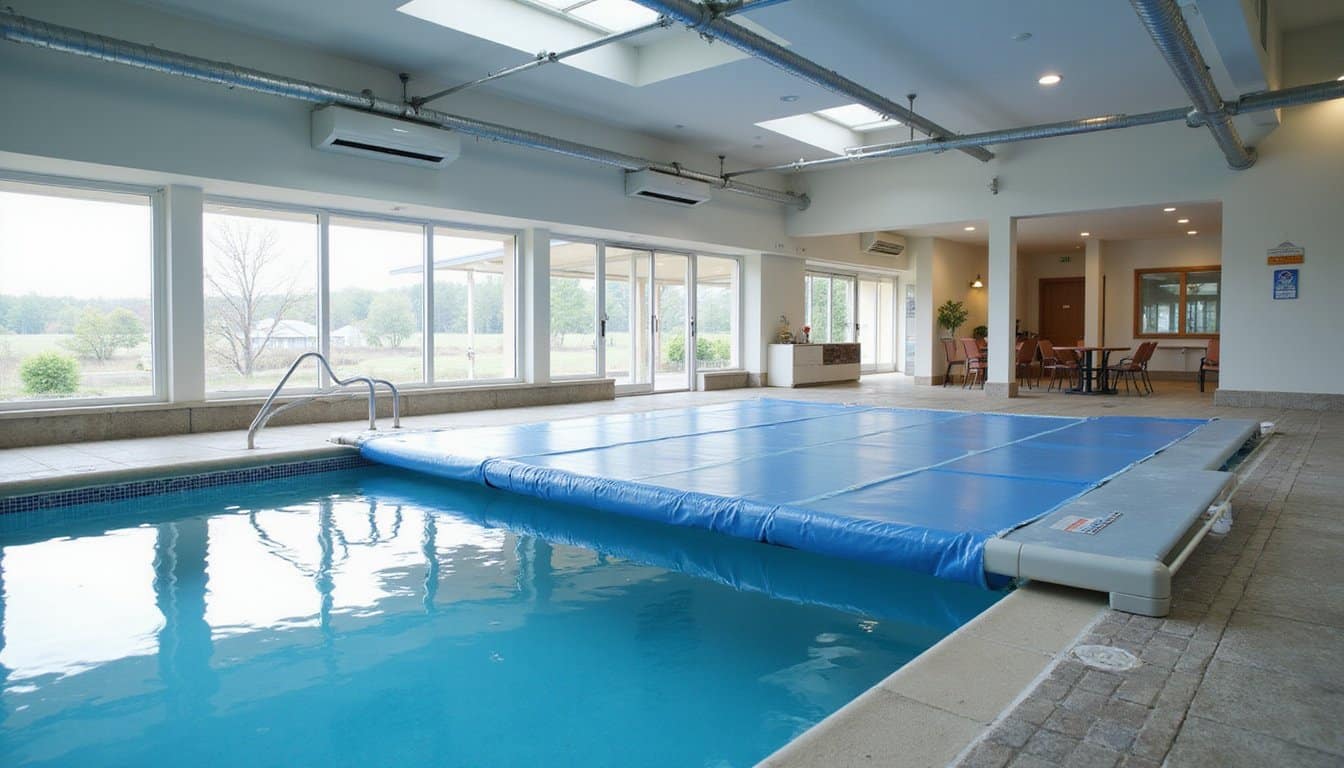
You’ll typically budget $20,000, $30,000 for a dedicated dehumidification system sized to your pool’s evaporation rate, with supplemental air-handling equipment, ventilation units at $600, $1,100 and air exchangers around $4,000, adding to your overall HVAC investment of $15,000, $30,000. Air-conditioning units at roughly $3,000 serve only as supplemental cooling, since they aren’t optimized for the high latent loads a natatorium generates. An automatic pool cover, priced at $12,000, $22,000, directly reduces evaporation and can considerably lower your ongoing dehumidification demand and energy costs.
Dehumidification System Pricing
Three primary system types dominate indoor pool dehumidification: refrigeration-based units, desiccant systems, and dedicated heat-pump dehumidifiers. You’ll find refrigeration-based units are most common, while desiccant systems perform better in cold climates where refrigeration efficiency drops. Dedicated heat-pump dehumidifiers offer the strongest balance of humidity control, energy recovery, and lifecycle reliability.
Your capital budget must account for more than equipment cost alone. You’ll need to factor in controls, humidity sensors, ductwork, air distribution, reheat integration, and mechanical-room modifications. Winter heating requirements and space constraints can push installed costs higher.
Size your system’s moisture removal capacity to match actual evaporation and ventilation loads, not room volume. Target 50% to 60% relative humidity. Evaluate total ownership value, including electricity, maintenance, corrosion-driven replacement, and heat recovery potential.
Air-Handling Unit Costs
Beyond the dehumidifier itself, the air-handling unit (AHU) forms the operational core of your indoor pool’s climate system. Your AHU reconditions warm, humid air while introducing fresh outside air, maintaining pool water within 1°F of air temperature to minimize evaporation. Standard components include fans, heating/cooling coils, air-control dampers, filters, and silencers.
Expect to budget £10,500, £20,000 for the AHU hardware, with separate ductwork adding £12,500, £20,000 depending on materials and routing complexity. In U.S. projects, dedicated HVAC systems for temperature control and fresh-air exchange typically add $5,000, $20,000+. Primary cost drivers include pool room volume, ductwork layout complexity, plant-room space constraints, and system integration level. Costs increase substantially when you’re combining air heating, pool-water heating, fresh-air intake, and dehumidification into one packaged unit.
Pool Covers Save Money
While your AHU and dehumidifier handle the heavy lifting of moisture control, a quality pool cover dramatically cuts their workload, and your operating costs. The U.S. EPA confirms covers prevent up to 95% of pool water evaporation, the primary driver of heat loss, humidity load, and chemical depletion in your natatorium.
That evaporation reduction translates directly to measurable savings. You’ll cut heating costs by 50%, 70%, per U.S. Department of Energy data. Chemical consumption drops 35%, 60%. Water-loss reductions reach 90%, 95%, lowering refill frequency and make-up water expenses. Your dehumidifier runs less frequently since the moisture load entering the pool room decreases substantially. Exhaust fans can potentially be shut off entirely when the pool’s covered. You’ll also maintain tighter water-temperature stability, with covers retaining approximately 8, 10°F that would otherwise escape unchecked.
Labor, Permits, and Costs You Won’t See Coming
Before breaking ground on an indoor pool, you’ll need local permits, and the fees, timelines, and submission requirements vary considerably by municipality. Most jurisdictions require stamped architectural, structural, and site plans. Inspections occur at multiple construction stages to verify zoning and safety compliance, and some counties mandate ongoing operating or renewal permits.
Labor spans excavation, framing, plumbing, electrical, HVAC, dehumidification, and finish work. Expect $10,000 to $40,000 for electrical, plumbing, and permits alone. Enclosure structures, walls, roof, foundation, run $50,000 to $200,000+.
Budget-busting line items often missed early include land surveys, retaining walls, dirt hauling, spoil removal, drainage corrections, post-construction landscaping, and code-required fencing upgrades. These hidden categories routinely push total project costs well above initial bids, with overall indoor pool installations typically ranging from $100,000 to $500,000+.
Pool Covers and Enclosures That Lower Indoor Pool Costs
Once your indoor pool is operational, covering it during periods of nonuse delivers the single largest reduction in ongoing costs, cutting heating expenses by 50%, 70%, make-up water demand by 30%, 50%, and chemical consumption by 35%, 60%. You’ll also reduce dehumidification runtime by 75%, 90%, extending HVAC equipment lifespan.
| Cover Type | Typical Cost |
|---|---|
| Solar covers (in-ground) | $40, $500 |
| Safety covers | $1,000, $4,000 |
| Automatic covers | $5,000, $15,000 |
| Standard screen enclosures | $4,000, $14,000 |
| Retractable enclosures | $15,000, $150,000 |
Automatic covers offer the highest convenience-to-savings ratio, providing instant deployment that maximizes overnight heat retention. For indoor applications, bubble covers prioritize heat retention and evaporation reduction over solar gain. You’ll stabilize chlorine strength and pH more effectively, reducing water-balance interventions and lowering total operational expenditure across heating, ventilation, and chemical systems.
What It Costs to Run an Indoor Pool Each Year
Because indoor pools operate year-round without seasonal shutdowns, their annual running costs consistently exceed those of comparable outdoor installations. Heating represents your largest ongoing expense, budget approximately £10 per day using a standard home heating system. Each additional degree on your thermostat increases energy consumption by 10% to 30%. Heat pumps and solar panels reduce long-term heating costs considerably.
Your dehumidification system draws continuous electricity alongside circulation pumps and ventilation equipment. LED lighting cuts illumination costs by up to 75% compared to conventional options. Chemical treatment runs year-round since evaporation affects water balance continuously, increasing consumption with heavier use. Total annual operating cost depends on pool size, usage frequency, heating method, enclosure type, and regional energy rates, meaning two identically sized pools can produce markedly different utility bills.
Do Indoor Pools Increase Home Value?
How much value an indoor pool adds to your home depends entirely on location, property type, and buyer demand, not on the pool itself. National pool premiums typically fall between 5% and 10%, with ROI recovering only 40% to 60% of installation cost. Luxury listings with indoor pools, roughly 0.7% of U.S. inventory, command approximately 4% more per square foot than comparable homes without one.
Climate drives the premium disparity. Warm-market properties in areas like Fort Myers, Florida, show the strongest gains, while cold-climate homes often register flat or negative impact. Indoor pools partially offset this by enabling year-round use, but buyer demand must exist in your specific neighborhood. If you’re building primarily for resale, expect incomplete cost recovery. If you’re building for lifestyle, treat any appreciation as secondary.
Call Today and Plan a Pool Built for Every Season
Indoor pools deliver year-round enjoyment, but only when built with the right design, ventilation, and finishes. At Cristallo Pools in Jupiter, FL, our skilled team delivers dependable Design and Planning built around your space, lifestyle, and luxury standards. Call +1 (561) 766-0353 today and turn your indoor pool dream into a reality.
Frequently Asked Questions
How Long Does It Take to Build an Indoor Residential Pool?
You can expect your indoor residential pool to take 12, 16 weeks from groundbreaking to completion, though simpler projects may finish in 8, 10 weeks. Your gunite shell alone requires 7, 10 days of curing, potentially stretching to four weeks in extreme weather. You’ll need to factor in enclosure construction, dehumidification system installation, plaster finishing (1, 2 days), and water balancing (5, 7 days). Permit processing and design complexity can extend your timeline further.
Do Indoor Pools Require Special Insurance Coverage for Homeowners?
You don’t typically need a separate policy, but you should review your homeowners coverage thoroughly. Insurers classify pools under dwelling, other structures, or personal property coverage, each carrying different limits. You’ll likely face higher premiums, mandatory safety requirements (fencing, locking gates, non-slip surfaces), and potential endorsements. You should increase liability limits to $300,000, $500,000 minimum and consider adding an umbrella policy to cover injury-related claims beyond standard limits.
What Safety Features Are Required for Indoor Residential Pools?
You’ll need a barrier at least 4, 5 feet high with openings under 4 inches, plus self-closing, self-latching gates that open away from the pool. Install exit alarms (minimum 85 dB at 10 feet) on all doors and windows accessing the pool area. You’re typically required to have at least two approved drowning-prevention features, such as a safety pool cover, pool alarms, and anti-entrapment drain covers, along with safety glazing and accessible life-saving equipment.
How Often Should Indoor Pool Water Be Tested and Treated?
Test your indoor pool’s pH and free chlorine at least daily until you understand your water’s fluctuation patterns, then maintain a minimum of twice-weekly testing. Check total alkalinity, calcium hardness, cyanuric acid, and TDS weekly to monthly. You’ll want a professional water analysis monthly. Increase frequency during heavy bather loads or after introducing fresh water. Always collect samples 12, 18 inches below the surface after running circulation for at least one hour.
Can Indoor Pools Cause Structural Damage to Your Home Over Time?
Yes, indoor pools can cause structural damage over time. Persistent humidity condenses on walls, ceilings, and framing, leading to mould, corrosion, and material degradation when you don’t install proper vapor barriers and dehumidification systems. Shell cracks allow water infiltration that erodes concrete, undermines surrounding soil, and causes foundation settlement affecting adjacent structures. You’ll need a dedicated dehumidification system, typically $20,000, $30,000, to maintain vapor control and protect your home’s structural integrity.