Olympic swimming pools must meet exacting specifications: a 50-meter length, 25-meter width, and 2-meter minimum depth, containing approximately 660,000 gallons of water. You’ll need eight standard 2.5-meter-wide lanes, with two additional outer lanes for Olympic competition. The water temperature must stay between 25°C-28°C, while reinforced concrete construction guarantees structural integrity. Precise lane markings and visual navigation features follow strict international standards, specifications that’ll prove critical for understanding modern competitive swimming facilities.
Defining Olympic Pool Dimensions

The dimensions of an Olympic swimming pool adhere to exacting specifications established by World Aquatics (FINA). You’ll find the official length set at precisely 50 meters between touch panels, with a strict tolerance of +0.010 and -0.000 meters. The standard width measures 25 meters for permanent installations and 26 meters for temporary pools, while the minimum depth requirement stands at 2 meters. These pools contain more than twice the amount of water compared to typical short course pools. Eight lanes are standard in most international competitions, though Olympic pools must accommodate ten lanes. The water temperature must be maintained at 25-28 degrees Celsius for optimal swimming conditions.
To safeguard accurate competition conditions, you’ll notice orientation markings and overflow channel design that maintain consistent water levels. Each pool must accommodate 10 lanes at 2.5 meters wide, with measurements taken both 0.3 meters above and 0.8 meters below the water surface. The pool walls must be positioned 50.020 to 50.030 meters apart to guarantee the exact 50-meter race course when touch panels are installed.
Water Quality and Temperature Requirements
Beyond precise dimensional requirements, Olympic pools must maintain stringent water quality and temperature specifications to guarantee ideal competition conditions. You’ll find thorough chemical storage requirements and continuous monitoring procedures in place to maintain perfect standards.
Key elements of Olympic pool water management include:
- Temperature control between 25°C-28°C, with sophisticated monitoring systems securing constant conditions
- Chemical balance maintenance through advanced feed systems, managing chlorine levels, pH, and alkalinity
- Water clarity optimization using high-performance filtration and regulated flow rates of 220-250 m³/h
The success of aquatic competitions depends on these exacting standards. With a capacity of 660,000 gallons of water, these pools require extensive filtration systems. Modern facilities utilize calcium hypochlorite briquettes, which require minimal storage space compared to traditional chlorination methods. Regular home testing kits and manual inspections supplement automated monitoring systems to maintain safety standards. Water quality parameters undergo verification through both automated systems and manual testing three times daily, while independent laboratories conduct regular analysis to ensure adherence with international requirements.
Essential Construction Materials and Methods
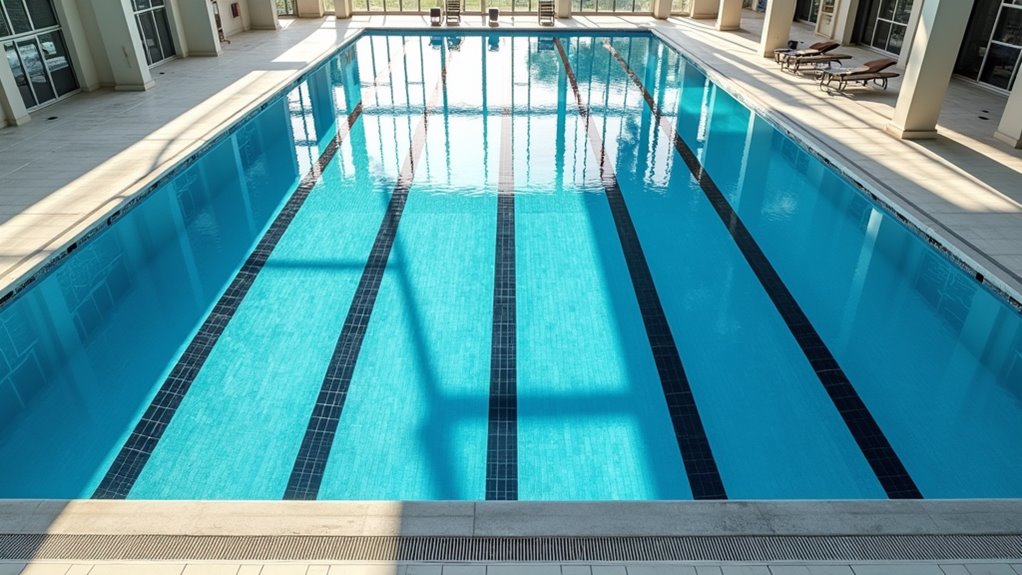
Building an Olympic-caliber swimming pool requires precise engineering and carefully selected construction materials to confirm decades of reliable performance. You’ll need reinforced concrete with steel rebar as the primary structure, augmented by eco-friendly concrete mixes that reduce environmental impact while maintaining durability. Waste-reducing prefabrication methods now allow for faster assembly and consistent quality control. The pool must maintain water temperature control between 25°C and 28°C for optimal athletic performance. For competitive standards, end walls must be perfectly vertical and form right angles with the water surface.
| Material Type | Primary Function | Key Requirements |
|---|---|---|
| Concrete Shell | Structural Support | High-density, vibration-compacted |
| Waterproofing | Leak Prevention | Chemical resistant, seamless |
| Surface Tiles | Athlete Interface | Non-slip, FINA-compliant |
| Coping Stones | Edge Protection | Shock-absorbing, rounded |
| Expansion Joints | Movement Control | Temperature resistant, flexible |
Modern construction techniques integrate computer-aided design and laser-guided leveling to secure precise dimensions. All materials must withstand intensive chemical exposure while providing ideal safety for athletes.
Lane Configuration and Marking Specifications
Olympic pools require precise lane configurations that you’ll need to comprehend for proper construction and competition. You must install eight standard 2.5-meter-wide lanes with supplementary 2.4-meter outer lanes in permanent facilities, while ensuring proper wave reduction through specialized lane ropes with 0.10-0.15 meter diameters. You’ll find specific visual navigation markers throughout, including contrasting lane lines measuring 0.2-0.3 meters in width, cross-lines at pool ends, and 15-meter markers to guide swimmers during competition. These lane divisions help create a fair competition environment by minimizing wave interference between swimmers during races.
Lane Measurements and Design
Precise measurements and standardized specifications define competitive swimming lanes in international pools, with specific requirements for width, markings, and configuration. Understanding lane dynamics is essential for ideal wave patterns and competitive performance in championship events.
Modern Olympic venues like the Paris La Defense Arena will showcase these exacting standards during international competitions.
- Standard competition lanes measure 2.5 meters wide, with center-to-center spacing maintaining consistent distances between swimmers
- Lane markings must feature dark, contrasting colors on the pool floor, spanning 46 meters in Olympic pools with distinctive 1-meter cross-lines at each end
- Lane ropes, measuring 0.15 meters in diameter, incorporate wave-reduction components and specific color coding for clear orientation
You’ll find these specifications strictly enforced in international competitions, where buffer zones and proper lane configuration work together to minimize turbulence and improve competitive conditions. The design guarantees fairness and optimal swimming conditions across all lanes.
Visual Navigation Features
Visual navigation features in Olympic pools incorporate an extensive system of standardized markings and cues that guide swimmers throughout their races. You’ll find dark, contrasting lane lines (0.2-0.3m wide) centered in each lane, extending 46m in 50m pools and 21m in 25m pools. Each lane line terminates 2m from the wall with a distinctive 1m cross-line. The durable vinyl pool surface provides an ideal foundation for these essential markings and indicators. The pool maintains eight competition lanes, with the two outer lanes always remaining empty to minimize wake interference.
The color code system extends to lane ropes, which must span the pool’s length with a 0.15m diameter. They’re equipped with wave reduction devices that can’t exceed 200mm at the ends. Target lines on end walls stretch up to 3m with a 0.5m cross-line 0.3m below water. Backstroke flag placement and 15m markers assist swimmers with turns and underwater phase regulations. All these features must comply with World Aquatics standards for competition eligibility.
Competition Safety Standards
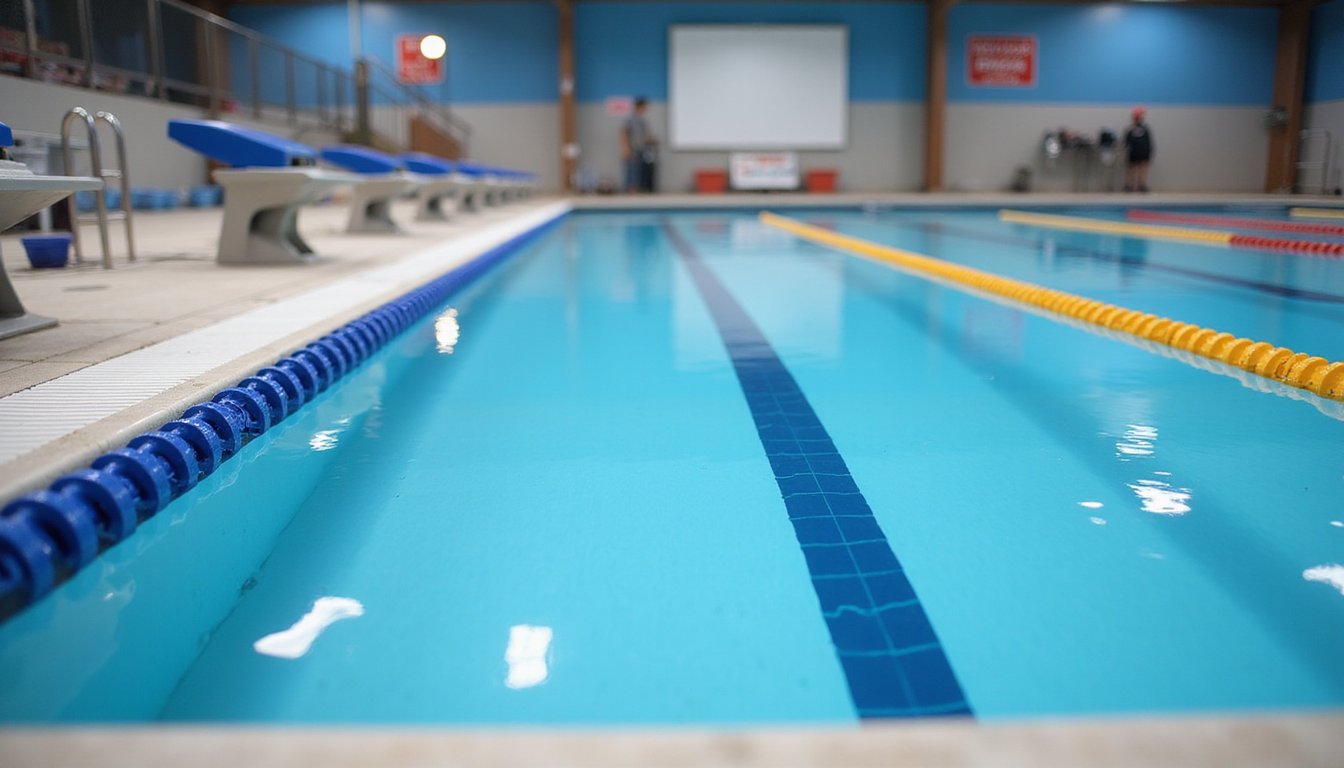
Three core elements form the foundation of competition safety standards in Olympic swimming: structural requirements, operational protocols, and emergency preparedness. To meet international standards, pools must maintain specific dimensions and safety features that guarantee both athlete protection and ideal performance conditions. Porcelain pool tiles with advanced non-slip technology are essential for preventing accidents in high-traffic areas around Olympic pools. Starting platforms must be firmly secured and elevated according to regulations for proper dive entry in freestyle, butterfly, and breaststroke events.
Olympic swimming competitions demand precise standards across structure, operations, and safety to protect athletes while enabling world-class performance.
- You’ll find strict structural requirements: 50-meter length, 2.5-meter minimum depth, and non-slip surfaces throughout wet areas, all critical for sponsorship agreements and athlete training protocols
- Water conditions must meet precise parameters: 25-28°C temperature, chemical balance monitoring, and crystal-clear visibility to the pool floor
- Emergency protocols require strategically placed rescue equipment, certified safety personnel, and unobstructed access points for rapid response
These standards ensure athletes can compete at peak performance while maintaining the highest level of safety throughout Olympic events.
Accessibility and Emergency Features
Modern Olympic pools incorporate sturdy accessibility and emergency features that guarantee safe participation for athletes and spectators of all abilities. You’ll find two accessible entry points in pools exceeding 300 linear feet, while smaller pools require one entry point – typically a pool lift or sloped entry. Clear, unobstructed routes connect pools to amenities, featuring slip-resistant surfaces and adequate clearance for wheelchairs. These features must be maintained and operational whenever the pool facility is open to the public.
Staff training emphasizes both standard rescue procedures and disability-specific protocols. Emergency equipment, including AEDs and accessible stretchers, must be readily available along marked routes. Thorough evacuation protocols incorporate both visual and audible alarm systems, with clearly posted instructions in multiple formats. You’ll also notice auxiliary aids, such as waterproof wheelchairs and transfer boards, available upon request to ensure equal access for all participants.
Lighting and Broadcast Requirements
Professional Olympic pools demand rigorous lighting specifications to meet both competitive and broadcast requirements. You’ll need to guarantee a minimum of 1500 lux for Olympic events, with electrical power consumption typically reaching 10,000 watts through 25 LED fixtures rated at 130 lumens per watt.
Key lighting considerations include:
- Strategic video camera placement requires uniform illumination across all lanes, minimizing shadows and water reflections
- LED tri-proof fixtures (IP66) must be waterproof and corrosion-resistant to withstand pool environments
- Spectator areas require 150 lux while the pool deck needs higher illumination for safety
Your lighting design must account for both underwater and above-water visibility during broadcasts. It is important to note that as of 2023, all pool lighting must deliver at least 45 lumens per watt to meet Department of Energy standards.
Pool Certification Process
The certification process for Olympic pools requires you to conduct rigorous inspections and testing under World Aquatics guidelines, including dimensional surveys, water quality analysis, and equipment verification. You’ll need to compile thorough documentation demonstrating compliance with international standards, supported by measurements from approved officials or surveyors. Your pool’s certification must undergo periodic renewal and maintenance checks to guarantee continued adherence to Olympic standards, with regular monitoring of critical parameters and immediate correction of any deviations.
Inspection and Testing Requirements
Rigorous inspection and testing protocols guarantee Olympic pools meet exacting international standards before receiving certification. Quality control procedures encompass extensive dimensional surveys, water quality analysis, and structural assessments that facility management protocols must strictly monitor.
Key inspection requirements include:
- Precise dimensional verification of pool length (50m), width (25m), and lane configurations with surveyor sign-off
- Water quality testing for chemical balance, filtration efficiency, and clarity standards
- Structural integrity checks of walls, surfaces, and safety systems
You’ll need certified professionals to evaluate starting blocks, timing systems, and temperature controls. The inspection process verifies that waterproofing, surface materials, and emergency systems meet international competition standards. All metallic fittings and pool components undergo thorough assessment for corrosion resistance and secure installation before certification approval.
Documentation and Compliance Steps
Obtaining Olympic pool certification requires painstaking documentation and systematic compliance procedures overseen by World Aquatics (formerly FINA). You’ll need comprehensive pool plans, technical drawings, and certified dimensional verification from an accredited surveyor. All documentation must align with current World Aquatics Competition Regulations and national federation requirements.
Your facility’s certification process demands independent inspectors who’ll verify physical attributes, materials, and finishes against approved specifications. You must maintain both digital archiving and physical records of all compliance documentation, including staff CPO certifications and training logs. Ongoing compliance monitoring requires periodic reporting to your national swimming federation. You’ll need to keep certification documents readily accessible for spot checks and guarantee all operator credentials remain current through continuing education programs.
Renewal and Maintenance Protocols
Maintaining Olympic pool certification requires a systematic approach to renewal protocols and ongoing maintenance procedures. You’ll need to guarantee compliance with World Aquatics regulations through periodic certifications and rigorous inspections. Personnel certification requirements mandate that your maintenance staff hold current qualifications in pool operations and water treatment.
Key elements of the renewal process include:
- Structural integrity assessments of walls, floors, and overflow systems
- Water quality verification, including chlorine levels, pH monitoring, and microbial testing
- Documentation review and physical facility testing by accredited surveyors
Whether you manage maintenance in-house or through outsourced maintenance practices, you must preserve detailed records of all inspections and repairs. Certification renewal typically follows a 4-year cycle aligned with Olympic schedules, though additional local inspections may be required. Non-compliance can result in immediate certification suspension and event disqualification.
Historical Evolution of Pool Standards
As competitive swimming progressed from its humble origins in London’s 1837 organized body to today’s precision sport, Olympic pool standards underwent dramatic transformations. You’ll find that advancements in filtration and evolution of timing technologies have revolutionized competitive swimming environments.
| Epoch | Key Development |
|---|---|
| Pre-1908 | Open water venues |
| 1908-1924 | Constructed pools, basic standards |
| 1924-2008 | 8-lane format, standardized depth |
| 2008-Present | 10-lane design, buffer zones |
Early competitions took place in open water until 1908, when the initial standardized pools emerged. By 1924, you’d see marked lanes and depth guidelines improving competitive fairness. Modern Olympic pools feature sophisticated wave-reduction systems, precise temperature control, and computer-monitored filtration. The 2008 Beijing Olympics introduced the current 10-lane configuration, optimizing performance through reduced turbulence and improved wave dissipation.
Maintenance and Operational Guidelines
Professional operation of Olympic pools demands rigorous adherence to standardized maintenance protocols. You’ll need to maintain water temperature between 25-28°C while guaranteeing flow rates of 220-250 m³/h for 50-meter pools. Chemical storage protocols require secure storage of acids and hypochlorites, with staff training procedures emphasizing proper handling and emergency response.
Key operational requirements include:
- Automated chemical dosing systems with manual testing every two hours
- Annual thorough facility maintenance, including pump, filter, and heating system inspections
- Strict enforcement of safety rules and proper swim apparel requirements
You must maintain chlorine levels below 2 mg/L while monitoring salinity under 3 g/L for record eligibility. Regular assessment of dosing systems, combined with proper documentation of all testing and adjustments, ensures compliance with regulatory standards and ideal pool performance.
Frequently Asked Questions
How Much Does a Standard Olympic Swimming Pool Cost to Build?
You’ll need to budget between $1.5-3 million to build a standard Olympic swimming pool, though costs can exceed $7 million for advanced facilities. Pool construction materials like stainless steel or pre-stressed concrete considerably impact your initial investment. Your total expenses will vary based on pool maintenance costs, mechanical systems, and regional factors. You’ll also need to account for competition-grade features like touchpad timing systems and wave-reducing gutters.
What Happens if the Pool Water Temperature Accidentally Exceeds Regulation Limits?
If your pool’s temperature exceeds regulations, you’ll face immediate consequences. Temperature monitoring systems will trigger alerts, and officials must pause competition until proper conditions are restored. You’ll need to implement emergency cooling measures while documenting the breach. For swimmer excessive heat safety, events won’t resume until readings return to 25-28°C. You’ll risk record invalidation, potential liability issues, and may need regulatory inspection before competition can continue.
How Long Does Olympic Pool Certification Remain Valid Once Approved?
Your Olympic pool certification typically remains valid for 5 years from your exam date, though this can vary by jurisdiction. You’ll need to meet pool certification renewal requirements before expiration, which often includes completing a refresher course and submitting updated pool maintenance schedule updates. If you’ve obtained certification online, you may face a shorter 3-year validity period. Remember, you must maintain an active certification to safeguard compliance.
Can Olympic Pools Be Used for Other Water Sports Competitions?
Yes, you’ll find that Olympic pools are versatile venues suitable for multiple aquatic sports. You can host water polo competitions by installing removable goals and adjusting lane lines to create the regulation 30m × 20m playing field. You can also conduct synchronized swimming events in these pools, as they meet World Aquatics’ minimum requirements for both dimensions and depth. However, you can’t use Olympic pools for diving competitions, which require greater depths of at least 5m.
How Often Must the Pool Water Be Completely Replaced?
You’ll rarely need to completely replace Olympic pool water due to advanced pool filtration systems and chemical treatments. Instead, you should replace 20-30% of water every 2-3 years for ideal maintenance. Regular water quality testing determines when partial replacements are necessary. You’ll only need a complete water change if there’s major contamination or during extensive renovations. Some facilities might drain completely every 7-8 years, depending on local regulations and maintenance practices.