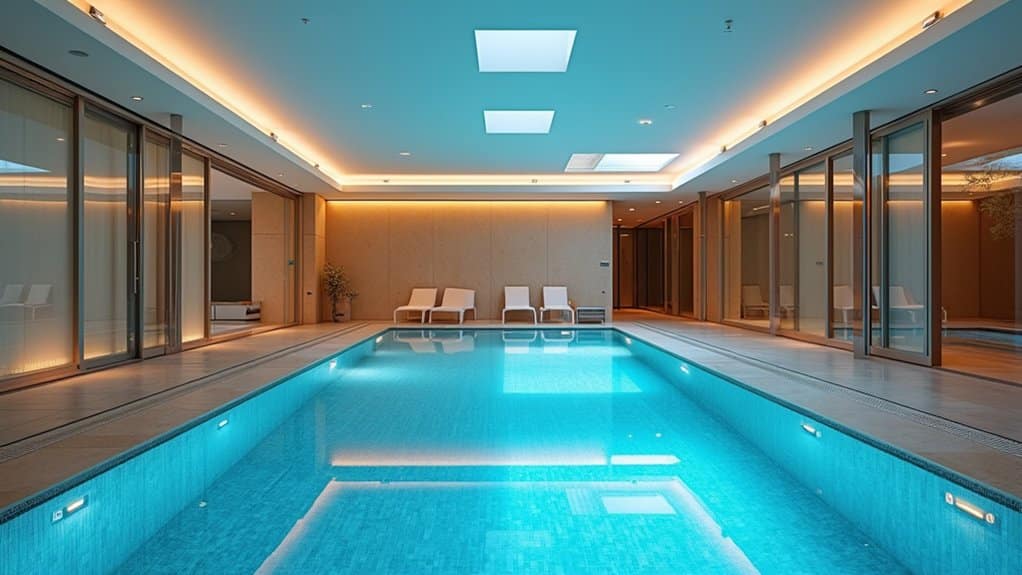
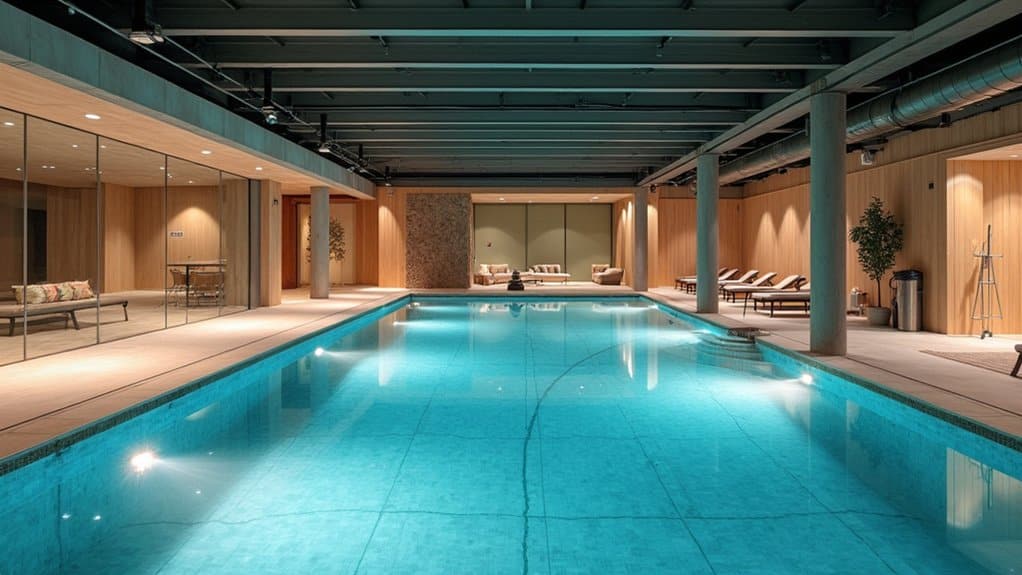
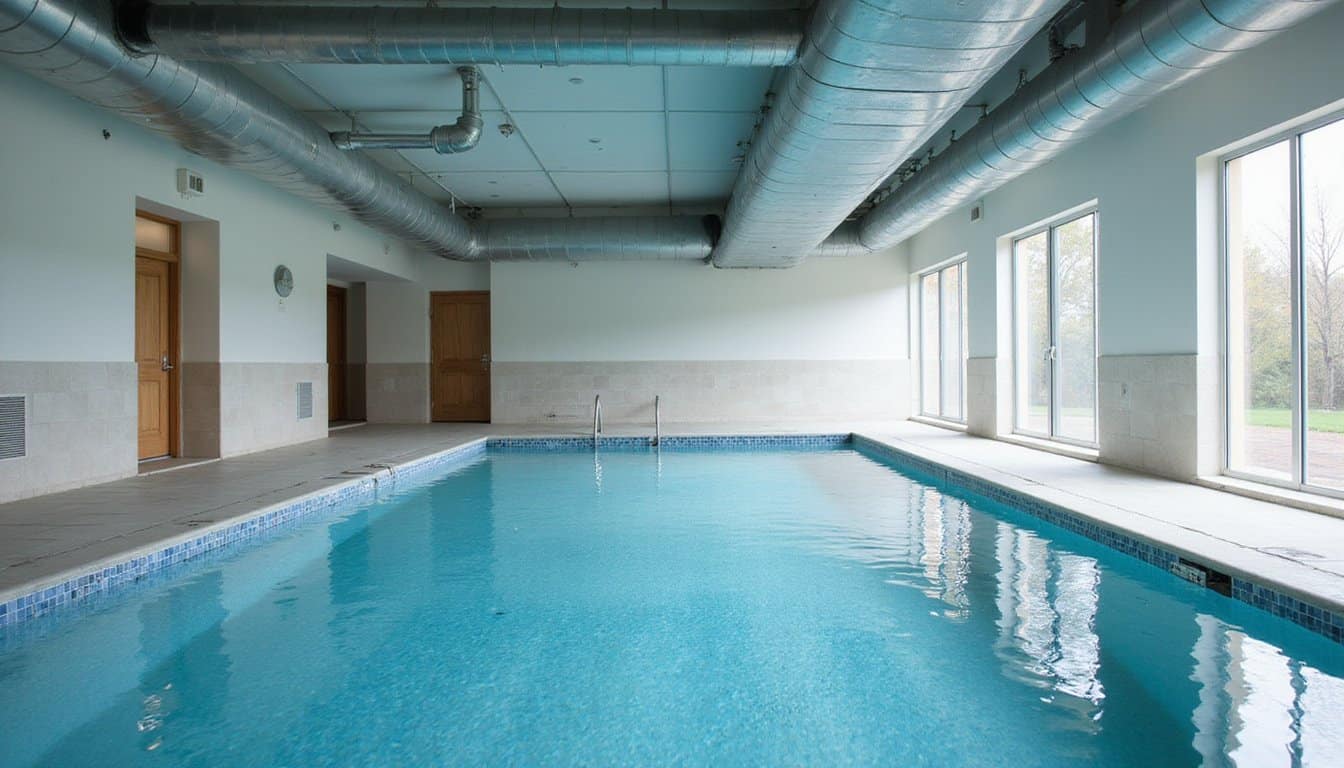
Building an Olympic pool requires 7 critical phases: Begin with thorough site selection and feasibility analysis, secure regulatory compliance and planning approvals, complete engineering design specifications, execute excavation and foundation work, construct the pool shell with integrated plumbing systems, install competition-grade equipment and interior finishes, and obtain final quality certification. You’ll need to maintain precise dimensional standards (50m x 25m), temperature controls (25-28°C), and FINA requirements throughout each phase. Guaranteeing the complete technical scope will safeguard your project’s success.
Site Selection and Feasibility Analysis
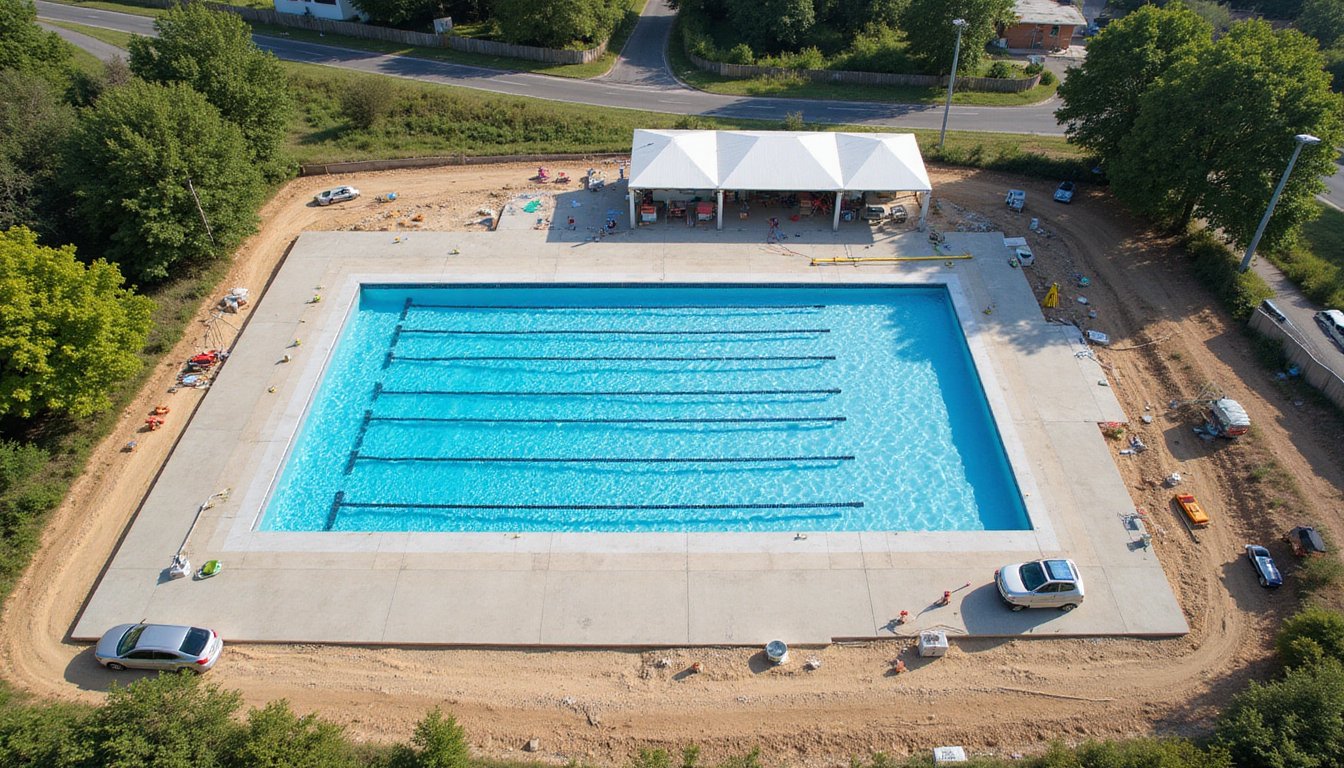
How do you guarantee the perfect location for an Olympic pool facility? Start by confirming your site can accommodate a 50m x 25m pool with mandatory 5-meter clearances and support facilities. You’ll need to conduct thorough geotechnical investigations to verify soil bearing capacity and assess groundwater conditions. The facility must maintain water temperature standards between 25-28 degrees Celsius for optimal swimming conditions. Meticulous attention to construction details is essential for meeting competitive swimming requirements. The site should include natural lighting and wind protection for ideal swimming conditions.
Evaluate the site’s proximity to main roads, public transit, and emergency services while securing adequate utility infrastructure. You must analyze environmental factors like wind patterns, solar orientation, and flood risks. Your technical assessment should align with FINA standards for pool construction and operation.
Don’t overlook community engagement and local economic impact – assess population demographics, projected usage rates, and potential tourism benefits. This exhaustive analysis ensures your facility will meet international competition requirements while serving as a valuable community asset.
Regulatory Compliance and Planning
Building an Olympic pool facility calls for strict adherence to World Aquatics standards while traversing multiple regulatory frameworks. You’ll need to secure thorough documentation, including water management plans and environmental impact assessments, before breaking ground. Stainless steel construction is highly recommended for its superior durability and minimal maintenance requirements.
Ensure your design meets the mandatory dimensions: 50 meters length, 25 meters width, and 2 meters minimum depth. The pool must include ten competition lanes to meet official Olympic requirements. Installation of a professional-grade filtration system will require approximately 660,000 gallons of water. You must engage an authorized surveyor to verify these measurements within strict tolerances. Your facility’s water quality system must maintain temperatures between 25-28°C with proper chemical balance.
You’ll need to submit detailed planning applications demonstrating compliance with both international and local regulations. Don’t overlook accessibility requirements, emergency systems, and public health standards. Your certification process will require sign-off from technical specialists and National Federation representatives for competition eligibility.
Engineering Design and Structural Requirements
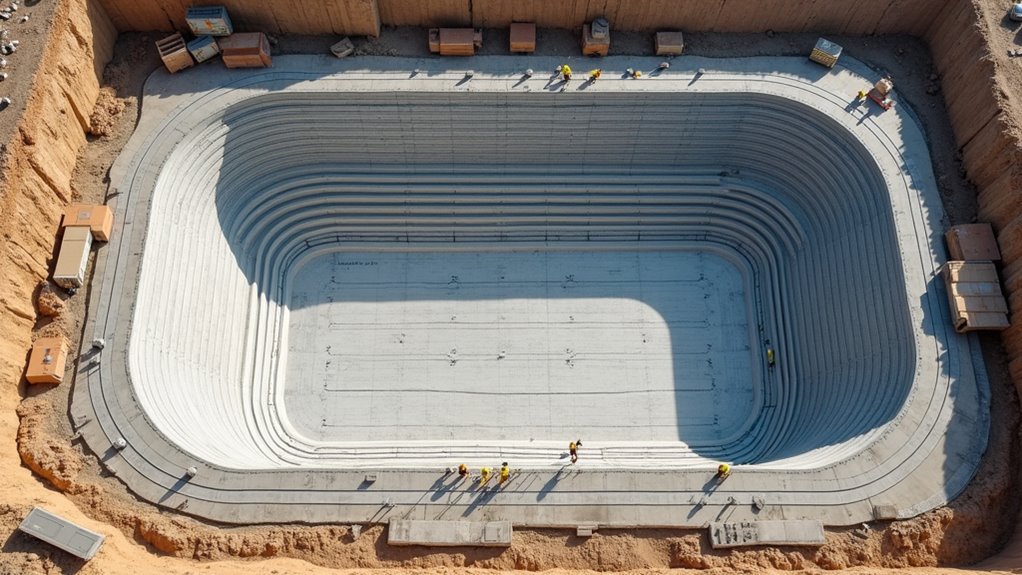
When undertaking Olympic pool construction, you’ll need to satisfy rigorous engineering specifications that guarantee both structural integrity and ideal athletic performance. The foundation requires reinforced concrete shell construction with precise material selection to withstand hydrostatic forces and prevent moisture infiltration. Proper soil analysis and stabilization must be completed before any construction begins.
You must secure the pool dimensions meet exact tolerances: 50.000 meters in length (50.020-50.030 with touch panels), 25 meters in width, and 2.5-3 meters in depth for elite competition. Install waterproofing materials between the shell and external surfaces, and incorporate expansion joints for pressure regulation.
The structural design must accommodate sophisticated mechanical systems, including filtration for 660,000 gallons and heating systems maintaining 25-28°C. Include access points for maintenance and integrate corrosion-resistant reinforcement to protect against pool chemicals and safeguard long-term durability.
Excavation and Foundation Work
Before initiating excavation work, you’ll need to execute a detailed site assessment and preparation strategy that aligns with Olympic pool specifications. Start with a thorough soil composition assessment to determine ground stability requirements and potential challenges.
Your excavation process must follow these critical steps:
- Clear and level the site, guaranteeing proper access for heavy machinery while installing safety fencing around the perimeter
- Deploy excavators and Bobcat conveyors to achieve precise pool dimensions, preserving strict adherence to Olympic standards
- Implement ground stabilization methods based on geotechnical testing results, addressing any drainage concerns
- Install steel rebar grid reinforcement and waterproof foundation layers before concrete pouring
Maintain detailed documentation throughout the process, and coordinate with local authorities to comply with building codes and environmental regulations.
Pool Shell Construction and Plumbing Systems

Three critical phases define successful Olympic pool shell construction: forming, reinforcement installation, and plumbing integration. You’ll need to select appropriate materials based on structural requirements and local codes. Whether you’re using gunite, shotcrete, or stainless steel panels, ensure corrosion resistance through proper material selection and treatment. Sand filters are crucial components that must be properly sized for Olympic pools to maintain water clarity. The proper waste management during excavation and shell construction is essential for maintaining a clean and efficient work site. A minimum depth of 2 meters must be maintained throughout the pool to ensure athlete safety during competitions.
| Construction Phase | Key Requirements |
|---|---|
| Shell Forming | Wood/steel forms meeting 50m x 25m dimensions |
| Reinforcement | Engineering-approved rebar placement |
| Plumbing | PVC/ABS corrosion-resistant materials |
| Surface Finishing | Tile, aggregate, or vinyl membrane |
| Quality Control | International competition standards |
Install the plumbing system before completing the shell structure, positioning return lines near the surface for maximum water circulation. You’ll need to integrate main drains, skimmers, and inlets according to competition specifications while maintaining strict adherence to safety codes and structural integrity requirements.
Equipment Installation and Interior Finishing
When installing Olympic pool surfaces, you’ll need to select materials that meet FINA standards, including high-performance ceramic tiles or waterproof membranes with non-slip finishes in light blue tones for maximum visibility. You must properly integrate timing touch panels measuring 2.4 x 0.9 meters at both end walls, ensuring they extend 0.3 meters above and 0.6 meters below the water surface for precise electronic timing. A comprehensive circulation and filtration system must be installed to maintain water quality throughout the facility. Your installation sequence should prioritize the waterproofing system initially, followed by surface materials, and ultimately the calibration of all timing equipment to competition specifications.
Pool Surface Materials Guide
Since Olympic pool construction demands exacting standards, the selection and installation of surface materials represent critical elements for both performance and safety. You’ll need to choose materials that safeguard chemical exposure mitigation while delivering long-term service life under intense usage conditions.
Key surface material considerations include:
- Stainless steel panels, offering superior corrosion resistance and minimal maintenance requirements
- Porcelain tiles provide excellent durability and low porosity while maintaining non-slip properties
- Non-slip coatings extending 0.8 meters below water on end walls for safe turns
- Prefabricated modular systems that enable precise installation and regulatory compliance
When installing these materials, you must guarantee seamless integration with equipment like lane rope anchors and overflow grates. Pool coping elements are essential for providing athletes with secure entry and exit points during competitions. The water temperature range of 25-28°C must be considered when selecting materials to prevent degradation. Recollect that all surfaces require certification by qualified officials and must meet FINA’s strict safety standards for slope, grip, and integrity.
Timing Equipment Setup Protocol
Proper timing equipment installation fundamentally determines an Olympic pool’s competitive integrity. You’ll need to coordinate interior finishing with equipment testing during pool commissioning. Begin by installing in-deck conduits (75mm diameter) and deck plates that align with FINA standards.
| Component | Specification | Testing Protocol |
|---|---|---|
| Touch Pads | 2.40×0.90×0.01m | Sensitivity check |
| Start System | LED/acoustic | Signal verification |
| Cabling | 6.3mm diameter | Connection test |
Mount touch pads using velcro gutter holders, positioning them 0.3m above and 0.6m below the water surface. Install starter systems with speakers at each block, ensuring uniform signal distribution. You’ll need to integrate flash start/LED strobes for visual cues. Connect the timing harness along the starting blocks and secure all cables through the deck plates. Complete installation by testing each lane’s touch pad sensitivity and calibrating manual pushbuttons for redundancy.
Quality Control and Certification
You’ll need to implement rigorous inspection protocols that verify compliance with FINA dimensional standards, water quality parameters, and safety requirements throughout the construction process. Professional teams conduct quality control checks at each stage to ensure materials and installations meet specifications. Your certification timeline must account for mandatory phase-wise inspections, including material verification, equipment testing, and performance validation of all life support systems. Maintaining the pool water temperature range between 25-28°C requires continuous monitoring systems. The final certification requires thorough documentation of test results, maintenance schedules, and regulatory compliance before the pool can be approved for Olympic competition.
Inspection Protocols and Standards
To certify Olympic pool construction meets rigorous safety and performance standards, thorough inspection protocols must be followed throughout the building process. You’ll need to coordinate multiple inspections with regulatory departments while adhering to FBC and Florida Administrative Code 64E-9 requirements.
Inspector responsibilities include conducting non-invasive visual assessments at critical phases:
- Initial site verification to confirm pool layout matches approved engineering plans
- Steel and rebar inspection to validate proper reinforcement installation
- Plumbing and electrical systems evaluation for code compliance
- Final inclusive review of water chemistry, safety equipment, and barriers
Interdepartmental coordination ensures all documentation, including engineered plans and compliance certificates, receives proper sign-off at each stage. You must maintain strict quality control criteria, including proper disinfectant levels and pH balance between 6.5-8.0, throughout the inspection process.
Certification Timeline Requirements
Following successful inspection clearance, the Olympic pool certification process requires thorough attention to documentation and timeline management. You’ll need to coordinate with authorized surveyors and technical specialists to complete required documentation submissions post-construction.
| Phase | Timeline | Key Actions | Documentation |
|---|---|---|---|
| Initial | Post-completion | Contact surveyor | Measurement records |
| Survey | 1-2 weeks | Complete measurements | Technical validation |
| Review | 2-4 weeks | Submit application | Compliance reports |
| Final | 1-2 weeks | Obtain certification | Official approval |
Your certification remains valid indefinitely unless you make substantial structural changes. The certification renewal process becomes mandatory after major renovations or upon World Aquatics’ request for significant competitions. Maintain detailed records of all measurements, quality control checks, and technical validations to guarantee smooth recertification when needed.
Frequently Asked Questions
How Long Does a Complete Olympic Pool Construction Project Typically Take?
You’ll typically need 10-36 days for the main pool structure, but your complete project timeline can extend vastly when accounting for all facilities. Construction challenges like spectator areas, landscaping, and amenities will stretch your schedule well beyond the initial pool build. For Olympic-standard facilities, you’re looking at several months to a year for thorough completion, depending on whether you’re using prefabricated elements or traditional concrete construction methods.
What Is the Average Cost to Build an Olympic-Standard Swimming Pool?
You’ll typically need to budget between $1.5M-$3M for a standard Olympic pool, though costs can surge to $7.75M with complex facilities. Pool size requirements of 50m length, 25m width, and 2m depth markedly impact expenses. Pool design considerations like competition-grade touchpads, wave-reducing gutters, and movable bulkheads will drive your costs higher. Don’t forget to factor in site preparation, material selection, and regional construction rates when planning your budget.
How Many Workers Are Typically Needed During the Construction Process?
You’ll need between 20-40 workers during peak pool construction timeline phases, with crew size fluctuating based on specific tasks. Your construction crew size will expand to 50+ workers during intensive phases like excavation and concrete pouring, while dropping to 5-10 workers during maintenance or preliminary work. You must guarantee proper staffing across specialized trades, including MEP technicians, pool builders, waterproofing experts, and safety officers throughout the project’s duration.
Can Olympic Pools Be Built in Areas With High Seismic Activity?
Yes, you can build Olympic pools in seismically active areas, but you’ll need to meet strict seismic retrofitting requirements. You must incorporate strengthened structural reinforcement, flexible joints, and specialized foundation systems. Your design must address soil stability concerns through thorough geotechnical analysis and proper soil compaction. You’ll also need to implement specific safety measures like automatic shut-off valves and secure anchoring for all pool equipment to guarantee compliance with local seismic codes.
What Is the Expected Lifespan of an Olympic Pool Facility?
You can expect a well-maintained Olympic pool facility to last 50+ years, though this depends heavily on pool maintenance requirements and environmental impact considerations. You’ll need to plan for concrete resurfacing every 10-15 years, acid washing every 3-5 years, and major system upgrades every 15-20 years. Indoor facilities typically outlast outdoor ones due to reduced environmental stress. Regular inspections, proper chemical balance, and timely repairs are indispensable for maximizing your facility’s lifespan.