Building an Olympic swimming pool requires seven critical phases: site assessment, engineering design, ground preparation, shell construction, mechanical systems installation, surface finishing, and certification. You’ll need a 65m x 30m site, precise 50m x 25m pool dimensions, and 660,000-gallon capacity. The process demands strict adherence to FINA standards, including 2.5m depth and ten 2.4m competition lanes. Understanding each phase’s technical requirements will determine your project’s success in meeting Olympic specifications.
Site Assessment and Planning Requirements
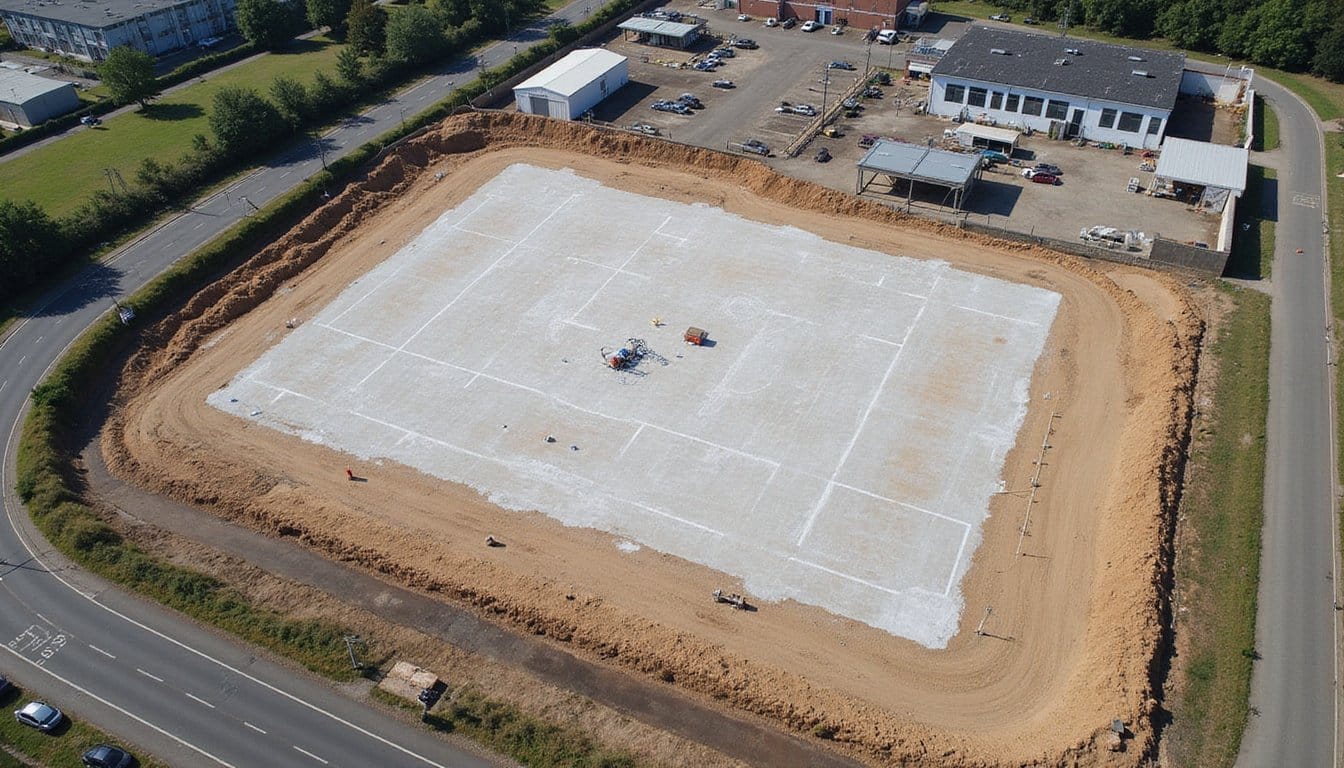
Before breaking ground on an Olympic swimming pool, a detailed site assessment and thorough planning process must be completed to guarantee project viability.
You’ll need to secure a location with minimum dimensions of 65m x 30m to accommodate the 50m x 25m pool, deck space, and access areas. During site acquisition, evaluate ground stability and soil conditions to confirm they’ll support the pool’s substantial weight and water volume. Installing an effective life support system requires careful integration of filtration, heating, and ventilation components during the planning phase. Working with an experienced team ensures meticulous attention to detail during the construction process. Stakeholder engagement with local authorities is pivotal to verify zoning laws and obtain necessary permits.
Your site must have proximity to essential utilities, water, power, and sewage infrastructure. Consider the impact on neighboring properties and assess environmental factors like groundwater levels and flood risks. You’ll also need to plan for adequate parking, emergency vehicle access, and delivery routes while guaranteeing compliance with FINA facility regulations.
Engineering Design and Specifications
To meet Olympic standards, you’ll need to design your pool with exact measurements: 50.000 meters in length, 25-26 meters in width, and a minimum depth of 2.5 meters, with zero tolerance for deviation in critical dimensions. The pool must hold 660,000 gallons of water to achieve regulation capacity. The design must include ten swimming lanes to comply with international competition requirements. You must incorporate a sophisticated water control system that achieves complete pool turnover every 4 hours through balanced supply outlets and automated chemical dosing. Your structural engineering plans should account for the immense hydrostatic pressure and dynamic loads, requiring reinforced concrete walls and base with precisely positioned expansion joints to prevent structural failure.
Precise Dimensional Requirements
When constructing an Olympic swimming pool, precise dimensional specifications must adhere to World Aquatics’ strict standards. Your measurement procedures must guarantee the pool extends exactly 50 meters from wall to wall, with a maximum positive tolerance of 0.010 meters. Testing requirements include verifying measurements from 0.3 meters above to 0.8 meters below the water surface. The pool must maintain water temperature between 77°F and 82.4°F for optimal competitive conditions.
Operating costs are considerably higher as these facilities require more than twice the water volume of standard short course pools. In permanent facilities used for international competitions, the pool requires ten competition lanes, with the outer lanes measuring 2.40 meters wide.
- Length must maintain 50 meters with installed touch pads at both ends
- Width must be exactly 25 meters, divided into ten 2.5-meter lanes
- Depth requires a minimum of 2 meters, with 2.5 meters for Olympic competitions
- Walls must be vertical and perpendicular to the floor, with smooth surfaces
You’ll need to verify these dimensions consistently throughout construction, assuring the pool maintains its specifications from foundation to completion. Regular testing confirms compliance with competition standards.
Water Control Systems
Engineering a thorough water control system stands at the core of any Olympic swimming pool construction project. You’ll need to install integrated systems that maintain water temperature between 25°C and 28°C, alongside filtration equipment capable of complete water turnover every 4 hours at flow rates of 220-250 m³/h. To ensure optimal swimming conditions, advanced wave-dampening systems must be incorporated into the pool’s design.
Your design must incorporate UV systems and chemical dosing pumps for precise water chemistry adjustment, with automated monitoring of pH and chlorine levels. The pool must maintain salinity below 3 gr/litre to allow for official record registration during competitions. Install strategic inlets and outlets to guarantee uniform circulation, and implement overflow gutters to control water levels. You’ll require backup power systems and operator training protocols for maintaining these complex systems. The control center should enable centralized monitoring of all parameters, including temperature, chemical levels, and filtration status, with remote diagnostic capabilities for immediate fault detection.
Structural Load Distribution
Building a reliable load distribution system requires just as much attention as water management. You’ll need to account for both static load factors from the pool structure itself and dynamic load considerations from active use. Your engineering calculations must incorporate hydrostatic pressure, spectator areas, and thermal expansion while meeting FINA’s strict dimensional tolerances. Soil analysis and stabilization is essential before proceeding with any foundation work.
- Guarantee your foundation can support the combined weight of concrete, water, and equipment through reinforced concrete slabs
- Design integral beams and buttresses to resist outward water pressure, with special attention to corner reinforcement
- Calculate live loads from swimmers, staff, and movable equipment with appropriate safety factors
- Install expansion joints at strategic intervals to accommodate structural movement from temperature changes
The entire load distribution system must comply with World Aquatics certification criteria, with walls maintaining a slope tolerance of ±0.3°.
Ground Preparation and Excavation
Before breaking ground on an Olympic swimming pool, thorough site preparation and excavation work must establish the proper foundation for this massive aquatic structure. You’ll need to evaluate access limitations and equipment staging to guarantee your construction vehicles can maneuver effectively. Start by clearing vegetation, installing safety barriers, and establishing precise reference markers for pool alignment. The excavation must account for a total volume of approximately 660,000 gallons of water that the completed pool will hold.
| Phase | Key Activities | Critical Checks |
|---|---|---|
| Survey | Geotechnical testing | Soil stability |
| Site Prep | Vegetation removal | Access routes |
| Excavation | Machine digging | Depth accuracy |
| Stabilization | Subgrade compaction | Load capacity |
After excavating to the required depth (typically 2.5-3 meters), you’ll need to implement proper dewatering systems and stabilize the subgrade. Verify continuous monitoring of groundwater levels and maintain strict dimensional tolerances using laser-guided instruments throughout the process.
Pool Shell Construction and Waterproofing
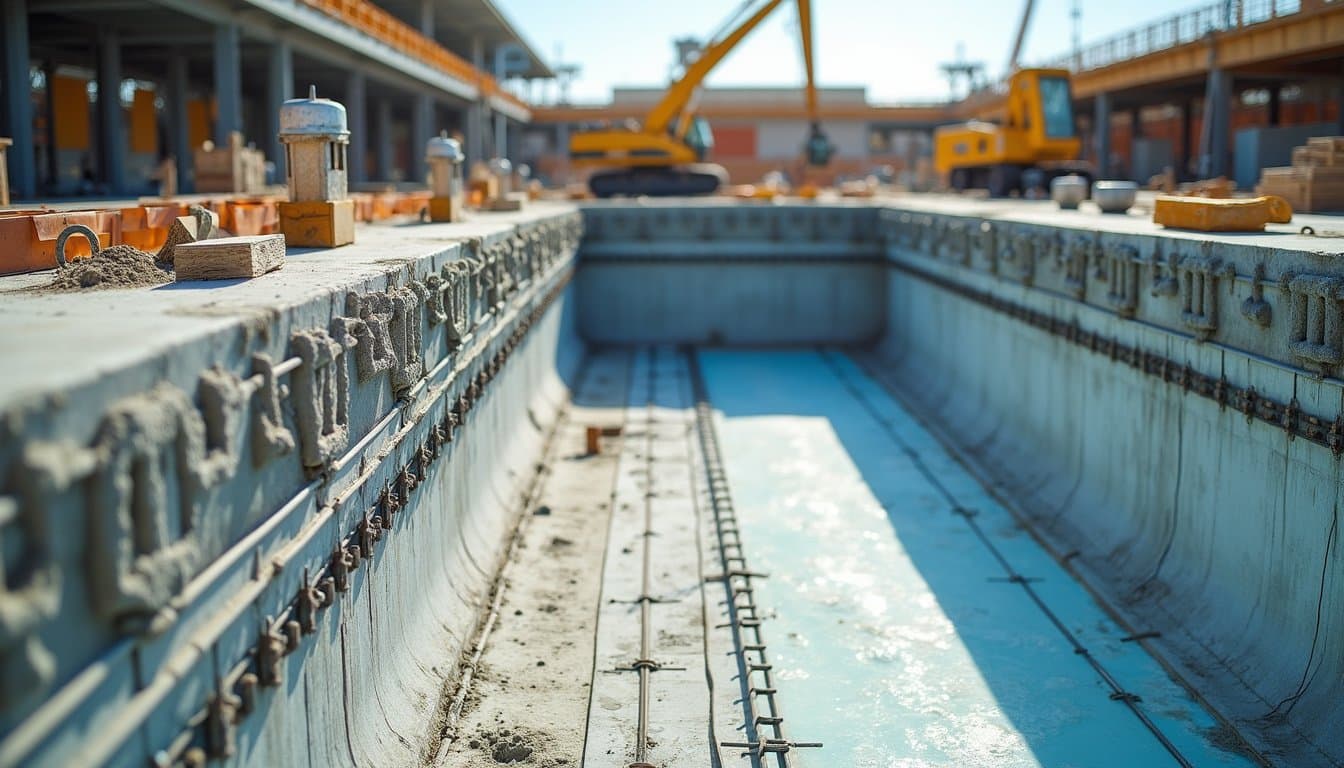
You’ll need to establish a sturdy reinforced concrete shell using either gunite or shotcrete methods, with carefully positioned steel rebar grids that meet engineering specifications for structural integrity. Your concrete mixture must achieve a minimum compression strength of 4000 psi, with shell thickness between 6-12 inches to satisfy Olympic pool regulations. Proper alignment and prevention of structural deviations must be maintained throughout the shell construction process. Regular quality control inspections are essential during shell construction to verify compliance with international standards. To guarantee watertightness, you must apply appropriate waterproofing treatments, including dense concrete curing, cementitious coatings, and proper sealing at all joints and penetrations. The tank must remain filled with water since ground water pressure can cause empty concrete pools to float upward.
Concrete Shell Reinforcement Methods
The construction of a proper Olympic pool shell demands precise concrete reinforcement methods to guarantee structural integrity and longevity. You’ll need to install high-grade steel rebar following strict engineering specifications, with double rows at the top sections for enhanced strength against freeze-thaw cycles. Concrete shell testing procedures must verify proper placement and structural integrity throughout the installation process. Using a dry gunite process allows for precise control of the concrete mixture and superior density compared to wet-mix alternatives.
- Install rebar at 6-12 inch spacing, ensuring it remains centered within the shell
- Apply concrete using either gunite or shotcrete methods for ideal strength
- Maintain minimum 2-inch concrete cover over rebar to prevent corrosion
- Implement monolithic pours with proper surface preparation between phases
Meeting concrete curing requirements is critical for achieving maximum strength. You’ll need to follow local building codes and FINA standards while maintaining detailed documentation of all materials and processes for final inspection approval.
Sealing Against Water Leakage
Since water containment represents the core function of any Olympic pool, implementing a thorough waterproofing system stands as a vital stage in construction. You’ll need to apply cementitious waterproofing membranes that address both positive and negative hydrostatic pressure while providing crack isolation properties.
Start by preparing all horizontal and vertical joints, ensuring you’ve smoothed and cleaned the surface thoroughly. Install fibreglass corner tapes and reinforcement mesh to bolster membrane durability. Apply your primer, followed by multiple layers of waterproofing membrane, paying careful attention to penetrations and passageways. Don’t forget to integrate preformed collars for pipes and drains.
Before finishing, conduct an all-encompassing hydrostatic test for 24-72 hours. This verification step proves indispensable for long-term maintenance and helps identify any potential issues requiring immediate attention.
Mechanical Systems Installation
Installing mechanical systems represents one of the most complex and critical phases of Olympic pool construction. You’ll need to coordinate multiple subsystems while adhering to strict energy efficiency standards and safety protocols. The mechanical room serves as the heart of your pool’s operations, housing essential equipment for filtration, heating, and chemical treatment.
- Install corrosion-resistant PVC or stainless steel piping with separate loops for supply, drainage, and backwash operations
- Mount bottom return jets and rosette diffusers to minimize turbulence and maintain ideal swimming conditions
- Set up redundant pump systems and automated chemical dosing equipment with safety interlocks
- Configure temperature control systems to maintain 25-28°C water temperature with heat exchangers
Your filtration system must handle the pool’s entire volume every 4-6 hours, while automated controllers monitor and adjust all mechanical functions from a central location. Install sensors throughout the system to enable real-time monitoring of water quality and equipment performance.
Surface Finishes and Competition Equipment
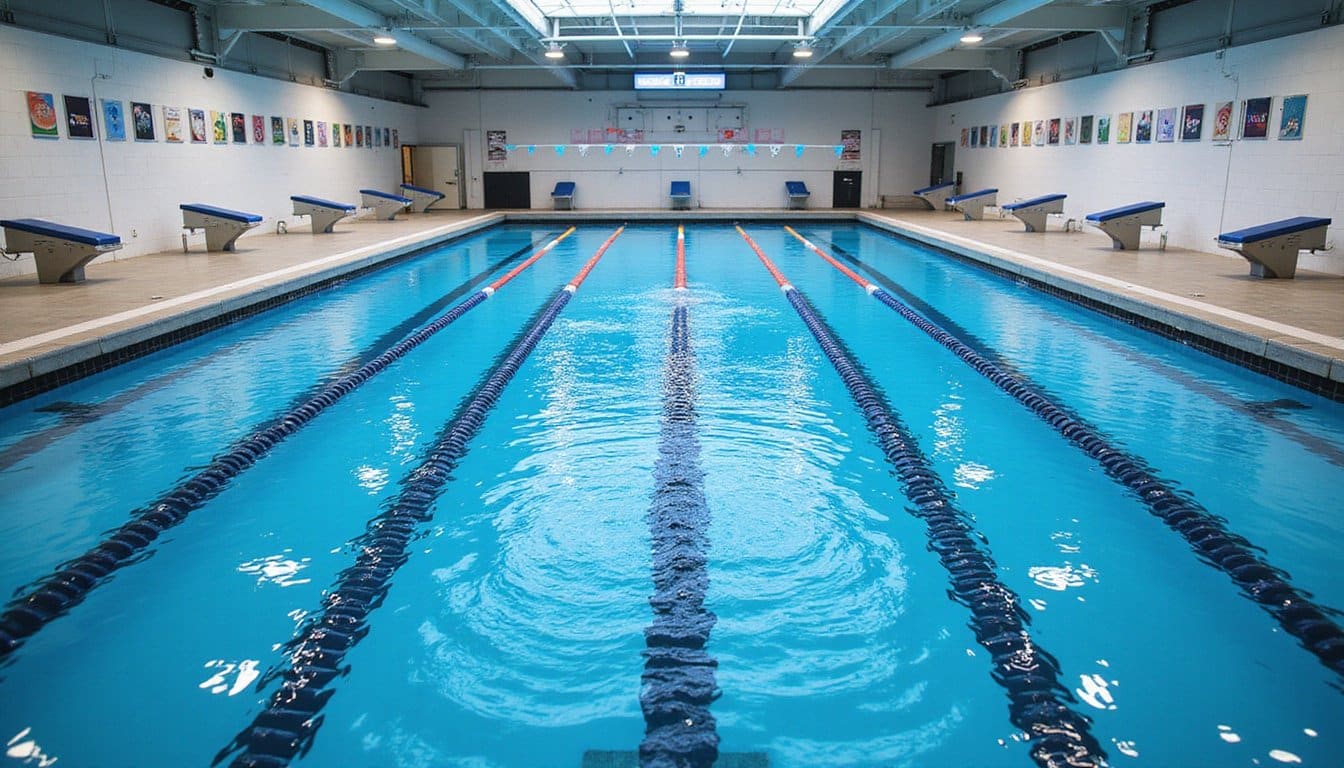
Selecting proper surface finishes and competition equipment marks a critical phase in Olympic pool construction, requiring painstaking attention to both safety and performance standards.
You’ll need to install porcelain tiles that meet chemical treatment regulations while providing superior non-slip properties. Install non-slip walkways throughout the deck area and guarantee vertical end walls extend 0.8 meters below the water’s surface with grip-enabling finishes. Position starting blocks 0.5-0.75 meters above water, incorporating non-slip surfaces and clear lane numbering.
Install lane ropes with anti-turbulence disks, maintaining 2.5-meter spacing between markers. Don’t forget to include buffer zones of 0.2 meters outside the first and last lanes. Certify all pool coping materials support safe turns while accommodating touch panel systems for electronic timing during competitions.
Testing and Olympic Certification
The final and most rigorous phase of Olympic pool construction involves obtaining World Aquatics certification, a process that validates every aspect of your facility against strict international standards. The authorization process requires precise measurements and testing by certified personnel with specific qualifications.
- Pool dimensions must measure exactly 50.000 meters in length and 25.000 meters in width, with tolerances of ±0.010 meters
- Water temperature must stay between 25°C and 28°C, with continuous monitoring systems in place
- You’ll need an authorized surveyor appointed by your national federation to verify all measurements
- Certification documentation requires signed reports from surveyors, technicians, and federation representatives
Your pool must maintain these standards continuously, as modifications require re-certification. Regular inspections guarantee compliance, particularly before major competitions, with detailed maintenance records required for review during championship events.
Frequently Asked Questions
How Long Does It Typically Take to Build an Olympic Pool?
You’ll find that an Olympic pool construction timeline typically spans 35-36 days, though this can vary based on your construction crew size and chosen materials. If you’re using stainless steel and prefabricated components, you can complete the project in about 36 days, as demonstrated in the Paris 2024 Olympics builds. However, if you’re opting for traditional concrete construction or facing complex site conditions, expect longer timeframes.
What Happens to Olympic Pools After the Games Are Over?
You’ll find two main pool repurposing options after the Olympic Games conclude. Temporary pools are dismantled, with their components redistributed to create new aquatic facilities elsewhere. For permanent structures, legacy facility usage typically involves conversion into community sports centers or training venues for local athletes. While some pools thrive as lasting recreational hubs, others face maintenance challenges. That’s why you’re seeing more host cities opt for temporary solutions to guarantee sustainable post-Games utilization.
How Much Water Is Needed to Fill an Olympic Pool?
You’ll need approximately 2.5 million liters (660,000 U.S. gallons) of water to fill an Olympic pool based on standard water volume requirements. These calculations follow pool size specifications of 50 meters long, 25 meters wide, and 2 meters deep. However, you might need more water if your pool exceeds the minimum depth requirement. The exact volume can vary depending on whether you’ve included supplementary features like overflow margins or sloped bottoms.
How Often Must the Pool Water Be Completely Replaced?
You don’t need to completely replace Olympic pool water if you maintain proper pool water chemistry and an efficient water filtration process. While industry standards suggest 20-30% partial replacement every 2-3 years, complete replacement is rare and typically only necessary every 7-8 years if water quality severely deteriorates. With advanced filtration systems and regular monitoring, some facilities successfully operate without ever requiring a full water replacement.
What Is the Average Cost to Maintain an Olympic Pool Annually?
You’ll need to budget approximately $250,000 annually just for basic chemicals and utilities to maintain an Olympic pool. When you factor in all operating expenses, including professional staff, repairs, insurance, and compliance requirements your total maintenance costs can easily exceed $500,000 per year. Your exact expenses will vary based on your facility’s climate, usage patterns, and efficiency systems, but you should expect these costs to represent a significant ongoing investment.