
Spa stabilizer, or cyanuric acid (CYA), is a chlorine-protecting compound that prevents UV rays from destroying your sanitizer. Without it, you’ll lose up to 90% of your chlorine within two hours of sun exposure. However, not every hot tub needs CYA, if you’re using bromine, keeping your cover on, or running dichlor tablets that contain built-in stabilizer, you may not need additional CYA at all. Understanding your specific setup determines whether stabilizer management becomes essential.
What Is Spa Stabilizer?
When you’re maintaining a spa or hot tub, understanding spa stabilizer, also known as cyanuric acid (CYA), becomes essential for effective water chemistry management. This triazine compound, represented as (CNOH)3, functions as a chlorine protection spa solution by shielding sanitizer from UV degradation. When maintaining a spa or hot tub, understanding spa stabilizer, chemically known as cyanuric acid (CYA), is critical for precise water chemistry control, as this triazine compound (CNOH)₃ acts as a UV shield that slows chlorine degradation in outdoor systems. Often referred to as pool stabilizer cyanuric acid, it functions as a chlorine protection solution by preserving free chlorine levels longer, improving sanitizer efficiency, and reducing the frequency of chemical adjustments.
Spa stabilizer binds to chlorine molecules, preventing rapid breakdown from ultraviolet exposure. Without it, you’d lose up to 90% of your chlorine within two hours under sunlight. CYA extends chlorine lifespan 3-5 times longer in sun-exposed environments. Unlike chlorine, bromine has a higher chemical temperature, allowing it to last longer in hot tub environments.
You’ll find spa stabilizer in multiple forms: granular products, liquid solutions, or pre-combined in stabilized chlorine tablets and pucks. Liquid stabilizer works instantly when poured directly into water in front of the return jet or along the interior perimeter. It also contributes to total alkalinity, providing pH buffering benefits. Unlike chlorine, CYA doesn’t evaporate, it accumulates, requiring regular monitoring. Since stabilizer is bio-accumulative in water, you’ll need to periodically dilute your spa water to prevent buildup.
Do Hot Tubs Actually Need a Stabilizer?
Not every hot tub requires cyanuric acid, the answer depends on your sanitizer type and UV exposure levels. If you’re using chlorine in an uncovered, sun-exposed hot tub, you’ll need a stabilizer to prevent rapid chlorine degradation. However, covered or indoor units eliminate most UV impact, making CYA unnecessary.
Understanding StabilizerNecessityChlorine helps you avoid overcomplicating your maintenance routine. Built-in outdoor spas without covers demand the utmost protection, while shaded installations can skip the stabilizer entirely.
Hot Tub Vs Pool Differences matter greatly here. Unlike pools designed for constant sun exposure with larger water volumes, hot tubs operate differently. High temperatures already accelerate chlorine breakdown through heat, not just UV. If you’re using bromine, stabilizer becomes irrelevant since bromine resists both UV and heat degradation without chemical protection.
Does Your Hot Tub Sanitizer Require Stabilizer?
Two primary sanitizer categories exist for hot tubs, and each has distinct stabilizer requirements. Understanding the bromine vs chlorine spa context helps you determine your specific hot tub stabilizer needs.
Chlorine-based sanitizers benefit from cyanuric acid protection against UV degradation. However, dichlor and trichlor products already contain stabilizer, so you won’t need a separate addition. These built-in stabilizers accumulate with continued use, reaching the recommended 30-50 ppm range within weeks.
Dichlor and trichlor chlorine products contain built-in stabilizer that accumulates naturally, eliminating the need for separate cyanuric acid addition.
Bromine-based sanitizers operate differently. Bromine remains unaffected by sunlight exposure, eliminating stabilizer requirements entirely. No stabilizing chemical exists for bromine, making it ideal if you want to avoid over-stabilization concerns.
Your sanitizer choice directly impacts whether you’ll manage cyanuric acid levels or bypass stabilizer considerations altogether.
Why Does Chlorine Disappear Without a Stabilizer?
When you leave chlorine unprotected in sunlight-exposed water, UV rays break down the sanitizer molecules within hours, leaving your hot tub vulnerable to bacterial growth. You’ll notice chlorine levels dropping rapidly, sometimes losing up to 90% of free chlorine in just two hours of direct sun exposure without cyanuric acid protection. This rapid degradation forces you to add chlorine constantly, wasting product and money while struggling to maintain the 3-5 ppm levels needed for safe sanitation.
UV Rays Destroy Chlorine
Because UV rays from sunlight trigger a chemical reaction that breaks chlorine molecules apart, unstabilized chlorine in outdoor pools and sun-exposed hot tubs can lose up to 90% of its sanitizing power within just two hours on a bright day. The uv exposure effect spa owners experience results in chlorine converting to gas and escaping into the air rather than remaining active in the water.
Without stabilizer protection, you’ll face these challenges:
- One-third of free chlorine destroyed every hour during peak sunlight
- Daily or twice-daily chlorine additions required to maintain safe levels
- Rapid sanitizer disappearance leaving water vulnerable to bacteria and algae
Understanding this breakdown mechanism helps you implement proper spa sanitizer retention strategies, preventing costly chemical waste and unsafe water conditions.
Rapid Sunlight Degradation
The molecular mechanism behind chlorine loss explains why your sanitizer vanishes so quickly. Without CYA protection, unstabilized free chlorine has a half-life of just 20 to 45 minutes. On bright sunny days, you’ll lose up to 90% of your chlorine within two hours, with complete depletion occurring in four hours.
This stabilizer necessity spa owners becomes critical for outdoor installations. Roughly one-third of unprotected chlorine breaks down every hour under UV exposure. Your outdoor spa stabilizer guidance differs from indoor hot tubs because UV penetration occurs even through cloud cover. For outdoor installations, stabilizer management becomes essential because nearly one-third of unprotected chlorine can degrade each hour under UV exposure, even through light cloud cover. While spa guidance differs from indoor hot tubs where UV is absent, issues like low stabilizer in pool conditions highlight how insufficient CYA leaves chlorine vulnerable to rapid depletion, resulting in inconsistent sanitizer levels and reduced water protection.
CYA keeps chlorine in your water up to eight times longer than unprotected sanitizer. Adding chemicals during evening hours prevents immediate degradation, giving your treatment time to establish proper sanitizer levels before sunrise.
Unprotected Chlorine Evaporates Fast
Beyond UV degradation, several environmental factors accelerate chlorine loss in hot tubs. Your warm water chemistry spa environment creates unique challenges that quickly deplete sanitizer levels without stabilizer protection.
Heat accelerates chlorine breakdown dramatically. Heightened temperatures cause sanitizers to dissipate faster, while steam carries chemicals away from the water surface. Jets compound this problem by creating turbulence that off-gasses chlorine into the air.
Key factors affecting hot tub maintenance:
- Running jets with the cover off accelerates chemical evaporation through surface agitation
- Uncovered spas allow chlorine gases to escape freely into the atmosphere
- Water temperatures burn through chlorine more quickly than cooler pool environments
Under these conditions, 2 ppm chlorine can dissipate in just 30 minutes. You’ll need consistent monitoring to maintain safe sanitizer levels.
How Much Stabilizer Does Your Hot Tub Need?
Most hot tubs require a stabilizer level between 30-50 ppm, significantly lower than the 60-80 ppm pools typically need. This difference exists because hot tubs have smaller water volumes and often receive less direct sunlight exposure. When following hot tub CYA recommendations, you’ll want to test your levels monthly alongside your regular water chemistry checks. Most hot tubs operate best with stabilizer levels between 30, 50 ppm lower than the 60, 80 ppm commonly maintained in swimming pools, because their smaller water volume and reduced sunlight exposure require less UV protection. Maintaining proper CYA balance is critical, as both insufficient levels and high stabilizer in pool conditions can impair chlorine efficiency and complicate water chemistry management. To stay within optimal range, test CYA monthly alongside your routine sanitizer, pH, and alkalinity checks.
To calculate your spa stabilizer dosage, use this formula: (Desired ppm, Current ppm) × (Gallons ÷ 10,000) × 13 = ounces needed. Add stabilizer gradually, as it takes up to 48 hours to fully dissolve.
Exceeding 50 ppm creates “chlorine lock,” reducing your sanitizer’s effectiveness. If your levels climb too high, you’ll need to drain and replace water, there’s no chemical shortcut to lower cyanuric acid concentration.
How Do You Add Stabilizer to a Hot Tub?
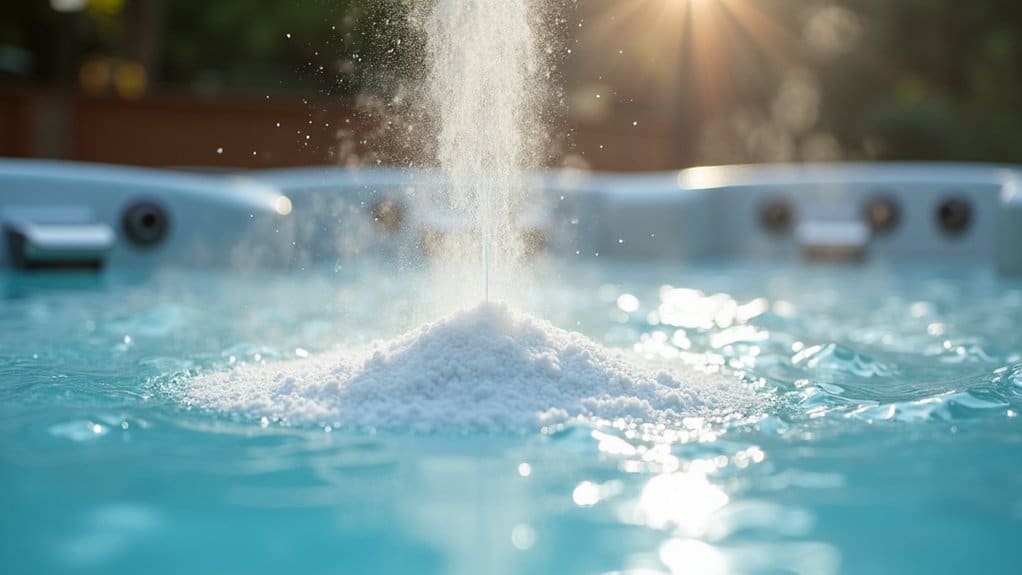
When you’re ready to add stabilizer to your hot tub, you’ll need to choose between two effective methods: pre-dissolving in a bucket or using a sock dissolving technique. The pre-dissolve method involves mixing granular CYA with warm water in a bucket before slowly pouring the solution into your circulating spa water. Alternatively, you can place the stabilizer in a clean sock or mesh bag and suspend it in the water flow, allowing it to dissolve gradually without shocking your system.
Pre-Dissolve Application Method
Although stabilizer granules can technically be added directly to hot tub water, pre-dissolving them first prevents undissolved particles from clogging filters or settling on surfaces. Pre-dissolve preparation requires filling a bucket with warm water from your hot tub, then slowly adding measured stabilizer granules while stirring continuously until completely dissolved.
Once your solution is clear and clump-free, use the jet circulation method for even distribution:
- Pour the dissolved stabilizer around the hot tub perimeter while jets run on low speed
- Keep air valves closed to prevent chemical oxidation during mixing
- Circulate water for at least 20 minutes to guarantee thorough dispersion
Test CYA levels 24-48 hours after application for precise readings. Target 30-50 ppm for optimal chlorine protection in your hot tub.
Sock Dissolving Technique
The sock dissolving technique offers hot tub owners a controlled method for adding cyanuric acid without risking filter clogs or surface staining from undissolved granules. Fill a clean white sock halfway with your measured stabilizer dose, then tie it securely with a knot or rubber band.
Position the filled sock in front of a jet or hang it over a return fitting where water flow accelerates dissolution. Run your pump continuously and squeeze the sock periodically to release the stabilizer faster. This method typically dissolves completely within a couple of days.
Understanding spa water balance differences helps you apply appropriate amounts. Given stabilizer’s absence indoor spa environments often experienced due to minimal UV exposure, you’ll likely need smaller doses than outdoor pools require.
What Happens When Hot Tub Stabilizer Gets Too High?
Excessive stabilizer levels frequently create a cascade of water chemistry problems that compromise both sanitation and water quality. When the spa stabilizer climbs above 50 ppm, you’ll notice chlorine becoming progressively ineffective against bacteria and algae. This condition, called chlorine lock, means your sanitizer can’t perform its primary function despite adequate readings.
Your spa chemistry interpretation becomes critical here. Watch for these warning signs:
- Cloudy or hazy water despite normal chlorine levels
- Persistent algae growth that won’t respond to shock treatments
- pH imbalances that resist correction efforts
You can’t chemically remove CYA from water. Your only solution involves partial or complete draining to dilute the concentration. Consider switching to non-stabilized chlorine to prevent future buildup in your hot tub.
How to Test and Adjust Hot Tub Stabilizer Levels
Accurate stabilizer testing requires either test strips or liquid reagent kits, with each method offering distinct advantages for hot tub owners. Test strips provide quick spa chemical testing CYA results within 15 seconds, while liquid kits like Taylor K-2005 deliver greater precision through reagent-based measurements.
To test spa stabilizer, fill your test tube to line A, add solution to line B, and mix with the plunger 10-12 times. After one minute, look down the tube’s center and adjust until the black dot disappears, then read your ppm level.
You’ll want readings between 30-60 ppm. If levels fall below 30 ppm, add cyanuric acid to reach the target range. When levels climb too high, partial drainage becomes necessary. Test monthly and recheck all parameters after adjustments.
Frequently Asked Questions
Can I Use Pool Stabilizer in My Hot Tub Instead of Spa Stabilizer?
You can use pool stabilizer in your hot tub since both products contain identical cyanuric acid. However, you’ll need to adjust your dosage carefully. Pool stabilizer concentrations target 60-80 ppm, while hot tubs require only 30-50 ppm. Your smaller water volume accumulates CYA faster, risking chlorine lock above 50 ppm. Pre-dissolve the stabilizer in warm water and add incrementally, testing frequently to prevent over-stabilization that reduces sanitizer effectiveness.
How Often Should I Drain My Hot Tub to Reset Stabilizer Levels?
You don’t need a fixed draining schedule, instead, test your CYA levels weekly and drain when concentrations exceed 50 ppm. Usage patterns and stabilized chlorine additions determine how quickly CYA accumulates, so monitoring is essential. When draining, calculate the volume needed to bring levels back to 30-50 ppm using a pool calculator. After refilling, rebalance your chlorine, pH, and alkalinity before resuming normal use.
Does Hot Tub Cover Usage Affect How Much Stabilizer I Need?
Yes, your hot tub cover directly impacts stabilizer requirements. When you keep your cover on, you’re blocking UV rays that break down chlorine, the primary reason you’d add cyanuric acid in the first place. Covered hot tubs experience minimal UV penetration, so you’ll need little to no stabilizer. If you’re running a chlorine system with consistent cover use, you can maintain effective sanitizer levels without CYA supplementation, reducing chemical buildup concerns.
Will Stabilizer Affect My Hot Tub’s Jets, Heater, or Other Equipment?
Yes, excessive stabilizer levels can damage your hot tub equipment. High cyanuric acid concentrations create corrosive conditions that accelerate wear on your heater, pumps, and metal components. You’ll also encounter mineral scaling that clogs filters and blocks jets, reducing water circulation efficiency. When stabilizer exceeds 30-50 ppm, your heater works harder, risking overheating and premature failure. Maintaining proper stabilizer levels protects your equipment investment and prevents costly repairs.
Can I Use My Hot Tub While Waiting for the Stabilizer to Dissolve?
You shouldn’t use your hot tub while the stabilizer dissolves. During this phase, chemical balance remains unstable, and chlorine can’t bond effectively with the cyanuric acid. This creates uneven sanitizer distribution, leaving some areas inadequately disinfected. Test strips won’t give you accurate readings until full dissolution occurs. You’ll risk skin irritation and potential exposure to pathogens in chemically imbalanced water. Wait until your stabilizer integrates completely and verify levels before soaking.