


You can add a spa to an existing pool, and concrete in-ground pools offer the strongest foundation for integration. A pool renovation specialist will evaluate your structure, equipment capacity, and available space before recommending a built-in integration, side extension, or stand-alone unit. Typical costs range from $8,000 to $25,000+, depending on complexity. You’ll also need to account for electrical upgrades, plumbing modifications, and permits. Below, you’ll find the full cost breakdown and method comparison to guide your project.
Can You Add a Spa to an Existing Pool?
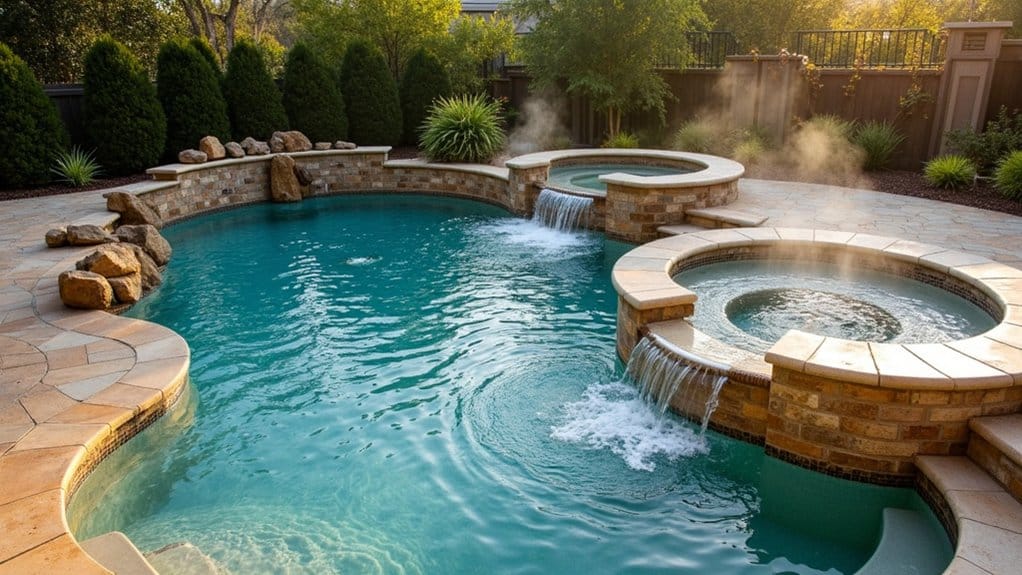
Whether you’re looking to boost your backyard’s relaxation potential or add hydrotherapy features, integrating a spa into an existing pool is achievable, but feasibility hinges on your pool’s construction type, structural condition, and available equipment capacity.
Concrete in-ground pools offer the strongest candidates for integrated spa pool systems, allowing direct structural attachment and seamless plumbing connections. Fiberglass and vinyl liner pools present more challenges but remain viable through spillover spa integration or adjacent configurations. Pool renovation specialists typically evaluate foundation reinforcement, existing equipment capacity, and available space before recommending an approach. Pool remodeling contractors also assess whether heating, filtration, and electrical systems can support added demand. Understanding your existing pool’s layout and plumbing early in the process helps streamline planning and ensures the integration approach aligns with your current infrastructure. Your pool’s age and current condition ultimately determine which modification method delivers the most efficient, code-compliant results. Modifying an existing pool is not as straightforward as it might seem, since cutting into the pool shell to attach a spa can weaken the structure, requiring additional reinforcement to maintain safety and integrity.
How Much Does It Cost to Add a Spa to a Pool?
Once you’ve confirmed your pool can support a spa addition, the next step is understanding what you’ll actually spend. A typical spa installation in existing pool runs $8,000, $15,000, though luxury pool remodeling services push costs beyond $25,000 for custom gunite designs with advanced jets and lighting.
| Cost Component | Basic Range | Premium Range |
|---|---|---|
| Electrical & Plumbing | $2,250, $6,200 | $6,200, $10,000+ |
| Pool Heater and Spa Heater Integration | $1,500, $3,000 | $3,000, $6,000 |
| Excavation & Permits | $500, $1,750 | $1,750, $3,000 |
You’ll also need pool plumbing modification contractors to install dedicated jet lines and automated valve systems. Building the spa during initial pool construction saves $2,000, $10,000 compared to retrofitting later. Beyond the upfront investment, plan for annual maintenance costs of $3,000 to $5,000 covering chemicals, energy, and cleaning to keep both your pool and spa running efficiently. You’ll also need pool plumbing modification contractors to install dedicated jet lines and automated valve systems, while considering factors like what is the temperature of an olympic pool for optimal performance and comfort standards. Building the spa during initial pool construction saves $2,000, $10,000 compared to retrofitting later. Beyond the upfront investment, plan for annual maintenance costs of $3,000 to $5,000 covering chemicals, energy, and cleaning to keep both your pool and spa running efficiently.
What Are the Hidden Costs of a Pool Spa Addition?
Even after you’ve budgeted for the major line items, a pool spa addition carries costs that don’t always show up in the initial quote. Retaining walls may be required depending on your yard’s slope, and builders often list them as “if needed,” leading to mid-project sticker shock. Extra concrete beyond the standard patio allowance adds up fast once you realize the included square footage won’t accommodate furniture or foot traffic. Dirt hauling from spa excavation can run thousands of dollars and isn’t always covered in the base price, clarify contractor responsibility upfront. Electrical & gas connections represent another layer: spa wiring runs $1,900, $4,200, and gas meter upgrades for heaters or fire features are frequently overlooked. Permits, delivery fees, and fencing compliance compound these expenses further.
Three Ways to Add a Spa to Your Pool
You can add a spa to your existing pool through three primary methods: built-in pool integration, a side extension, or a stand-alone unit. Each approach differs in construction complexity, cost, and how tightly the spa connects to your pool’s plumbing and heating systems. Understanding these options helps you match the right installation method to your budget, pool structure, and long-term maintenance preferences.
Built-In Pool Integration
- Jacuzzi at pool end, hydromassage jets, waterfalls, and cervical cannons installed at one end, covered with matching shell material for seamless continuity.
- Hydrotherapy platform, a built-in work bench integrating lying-down massage points without reducing your main swimming area.
- Camouflaged stair spa, an extended entry step doubles as a seating area with concealed jets, preserving pool aesthetics.
- Raised spa addition to pool, an elevated basin with independent temperature control and spillover cascade, completing your integrated spa pool design.
Side Extension Method
Residential pool contractors typically cut into the existing deck and reinforce the foundation before connecting new plumbing and electrical lines. A raised configuration creates a natural spillway effect, with heated water cascading into your pool. You’ll need pool automation system upgrades to switch seamlessly between pool and spa modes. Gas heaters deliver the fastest temperature rise for hydrotherapy spa installation, reaching ideal 37°C, 40°C quickly. Expect two to four weeks for completion.
Stand-Alone Spa Option
A stand-alone spa gives you the most flexibility when your existing pool layout can’t accommodate a direct structural addition. A modular prefab swim spa assembles in two days using steel panels and basic tools, requiring only a level surface supporting 200 lbs per square foot. A stand-alone spa gives you the most flexibility when your existing pool layout can’t accommodate a direct structural addition, especially when considering factors like are olympic pools heated for maintaining consistent water temperatures. A modular prefab swim spa assembles in two days using steel panels and basic tools, requiring only a level surface supporting 200 lbs per square foot.
You’ll want smart backyard spa systems that streamline daily operation. Here’s what your installation involves:
- A 220V/30A or 110V/20A GFCI electrical connection, installed by smart spa automation installers for code-compliant wiring.
- A reinforced concrete slab or compacted gravel bed measuring approximately 8×15 feet.
- Garden hose fill with water replacement every one to two years, no household plumbing tie-in required.
- Remote spa control via smartphone for temperature, jets, and lighting adjustments from anywhere.
Stand-Alone Spa vs. Built-In: Which Saves More?
When you’re weighing a stand-alone spa against a built-in model integrated with your pool, the cost comparison isn’t as straightforward as sticker price alone, it spans installation, energy consumption, and long-term maintenance. Custom pool spa builders typically price built-in combinations between $50,000 and $100,000, while stand-alone units considerably reduce upfront investment.
Energy-wise, stand-alone spas outperform built-ins through superior insulation and dedicated covers. Pool energy efficiency upgrades can help, but integrated spas inherently lose heat to the adjacent pool structure. Spa blower system installers and pool equipment retrofit specialists often recommend separate units for targeted hydrotherapy without compromising pool circulation. Stand-alone models warm faster, require no shared plumbing, and let you control chemical balance independently, reducing long-term operational costs despite running dual systems. Energy-wise, stand-alone spas outperform built-ins through superior insulation and dedicated covers, making them a strong consideration in pool and spa design for efficiency-focused setups. Pool energy efficiency upgrades can help, but integrated spas inherently lose heat to the adjacent pool structure. Spa blower system installers and pool equipment retrofit specialists often recommend separate units for targeted hydrotherapy without compromising pool circulation. Stand-alone models warm faster, require no shared plumbing, and let you control chemical balance independently, reducing long-term operational costs despite running dual systems.
Will a Pool Spa Addition Pay for Itself?
When you’re weighing the cost of a spa addition against its financial return, the numbers can work in your favor, homes with integrated spas see resale value increases of up to 20% in certain markets, and properties with wellness features tend to sell faster. Your long-term cost recovery depends on balancing installation expenses, which average around $13,500, against both the property value boost and ongoing operational costs of $240, $600 annually for energy alone. You’ll maximize your return by choosing energy-efficient equipment, investing in professional installation with durable materials, and keeping your total outdoor improvement budget within roughly 7% of your home’s market value.
Property Value Increase
Because homebuyers increasingly prioritize outdoor living spaces, adding a spa to your existing pool can deliver a measurable boost to your home’s market value, though the return depends heavily on your location and the quality of the build.
When you consult backyard pool spa designers for a pool project design consultation, consider these regional benchmarks:
- Los Angeles homes with pools see a $95,000 premium, roughly 10%, making infinity edge spa integration a strong investment.
- Florida markets like Fort Myers show premiums reaching 20.4%.
- Arizona properties gain 5% to 8%, translating to $20,000, $30,000+.
- Austin and Orange County additions command $50,000+ increases.
Built-in spas signal higher-end construction to buyers. Work with pool construction engineering contractors to guarantee your addition maximizes both structural integrity and resale positioning.
Long-Term Cost Recovery
Market value gains tell only part of the story, you also need to know whether your spa addition will pay for itself over time. For every $10,000 spent, you’ll recover $3,000, $7,000 in home value, meaning full cost recovery through resale alone is unlikely. However, factoring in daily therapeutic use, reduced external spa memberships, and energy savings from automated water temperature control and intelligent pool control platforms, the equation shifts favorably.
Your pool electrical system upgrades typically run $1,500, $5,000, while total renovation costs average $10,000, $20,000. In warm climates, a $20,000 renovation adds $12,000, $15,000 in value, recovering 60, 75%. Aquatic facility renovation contractors recommend high-efficiency equipment to minimize ongoing operational costs, accelerating your break-even timeline through reduced monthly energy and maintenance expenses.
The Backyard You’ve Always Wanted Starts Here
Your dream outdoor space deserves more than a standard pool, it deserves a design built around your lifestyle and vision. At Cristallo Pools, our award-winning team specializes in custom pool construction, spa additions, complete backyard makeovers, and concierge maintenance, delivering resort-style results that go far beyond what typical pool contractors offer. Call +1 (561) 766-0353 today and let us bring your vision to life.
Frequently Asked Questions
Does Adding a Spa Require Upgrading My Existing Pool Heater?
You’ll likely need to upgrade your existing pool heater since spas require temperatures between 37°C and 40°C, significantly warmer than your pool’s typical 25°C to 28°C range. If your current heater can’t handle the combined heating demand, you’ll want to install a higher-capacity unit or add a dedicated spa heater. You should verify your heater’s BTU output, assess its age, and consult a professional to determine the most efficient solution.
How Does Spa Water Chemistry Differ From Regular Pool Maintenance?
Your spa demands tighter chemical control than your pool. Higher water temperatures break down sanitizers faster, so you’ll need bromine (4-6 ppm) instead of chlorine for better heat stability. You’ll also maintain narrower ranges, pH at 7.4-7.6 and total alkalinity at 80-120 ppm. Since four bathers in a 400-gallon spa impact chemistry equivalent to 250 in a pool, you’ll test and adjust chemicals extensively more frequently.
Can a Spa Be Added to a Fiberglass or Vinyl Pool?
You can add a spa to both fiberglass and vinyl pools, though your approach differs. With fiberglass pools, you’ll install a free-standing or adjacent in-ground spa that taps into existing utilities and circulation systems. For vinyl liner pools, you’re better off choosing a prefabricated standalone spa or spillover design that won’t compromise the liner’s structural integrity. Either way, you’ll connect plumbing to your main pool equipment for shared filtration and heating efficiency.
What Plumbing Modifications Are Needed for Spa Jet Systems?
You’ll need dedicated 1-inch PVC plumbing lines running from your pump directly to each jet insert, along with a 25mm air line manifold connected to a Venturi valve for adjustable air mixing. Install automated diverter valves to redirect flow between pool and spa circuits. Your jet system demands flow rates exceeding 100 gallons per minute, so you’ll likely need a dedicated high-speed pump to deliver effective massage pressure through your spa jets.
Do Automated Valve Systems Come Standard With Spa Additions?
Automated valve systems don’t come standard with spa additions to existing pools. You’ll need to purchase and install actuators separately, options like the PTP Series or IntelliValve work with 3-way ball valves to divert flow between your pool and spa circuits. Basic additions typically use manual valves instead. If you’re retrofitting automation, you’ll need a licensed electrician to wire actuators to compatible control panels like EasyTouch or IntelliTouch systems.