


Yes, every Olympic pool is heated to a precise range of 77°F to 82°F (25°C to 28°C), as mandated by FINA’s strict standards. You’ll find that temperatures below 77°F can adversely affect your breathing and performance. Facilities use industrial-grade equipment with sub-1°F control increments, and automated sensors check the water every few seconds. From data center heat recovery to inverter heat pumps, the methods behind this precision will surprise you. Yes, every Olympic pool is heated to a precise range of 77°F to 82°F (25°C to 28°C), as mandated by FINA’s strict standards, clarifying why are Olympic pools so cold despite being temperature-controlled. You’ll find that temperatures below 77°F can adversely affect your breathing and performance. Facilities use industrial-grade equipment with sub-1°F control increments, and automated sensors check the water every few seconds. From data center heat recovery to inverter heat pumps, the methods behind this precision will surprise you.
Yes, Olympic Pools Are Heated: Here’s the Target Temperature
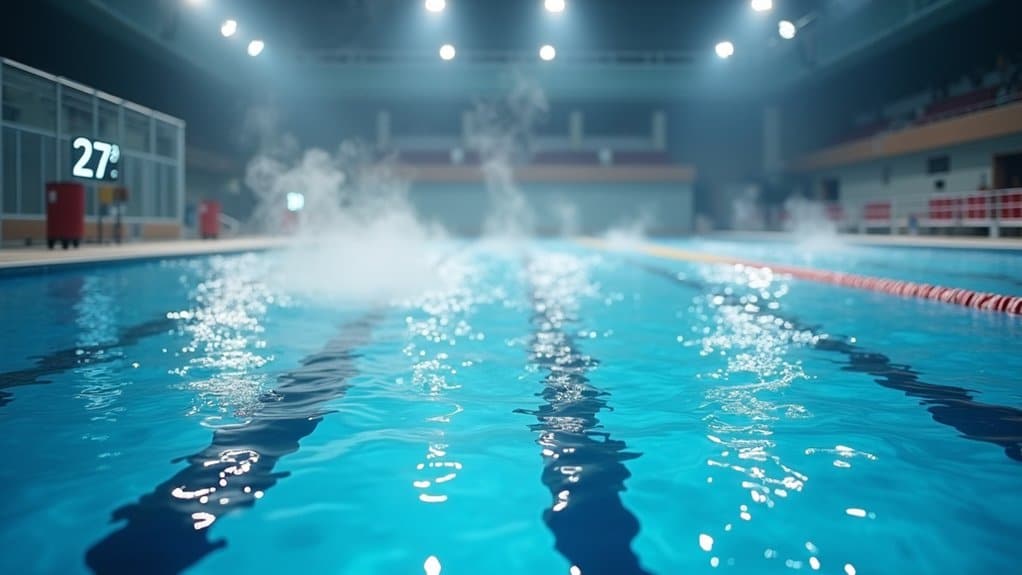
To achieve this precision, facilities deploy industrial-grade pool water heating equipment, including gas-fired heaters, electric heat pumps, and heat exchangers. These systems adjust output in sub-1°F increments, ensuring you’re competing under exact thermal standards every time you enter the water. The official target is a range of 77°F to 82°F (25°C to 28°C), as established by FINA after years of research into optimal athlete performance and safety. This carefully maintained temperature range not only optimizes performance but also ensures swimmer comfort, allowing athletes to focus entirely on their strokes without thermal distraction. Water temperatures falling below this range can be problematic, as breathing becomes adversely affected below 77°F (25°C), which is precisely why Olympic standards enforce such a strict thermal minimum.
How Data Center Heat Warms the Paris Olympic Pool
You might not expect a data center to heat an Olympic pool, but that’s exactly what Equinix’s PA10 facility in Saint-Denis accomplishes through its excess heat pipeline system. The facility’s servers generate heat at 28°C year-round, and three on-site heat pumps elevate that temperature to 65°C before transferring it through pipes connected to the district heating network operated by Engie. This heat export system delivers up to 6.6 thermal megawatts at full capacity, supplying the Paris Olympic Aquatic Centre with the consistent thermal energy required to maintain competition-standard water temperatures without relying on conventional gas or electric heating. You might not expect a data center to heat an Olympic pool, but that’s exactly what Equinix’s PA10 facility in Saint-Denis accomplishes through its excess heat pipeline system, an approach that reflects pool and spa built with proven smart design choices focused on energy efficiency and sustainability. The facility’s servers generate heat at 28°C year-round, and three on-site heat pumps elevate that temperature to 65°C before transferring it through pipes connected to the district heating network operated by Engie. This heat export system delivers up to 6.6 thermal megawatts at full capacity, supplying the Paris Olympic Aquatic Centre with the consistent thermal energy required to maintain competition-standard water temperatures without relying on conventional gas or electric heating.
Excess Heat Pipeline System
One of the most innovative engineering systems deployed for the Paris 2024 Olympics routes waste heat from a nearby data center directly to the Aquatic Centre’s pool heating infrastructure. Through data center heat recovery, server-generated heat at 25, 30°C is boosted to 60°C+ via heat exchangers before distribution through insulated underground pipes.
This olympic pool integration leverages the existing district cooling network to transport thermal energy efficiently:
- Heat converts from air-form to liquid for pipeline transport
- Buried insulated pipes deliver warmth directly to the Aquatic Centre
- The system simultaneously serves 1,600 homes and 200,000 m² of commercial space
- Water returned to the Seine stays within 5°C of intake temperature
- Off-peak overnight operation reduces grid demand
You’re seeing waste repurposed as a primary heating resource.
Equinix PA10 Heat Export
| Parameter | Specification |
|---|---|
| Server Heat Output | 28°C year-round |
| Amplified Temperature | 65°C via heat pumps |
| Annual Heat Generated | 10,000 MWh |
| Community Coverage | Up to 1,000 homes |
You’ll find this system addresses aquatic facility engineering standards by delivering consistent thermal input, solving heat retention in large pools through continuous supply, provided free for 15 years via Engie’s distribution network.
Three Ways Olympic Pools Are Heated
When you need rapid temperature recovery, gas-fired heaters deliver the highest BTU output and can bring pool water to competition-standard 25°C, 28°C faster than any alternative. Heat pumps operate on a different principle, they don’t generate heat but transfer it from outdoor air through an evaporator-compressor-condenser cycle, achieving a coefficient of performance between 3.0 and 7.0. You’ll find that most Olympic facilities pair these two systems strategically, using gas heaters for initial warm-up and heat pumps for efficient, sustained temperature maintenance.
Gas Heaters Work Fast
Key operational specifications include:
- Achieve up to 96% thermal efficiency in current commercial models
- Raise spa temperatures from 50°F to 100°F regardless of ambient air conditions
- Require proper venting for indoor installations to prevent gas buildup
- Demand annual servicing to maintain safety and performance standards
- Commercial-grade units handle Olympic-sized pool volumes effectively
You’ll find gas heaters essential when rapid, reliable temperature control is non-negotiable.
Heat Pumps Transfer Energy
While gas heaters deliver rapid temperature gains through combustion, heat pumps achieve superior long-term efficiency by transferring existing thermal energy rather than generating it. You’ll find heat pumps extract ambient air heat through an evaporator coil, compress the refrigerant to elevate temperature, then transfer it to pool water via a condenser.
| Parameter | Specification | Operational Note |
|---|---|---|
| COP Range | 3.0, 7.0 | 300%, 700% efficiency |
| Min. Ambient Temp | 45°F, 50°F | Below threshold reduces output |
| Defrost Capability | Low 40s°F | Reversing heat pump technology |
Cascaded heat pump systems connect units in series to meet Olympic base-load demands. Inverter-driven models regulate compressor speed based on tank outlet temperature. Reversing heat pump technology enables defrost cycles and seasonal cooling, extending operational range beyond standard configurations.
How Climate and Pool Size Dictate the Method
Because climate conditions and pool dimensions directly determine heating system requirements, facility engineers must evaluate both variables before selecting a method. Olympic aquatic facility requirements mandate water temperatures between 25, 28°C, but achieving this varies by region. Pool circulation and heating integration must account for surface area, thermal mass, and ambient conditions. Because climate conditions and pool dimensions directly determine heating system requirements, facility engineers must evaluate both variables before selecting a method, including considerations like how much does it cost to add a spa to an existing pool when integrating heating systems. Olympic aquatic facility requirements mandate water temperatures between 25, 28°C, but achieving this varies by region. Pool circulation and heating integration must account for surface area, thermal mass, and ambient conditions.
You’ll find aquatic facility management practices differ based on these factors:
- Colder climates prioritize heat recovery systems exporting up to 6.6 thermal megawatts
- Temperate zones rely on ventilation systems covering 70, 80% of heating needs
- Hot climates utilize solar collectors eliminating supplemental energy demands
- Larger 50m pools require automated sensors checking temperature every few seconds
- Indoor facilities integrate chillers recovering exhaust heat for hot water loops
Each configuration addresses climate-specific and size-specific thermal challenges.
How Heat Exchangers Hold Exact Pool Temperatures
Inverter heat pumps cascade output through exchangers, while AI-powered tracking optimizes performance dynamically. You’re looking at temperature control accurate to ±0.5°C, backed by models predicting 79% heat capacity within ±25kW, ensuring every race meets exact protocol standards.
The Future of Sustainable Heating at Major Events
- Equinix PA10 generates 10,000 MWh annually, enough for 1,000+ homes
- Deep Green micro-data centers heat UK public pools using immersion-cooled servers
- Octopus Energy’s €200M+ investment targets 150 municipal facilities
- Toronto’s TR5 supplies year-round hot water to hospitals and residential buildings
- All future Equinix centers incorporate heat recovery by design
Ready to Turn Your Backyard Into Something Extraordinary?
Your dream outdoor space deserves more than a standard pool; it deserves a design built around your lifestyle and vision. At Cristallo Pools, our award-winning team specializes in custom pool construction, spa additions, complete backyard makeovers, and concierge maintenance, delivering resort-style results that go far beyond what typical pool contractors offer. Call +1 (561) 766-0353 today and let us bring your vision to life.
Frequently Asked Questions
How Often Is Olympic Pool Water Completely Replaced During the Games?
You won’t see Olympic pool water completely replaced during the games. Filtration systems turn over the entire pool volume every few hours, so you’re swimming in continuously circulated and treated water. Crews add fresh water gradually to compensate for evaporation and splash-out, but they don’t drain and refill the pool. They check chemicals at least twice daily, maintaining strict chlorine and pH standards to keep conditions competition-ready throughout the event.
What Happens if the Pool Temperature Falls Outside Regulation Mid-Race?
If the pool temperature drops outside the 25, 28°C range mid-race, FINA protocols require officials to halt the event immediately. You’ll see continuous sensor monitoring flag the deviation, triggering corrective action through heaters or thermal covers. Officials won’t resume competition until temperatures return to compliance. Depending on severity, they’ll restart affected heats or issue disqualifications. You should know that non-compliant venues have historically faced penalties for regulation violations.
How Much Does It Cost to Heat an Olympic Pool Daily?
You’ll spend between $200 and $1,500 daily to heat an Olympic pool, depending on your heating system. Electric heat pumps cost you roughly $50, $150 daily, while natural gas heaters run $40, $144, and propane systems push $144, $240. Your actual costs depend on energy rates, ambient climate conditions, and whether you’re using thermal pool covers, which can reduce heat loss by up to 90%, substantially lowering operational expenditure.
Do Olympic Divers and Swimmers Share the Same Heated Water System?
You’ll find that Olympic divers and swimmers don’t typically share the same physical pool, but they do operate under identical temperature protocols. World Aquatics mandates a 25, 28°C range for both swimming and diving pools, with 26°C as the standard target. Venues use unified heating and circulation systems to maintain compliance across all competition pools. Automated sensors and precision controls guarantee both pools meet the same regulated thermal standards simultaneously.
How Long Does It Take to Initially Heat an Olympic Pool?
You’re looking at 8 to 48 hours to initially heat an Olympic pool, depending on your heating system. Gas heaters deliver the fastest results, raising water temperature 1, 3°F per hour and completing the job in roughly 8, 12 hours. Heat pumps require 12, 48 hours based on ambient conditions and pool volume. You’ll need to factor in the pool’s 660,000+ gallons, target temperature of 26°C, and your heater’s BTU output.