You’ll find that the best materials for fiberglass pool repair in 2026 combine advanced chemical resistance with flexible bonding properties that move with your pool’s natural expansion cycles. Top performers include AQUAGUARD®X Gelcoat for fade-resistant surface protection, flexible epoxy-based fillers that cure seamlessly with existing gelcoat, and vinyl ester resins offering superior elongation in high-stress areas. Saltwater-compatible bonding agents now maintain integrity at 4,000 ppm concentrations. Each material below addresses specific repair challenges you’re likely facing.
AQUAGUARD®X Gelcoat for Superior Surface Protection
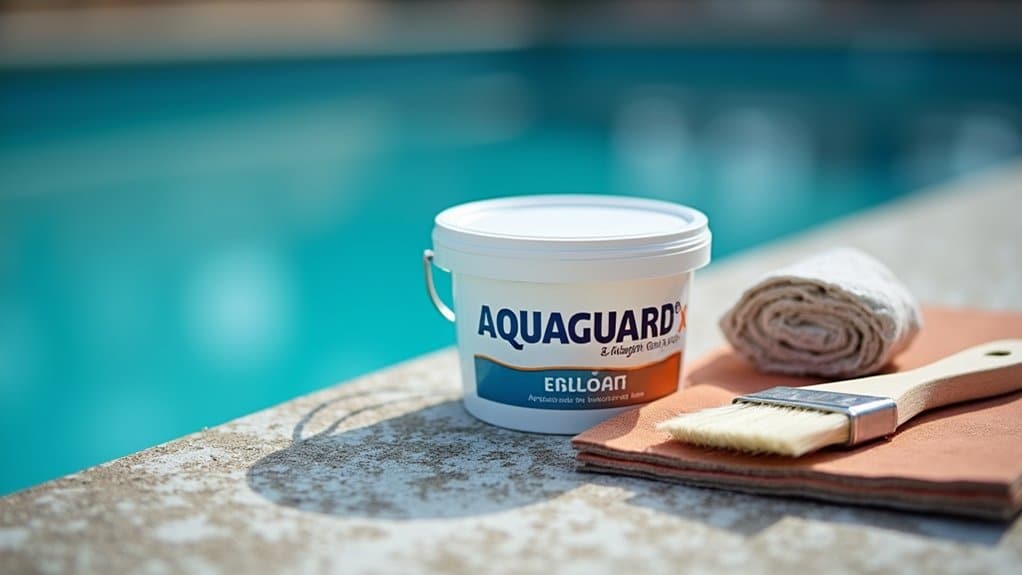
When you’re investing in fiberglass pool repair, the gelcoat you choose determines how long that repair will last. AQUAGUARD®X delivers Australia’s highest fade resistance, engineered specifically to combat UV degradation while maintaining color vibrancy in demanding outdoor conditions.
This gelcoat’s antimicrobial properties eliminate up to 99% of common pool bacteria and naturally resist algae attachment on its non-porous surface. You’ll spend less time on weekly cleaning and reduce chemical requirements considerably. The ultra-smooth surface is engineered for optimal performance, ensuring your repair maintains its quality over time.
The surface comfort enhancement comes from AQUAGUARD®X’s luxurious smooth texture that prevents abrasions on skin, swimwear, and pool accessories. It creates an impermeable barrier against salt penetration, working efficiently with saltwater chlorinators. This Australian made next generation gelcoat is incredibly chlorine resistant, ensuring long-term durability in chemically treated pools.
Backed by a 10-year warranty and ISO 9001/ISO 14001 certification, AQUAGUARD®X provides proven, lasting protection for your repair investment. This quality gelcoat ensures your pool shell maintains integrity for decades, delivering exceptional value for homeowners seeking lasting repairs.
Composite Armour™ Core Reinforcement Materials
Everything in structural fiberglass pool repair depends on the reinforcement materials beneath the surface, and Composite Armour™ Core technology delivers exceptional strength-to-weight performance.
Composite Armour™ Core technology transforms structural pool repair with unmatched strength-to-weight performance where it matters most.
You’ll find this composite armor design integrates ceramic tiles individually edge-wrapped with fiber, then encapsulated in hyperelastic polymer material. The polymer mixture combines MDI-polyester prepolymer with long-chain polyols, creating flexible yet durable bonds that resist cracking under stress.
When you’re addressing severe structural damage, impact resistant ceramic materials like Al2O3 provide superior hardness while glass-epoxy laminates absorb higher energy than carbon-epoxy alternatives. This matters for pools experiencing ground movement or freeze-thaw cycles. Similar to how modular composite armor allows military vehicles to quickly switch out damaged sections, pool repair systems benefit from components that can be efficiently replaced or upgraded.
The system’s back plate adheres directly to encapsulated components, distributing stress across larger surface areas. You’ll achieve lighter weight than traditional rigid repairs while maintaining equivalent penetration resistance and improved longevity. The manufacturing process involves combining woven-roving fiberglass with resin, then precision-assembling and curing under controlled conditions to ensure consistent quality. During this process, epoxy resins transform from liquid to solid through a curing reaction that creates permanent molecular bonds.
Flexible Epoxy-Based Fillers for Crack Repair
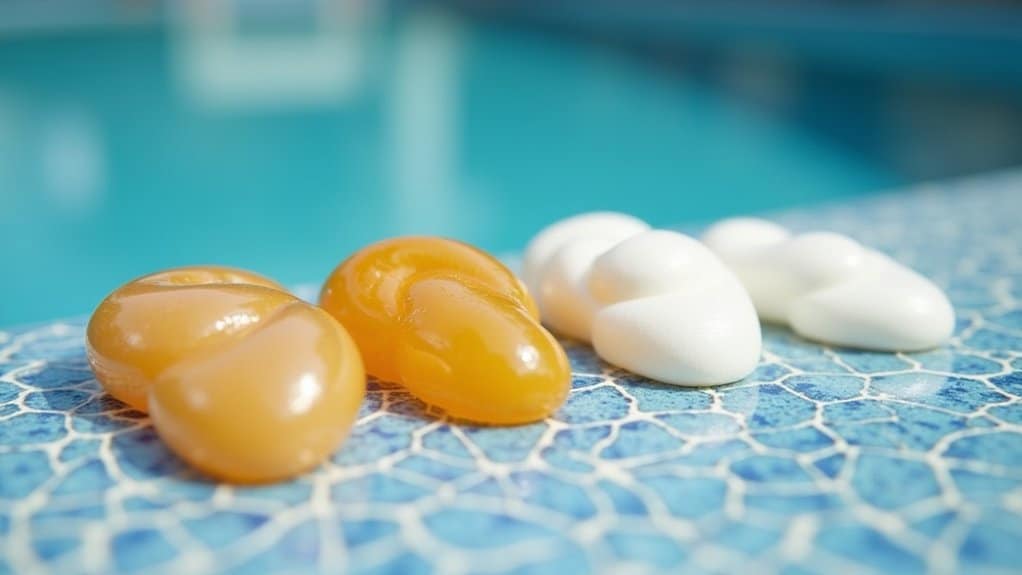
When you’re repairing cracks in a fiberglass shell, you need a filler that flexes with the pool’s natural expansion and contraction rather than rigid epoxies that’ll crack again under stress. Flexible epoxy-based fillers move with your pool during temperature swings and ground shifts while maintaining long-term resistance to chlorine, salt, and UV exposure. These advanced formulations cure to match the surrounding gelcoat, creating a seamless integration that eliminates the thick, unsightly globs associated with traditional pool putties. Standard epoxy pool putty is not flexible and will not move with the fiberglass pool shell, making it unsuitable as a permanent repair solution. For smaller surface repairs, products like the Swimming Pool Epoxy Repair Kit or Dadiaei Underwater Pool Putty can address minor damage, though these work best for non-structural fixes. For structural crack repairs, polyurethane foam injection kits can permanently seal leaks by plugging cracks and voids through the entire fiberglass thickness.
Flexibility Matches Fiberglass Movement
Fiberglass pools expand and contract with temperature changes, and any repair material must move with the shell or it’ll crack and fail. Rigid epoxy putties and polyester fillers can’t deliver the movement matching performance your pool demands. They’ll absorb water below the waterline, lose adhesion, and eventually pop off, leaving you with a bigger problem than you started with.
Two-part hybrid epoxy adhesives provide the durable bonding characteristics needed for lasting repairs. They bond tenaciously to fiberglass while maintaining enough flex to handle thermal cycles and ground movement. You can apply them wet or dry on horizontal and vertical surfaces, and they won’t stub toes like thick putty applications. Polyurethane foam injection offers another flexible solution, maintaining volume and flexibility long after curing. Quality underwater repair putties offer permanent bonding to fiberglass surfaces while resisting chlorine, bromine, and salt system chemicals that would degrade lesser materials.
Long-Term Chemical Resistance
Pool chemicals create a harsh environment that breaks down inferior repair materials within months. You need flexible epoxy fillers specifically engineered for prolonged chlorine and bromine exposure. Their chemical bonding properties create molecular-level adhesion that standard polyester fillers can’t match, preventing the water absorption issues that compromise repair integrity.
When you’re applying underwater repair techniques, choose hybrid epoxy adhesives designed for continuous submersion. These formulations maintain their structural bond despite constant chemical contact, eliminating the degradation cycle that forces repeated repairs. Quality underwater repair compounds like UW-5000 bond to a wide range of materials including fiberglass, PVC, ceramic, and concrete, making them versatile solutions for various pool surfaces.
Products like Pool Putty offer two-part epoxy systems with verified chemical resistance ratings. You’ll find they withstand spa and pool chemical degradation without softening or delaminating. This durability means your crack repairs remain sealed through seasonal chemical fluctuations and shock treatments that destroy lesser materials.
Seamless Surface Integration
Chemical resistance protects your repair from degradation, but achieving invisible results requires materials that physically integrate with your pool’s surface.
Flexible epoxy fillers bond tenaciously to fiberglass, creating seamless adhesion that traditional putties can’t match. When you mix epoxy with colloidal silica, you’ll achieve a peanut butter-like consistency ideal for integrated surface repair. This paste formulation cures evenly without settling, eliminating the thick, unsightly globs that two-part epoxy putties leave behind.
For watertight bonding, apply materials like AquaFlex or hybrid epoxy adhesives that flex with your pool’s shell movement. Unlike rigid putties that crack under hydrostatic pressure, flexible formulations maintain their seal during temperature fluctuations and ground shifts. Clean excess material with acetone before full cure to ensure smooth surface blending that won’t stub toes or disrupt your pool’s aesthetic finish.
Advanced Polyester Resins for Structural Reinforcement
When you’re reinforcing structural damage in a fiberglass pool, advanced polyester resins deliver the tensile strength and chemical resistance necessary for long-term durability in wet environments. Isophthalic polyester grades offer superior moisture impermeability and heat distortion resistance, which directly prevents the delamination issues that compromise standard repairs. You’ll also benefit from UV-stable formulations that maintain their integrity against pool chemicals and sunlight exposure without degrading the bond. These resins feature fast curing at room temperature, allowing you to complete repairs efficiently without specialized heating equipment. For proper curing, you’ll need to add MEKP catalyst to activate the polyester resin before application. Before applying the resin, sand the damaged area with 80 grit sandpaper to remove gel coat, paint, and debris for optimal adhesion.
Tensile Strength Enhancement
Although standard polyester resins offer economical solutions for basic fiberglass pool repairs, they exhibit inherent tensile limitations that can compromise long-term structural integrity. Their rigidity makes them susceptible to stress cracks under repeated mechanical loads and temperature fluctuations. Polyester resin’s tendency toward water absorption and osmosis damage further accelerates deterioration in pool environments. Additionally, polyester resins are porous materials that allow liquids to permeate through the coating over time.
To achieve tensile strength advantages, you’ll want to examine these reinforcement customization strategies:
- Upgrade to vinyl ester resin, You’ll gain superior flexibility and elongation at break, preventing fractures during expansion and contraction cycles.
- Layer fiberglass cloth or mat, This boosts your polyester laminate’s tensile capacity tremendously in high-stress repair areas.
- Apply industrial-grade polyester with hardener, You’ll create water-resistant bonds capable of handling sustained tensile demands.
When you combine advanced resin selection with proper fiberglass reinforcement, you’re building pool shells that withstand decades of mechanical stress without breakdown.
UV and Chemical Resistance
Beyond tensile strength considerations, you’ll need to address how polyester resins perform against UV radiation and pool chemicals over extended service life. Modern UV-stable polyester formulations cure bone-dry under UV light exposure, maintaining clarity without degradation. These advanced resins deliver long term chemical durability when properly applied with gelcoat overcoats.
Standard polyesters present significant limitations, microscopic pinholes compromise watertightness, and toxic component leaching occurs over time. You’ll achieve improved stain resistance by selecting industrial-grade polyester specifically engineered for pool environments.
For ideal results, apply gelcoat finishes over your polyester laminations. This combination addresses inherent UV and chemical weaknesses while creating a non-porous barrier against pool chemicals. The dual-cure polyester option allows precise shaping during the B-stage before final UV exposure locks in dimensional stability.
Preventing Delamination Issues
Protecting your pool’s structural integrity from UV and chemical damage represents only part of the equation, you’ll also need to address delamination, which remains the primary failure mode in fiberglass pool repairs.
Advanced polyester resins combat delamination through proven adhesion promotion techniques and reliable void fill solutions. These resins create water-resistant bonds specifically engineered for wet environments while curing quickly enough to prevent movement-induced separation.
Key delamination prevention strategies:
- Surface preparation, Remove all debris, moisture, and contaminants to maximize adhesion between resin and existing fiberglass.
- Proper layering, Apply gelcoat over cured resin to eliminate porosity issues that invite water infiltration.
- Reinforcement integration, Combine resin with fiberglass mat or cloth to create flexible laminates that accommodate shell movement.
This systematic approach guarantees long-lasting structural reinforcement without premature bond failure.
Vinyl Patch Kits for Edge and Step Repairs
Convenience drives many pool owners toward vinyl patch kits when addressing minor tears and punctures along edges and steps, though you’ll need to understand a critical limitation: products like the Poolmaster Wet Vinyl Patch Kit are specifically designed for vinyl pool liners and inflatables, not fiberglass or concrete surfaces.
These kits excel at watertight bonding on vinyl-coated pool components, delivering chemical and UV resistance that withstands harsh pool environments. The vinyl compatible adhesives cure to flexible, non-yellowing finishes within 24 hours, allowing underwater application without draining.
For fiberglass pool repairs, you’ll need different materials entirely. While vinyl patch kits handle tears on vinyl liner steps and edges effectively, fiberglass demands epoxy-based compounds and fiberglass cloth for structural integrity. Don’t substitute vinyl adhesives for fiberglass work, the bond won’t hold against pool pressure.
Marine-Grade Fiberglass Cloth for Shell Restoration
When you’re tackling shell restoration on a fiberglass pool, marine-grade fiberglass cloth becomes your primary reinforcement material, and selecting the right weight matters for long-term durability. E-Glass plain weave construction in 6 oz weight delivers superior mechanical properties while maintaining flexibility during application. You’ll find these fabrics compatible with epoxy, vinyl ester, and polyester resins.
Consider these options for your shell restoration project:
- Medium weight cloths (4-5.6 oz) wet out easily, creating transparent laminates ideal for surface repairs.
- Biaxial 8-inch mats provide exceptional tensile strength for critical structural areas requiring consistent quality control.
- Heavy woven roving (18-30 oz) handles demanding structural reinforcement where maximum durability is essential.
Plain weave 6-8 oz fabrics resist pulling during cure and cut cleanly with scissors for uniform patching.
UV-Resistant Topcoat Sealants for Lasting Finish
Once you’ve completed structural reinforcement with marine-grade cloth, your repair’s longevity depends on the UV-resistant topcoat you select. Products like polyFIBRO Coatings and AquaGuard 5000 deliver anti fading properties that prevent chalking and color degradation from sun exposure.
For seamless coatings integration, aliphatic polyurea topcoats bond directly over primer layers while resisting chlorine, saltwater, and pH adjusters. ArmorKote Epoxy offers a 20ml thick, self-leveling application that’s five times stronger than standard formulas and cures within 24-48 hours.
You’ll want to evaluate curing times against pool downtime requirements. Most UV-stable topcoats become walkable within 24 hours at 70°F. Plan for periodic reapplication every few years to maintain your protective barrier. Professional installation guarantees proper coverage and compatibility with your existing gelcoat surface.
Saltwater-Compatible Bonding Agents
When repairing fiberglass pools in saltwater environments, you’ll need bonding agents specifically formulated to withstand the corrosive effects of salt chlorination and electrolysis byproducts. Corrosion-resistant epoxy formulas and one-component adhesives like Underwater Magic provide reliable adhesion without degrading the gel coat or reacting negatively with chlorine-alternative sanitization systems. These specialized agents must maintain structural integrity at salt concentrations up to 4,000 ppm while resisting the continuous chemical exposure that would compromise standard repair materials.
Corrosion-Resistant Epoxy Formulas
Because saltwater environments accelerate corrosion on standard pool coatings, you’ll need epoxy formulas specifically engineered to resist chloride ion attack while maintaining strong adhesion to fiberglass substrates.
High solid coating formulas like AquaGuard 5000’s 100% solids epoxy create non-porous barriers that prevent salt, chlorine, and algae penetration. For fusion bond applications, ArmorPoxy’s self-priming formulation eliminates separate primer steps while delivering superior chemical resistance.
Consider these proven corrosion-resistant options:
- Benjamin Moore IG-40XX: Two-component polyamide epoxy with 62% volume solids, designed for both fresh and saltwater environments
- AquaGuard 5000: 100% solids formula resistant to salt, chlorine, acid, and abrasion
- ArmorPoxy High Build: Self-priming, high solids formulation that resists saltwater corrosion and fading
Each formula bonds directly to properly prepared fiberglass without primers.
Chlorine-Alternative Chemical Compatibility
Beyond selecting the right corrosion-resistant epoxy, you’ll also need bonding agents that won’t degrade when exposed to chlorine-alternative sanitizers like saltwater systems. 3M Marine Adhesive Sealant 5200 provides permanent adhesion specifically engineered for fiberglass substrates in salt-chlorinated environments. This sealant remains non-reactive with chlorine generated through electrolysis and withstands continuous saltwater exposure without compromising bond integrity.
When you’re working with alternative shock oxidizers or salt free sanitizer options, material compatibility becomes critical. The 5200 formula resists weathering and chemical degradation across salt concentrations of 3,000, 4,000 ppm. To guarantee your repair surface is clean and properly prepared before application.
Pair these bonding agents with Composite Armour vinyl ester resin for thorough protection. This combination delivers decades of trouble-free performance in salt systems worldwide.
Long-Term Salt Exposure Performance
Although saltwater systems generate chlorine through a gentler electrolysis process, the continuous salt exposure at 2,700, 4,000 ppm creates unique demands on bonding agents that standard adhesives can’t meet.
For long term wear protection, you’ll need sealants specifically engineered for salt environments. Underwater Magic and similar marine-grade products resist both sea and chlorine water, making them ideal for saltwater pool repairs.
Select bonding agents that provide:
- Vinyl ester resin compatibility for enhanced adhesion to gel coat surfaces
- Resistance to ongoing electrolysis-generated chlorine without degradation
- Non-porous bond formation that prevents salt penetration
Before applying any sealant, follow a thorough surface cleaning regimen to guarantee optimal adhesion. Proper material selection eliminates premature bond failure, protecting your repair investment throughout years of salt exposure.
Non-Porous Surface Primers for Adhesion Enhancement
When you’re working with fiberglass pool surfaces, selecting the right primer determines whether your repair lasts years or fails within months. Marine epoxy primers deliver the strongest adhesion on gelcoat without requiring additional sealers, while their moisture resistant properties make them ideal for constant water exposure.
For DIY repairs, polyester primers offer easier application with a 4:1 base-to-catalyst ratio. Apply in 4-square-foot sections to prevent lap marks, allowing 2-4 hours cure time between coats.
Specialized products like polyFIBRO bond directly to gelcoat, resisting UV damage and chemical exposure without peeling. Master non porous application techniques by ensuring surfaces are clean and dry before priming. These flexible formulations accommodate pool shell movement while maintaining pH-neutral, easy-maintenance finishes.
High-Performance Resin Hardeners for Quick-Cure Applications
Your primer creates the foundation for adhesion, but the resin hardener you select controls how quickly you can complete the repair and return your pool to service. Fast curing options like MEKP-activated polyester resin deliver tack-free results within 24 hours, while epoxy fast hardeners cure overnight even at temperatures as low as 55°F.
Your hardener choice determines downtime, fast-curing options get your pool back in service within 24 hours.
Consider these performance factors when selecting your hardener:
- MEKP polyester hardeners provide 10, 15 minutes working time with temperature resistance variations affecting cure speed.
- Epoxy fast hardeners achieve compressive strength up to 9,900 psi with minimal volumetric shrinkage.
- Vinyl ester hardeners offer superior hydrolysis resistance, preventing water penetration and osmotic blistering.
Each system requires dry, clean surfaces for ideal chemical bonding and water-resistant performance.
Frequently Asked Questions
How Long Should I Wait Before Refilling My Pool After Repairs?
You should wait 24 to 48 hours after fiberglass repair before refilling your pool. The ideal curing duration depends on temperature and humidity conditions, higher humidity extends drying time. Once you’ve completed the proper pool drainage process and applied all resin layers, guarantee each coat dries completely. Fill continuously without stopping, monitor the repaired area closely, and avoid adding chlorine for the first 48 hours post-filling.
Can I Perform Fiberglass Pool Repairs Myself or Hire Professionals?
You can handle minor surface cracks and scratches yourself using specialized fiberglass repair kits, keeping material costs low. Your repair timeline typically spans 24-48 hours for drying alone. However, you’ll need certified professionals for structural damage like shell cracks or bulging walls, these repairs run $1,000 to $5,000. Don’t risk over-sanding or improper void filling, as mistakes lead to costly further damage and extended project timelines.
What Temperature Conditions Are Ideal for Fiberglass Pool Repair Work?
You’ll need an ideal ambient temperature between 65°F and 85°F for fiberglass pool repairs, with 70°F being favorable for primer working time of 15-20 minutes. Keep humidity below 50% to guarantee proper adhesion. Temperatures below 65°F cause gelcoat hazing, while conditions above 85°F accelerate curing too rapidly. The perfect pool water temperature matters less during repairs, focus on air conditions and maintain dry surfaces for the full 24-48 hour curing period.
How Much Do Professional Fiberglass Pool Repairs Typically Cost?
You’ll find average repair costs vary drastically based on damage severity. Minor repairs like gel coat applications and leak fixes typically run $300 to $400, while structural crack repairs range $5,000 to $10,000. Typical material expenses depend on your chosen coating, basic gel coat costs $5,000 to $8,000, whereas epoxy coatings reach $7,000 to $12,000. Factor in labor costs of $2,000 to $5,000, plus $300 to $700 for water refill and chemicals.
Will My Pool Warranty Cover Material Defects After DIY Repairs?
Your warranty likely won’t cover material defects after DIY repairs. Warranty coverage conditions typically require you to follow the manufacturer’s recommended repair procedures and use certified professionals. When you perform repairs yourself, you’re violating these terms, which voids your coverage for structural and surface defects. To maintain warranty protection, you’ll need documentation proving professional compliance, proper materials, and adherence to manufacturer guidelines. Any deviation gives manufacturers grounds to deny your claims.