



Olympic swimming venues showcase engineering brilliance through cutting-edge designs you’ll find across the globe. Beijing’s Water Cube features 3,500 ETFE bubbles spanning 110,000 square meters, while London’s Aquatics Centre employs wave-like geometry with 160-meter curved trusses. Sydney’s facility maintains Olympic standards while serving 25,000 weekend visitors, and Paris 2024’s venue introduces data center heat recovery systems. These architectural marvels represent just the surface of aquatic engineering excellence.
The Engineering Marvel of Beijing’s Water Cube
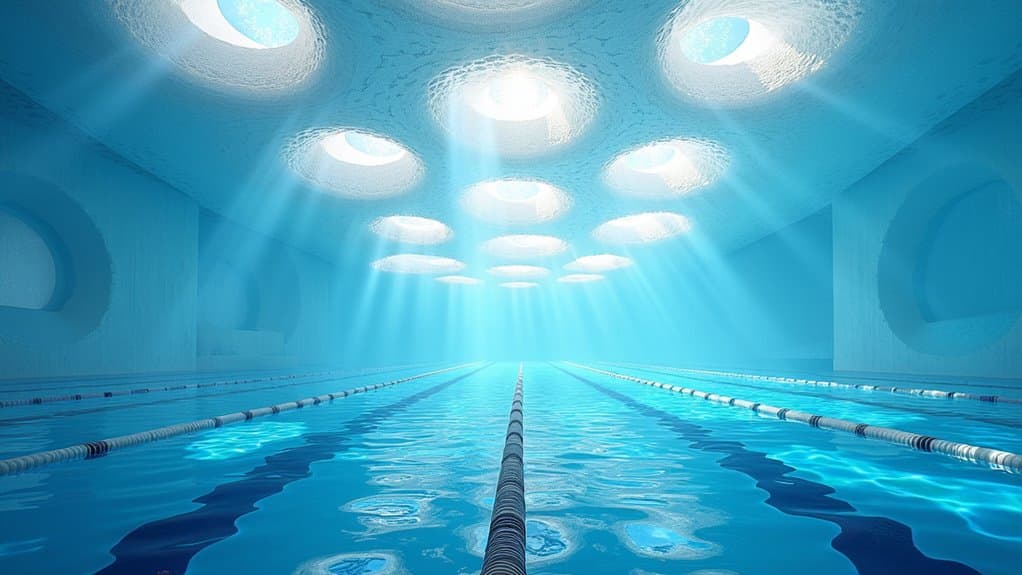
When Beijing revealed the Water Cube for the 2008 Olympics, it redefined aquatic venue engineering through its novel fusion of form and function. You’ll find a remarkable membrane technology integration featuring 3,500 ETFE bubbles covering 110,000 square meters, setting a world record for this sustainable material that’s lighter and more energy-efficient than glass. The facility’s completion in January 28, 2008 marked a milestone in Olympic venue construction.
The advanced load bearing structure houses competition-ready facilities, including a 50m x 25m main pool and a separate diving pool, all maintained at ideal temperatures through sophisticated climate control. The vast interior features multiple training pools with distinct facilities on opposite sides of the building. The innovative design draws inspiration from Chinese traditional values while incorporating modern architectural elements. You’re looking at a building that’s cut operational costs by 30% through its innovative design. The structure’s adaptability shines in its post-Olympic transformation, featuring one of China’s largest indoor water parks while maintaining its status as a top-tier competitive venue.
Zaha Hadid’s Flowing Legacy in London
The London Aquatics Centre stands as Zaha Hadid’s masterpiece of fluid architecture, embodying the movement of water through its dramatic wave-like roof and double-curvature geometry. You’ll find an experiential atmosphere created by 628 glass panes that flood the space with natural light, while curved steel trusses span 160 meters to create unobstructed sightlines. Deyan Sudjic’s exploration provided deep insights into the venue’s revolutionary design and cultural impact. The design concept draws inspiration from moving water landscapes along the riverside. The facility features three Olympic pools that include a 50-meter competition pool, diving pool, and warm-up pool.
The venue’s architectural influence extends beyond its striking aesthetics. You can witness how the design shifts from Olympic venue to public facility, reducing seating from 17,500 to 2,800 while maintaining world-class features. Despite budget challenges, the center’s sustainable design and functional adaptability serve 800,000 visitors annually. The cascade podium design integrates perfectly with Stratford City Bridge, creating a landmark that continues to inspire modern sports architecture worldwide.
Sydney’s Versatile Aquatic Excellence
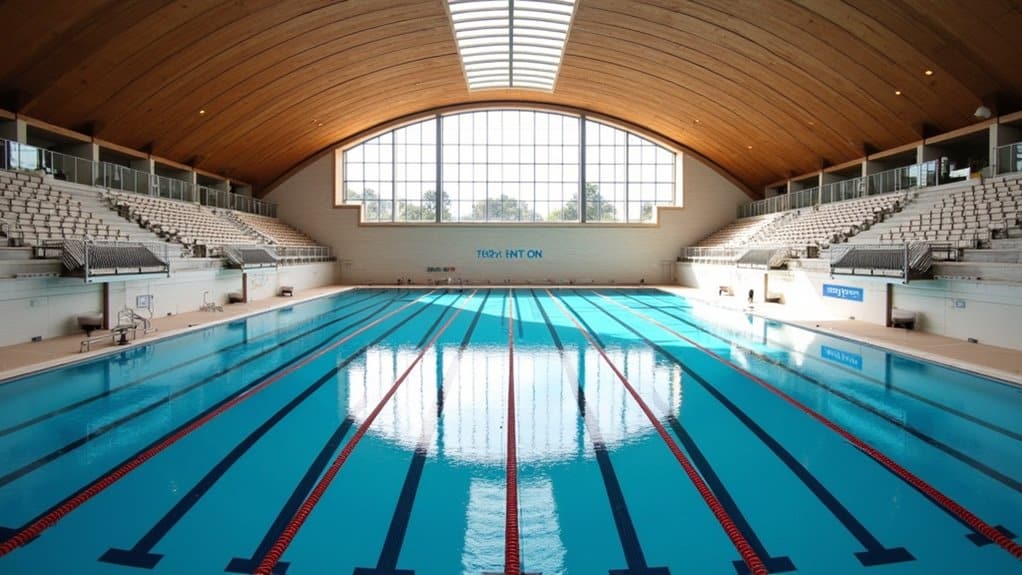
Sydney’s Olympic Aquatic Centre stands among the world’s most versatile swimming facilities, masterfully balancing elite competition requirements with community engagement.
The facility was instrumental in Sydney being awarded the 2000 Olympics, with Juan Samaranch declaring it the best Olympic pool. A $33.7 million upgrade transformed the public pool into Australia’s first major indoor swimming venue. You’ll find cutting-edge programming at every turn, from the 50-meter competition pool‘s 10-lane setup to the movable floor utility pool that adapts for multiple uses. The center’s holistic community access approach welcomes 25,000 weekend visitors while maintaining Olympic-caliber training capabilities.
COX Architecture’s award-winning design seamlessly integrates competition, leisure, and utility pools under one roof. The innovative green star standard sustainability features showcase the facility’s commitment to environmental responsibility. You can experience everything from bubbling beaches to competitive swimming meets in this facility that sits beneath the Sydney Harbour Bridge. The $58 million investment delivers state-of-the-art amenities while preserving heritage aesthetics through decorative brickwork, proving that historical character and modern functionality can coexist brilliantly.
Paris 2024: Setting New Standards
You’ll find the Paris 2024 Olympic pool sets new benchmarks with its advanced temperature regulation systems, integrating cutting-edge heat exchangers and automated climate controls that maintain ideal conditions for competition. The facility’s sustainable design incorporates a timber catenary roof with photovoltaic panels, reducing energy consumption by 30% while generating 25% of the venue’s electricity needs. The innovative design is the result of collaborations between VenhoevenCS, Atelier 2/3/4, and schlaich bergermann partner who created an architectural masterpiece. The venue features a swimming basin constructed with reinforced concrete to ensure maximum structural integrity and longevity. When it comes to spectator accommodations, the venue was built with half permanent seating arrangements that will be utilized for the 2026 European Aquatics Championships. Your appreciation of the post-Games legacy will grow as the adaptable pool system, featuring mobile floors and partitions, transforms to serve diverse community needs from elite training to public recreation.
Advanced Temperature Control Systems
Paris 2024’s Olympic Aquatics Centre stands out with its groundbreaking temperature control system that taps into waste heat from the adjacent Equinix PA10 AI data center. The facility’s algorithmic control systems maintain precise 25°C water temperatures through sensor-driven monitoring, ensuring ideal conditions for elite athlete performance. The aquatic center receives this innovative heating solution free for 15 years through Equinix’s partnership with French utility company Engie. The building showcases exceptional environmental design with its bio-based materials throughout the structure. The consistent 77 degrees Fahrenheit maintained by these systems helps prevent muscle fatigue during intense competition swimming.
Key features of this cutting-edge system include:
- Heat exchangers that capture and redirect data center waste heat
- Real-time temperature monitoring and automated adjustments
- Integration with district heating for 1,600 homes and businesses
- 6.6 thermal megawatts of sustainable heating capacity
- Compliance with Olympic and World Aquatics Federation standards
You’ll find this sustainable design eliminates the need for traditional fossil-fuel boilers while delivering competition-grade temperature stability. The system’s precision controls prevent performance-impacting fluctuations, demonstrating how technical advancement can serve both athletic excellence and environmental responsibility.
Sustainable Post-Games Legacy Plan
Building on the advanced temperature control innovations, the extensive legacy plan for the 2024 Games sets unprecedented standards for sustainable venue adaptation. You’ll find the Aquatics Centre transformed into a multi-purpose facility featuring four distinct pools, while its photovoltaic roof generates 20% of required electricity.
The venue’s community integration programs prioritize local impact through learn-to-swim initiatives and employment opportunities, particularly benefiting Seine-Saint-Denis youth. Environmental impact mitigation extends beyond the facility itself, with low-carbon construction techniques and data center heat recovery systems optimizing operational efficiency. The broader urban regeneration strategy converts the Athletes’ Village into 2,800 residential units and creates 23 public swimming spots along the Seine, demonstrating how Olympic infrastructure can catalyze lasting social and environmental benefits.
Atlanta’s Record-Breaking Pool Design
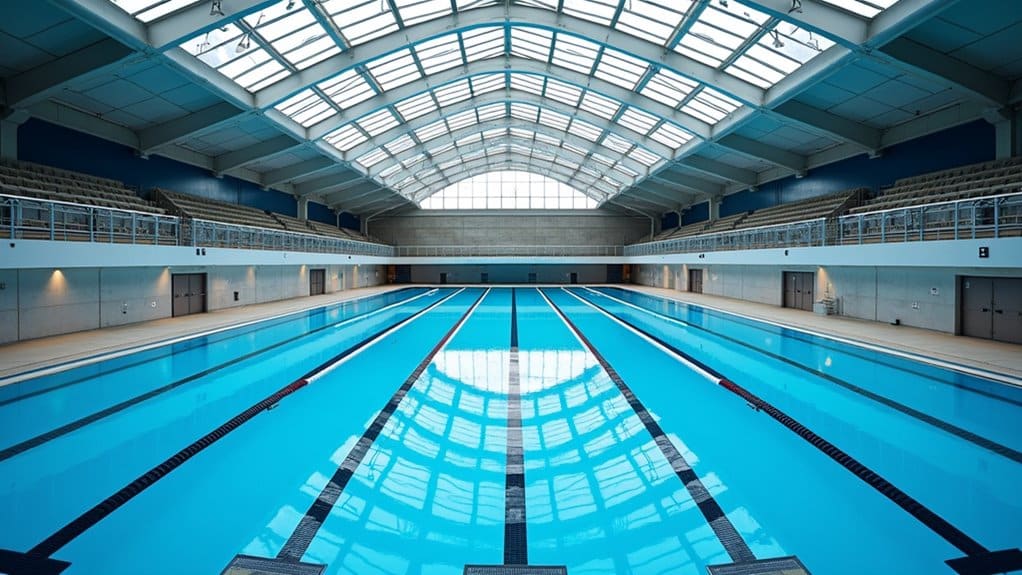
The Georgia Tech Aquatic Centre’s record-breaking pool design utilizes an oversized gutter system and laminar airflow to minimize wave reflection and reduce drag forces that typically slow swimmers. You’ll notice the pool’s optimized 50-meter configuration with 10 lanes, featuring movable bulkheads that enable multiple course setups while maintaining competition-standard depths throughout. The facility’s engineering excellence extends to its temperature control systems and solar-heated water, creating ideal racing conditions that have helped athletes achieve remarkable performances since the 1996 Olympics.
Fast Pool Engineering Elements
While Olympic swimming records continue to fall, Atlanta’s groundbreaking pool engineering established new standards for competitive aquatics design. The integration of wave energy capture through oversized gutters and specialized lane lines revolutionized water quality management, guaranteeing ideal racing conditions.
Key engineering elements that define modern Olympic pools include:
- Advanced circulation systems maintaining 625 m³/h flow rates
- Precision temperature control at 28°C for peak performance
- Solar thermal arrays provide consistent heating
- Strategic buffer zones minimize lateral turbulence
- Ultraviolet treatment systems reduce particulate drag
These innovations work together to create the fastest possible racing environment. You’ll find thorough wave dissipation technology throughout the design, from the perimeter gutters to specialized lane lines, while sustainable climate control systems assure consistent conditions regardless of external factors.
Optimal Depth Configuration
Since Atlanta’s groundbreaking 3-meter pool depth revolutionized competitive swimming in 1996, facility designers have adopted this configuration as the gold standard for elite venues. You’ll find this depth optimizes wave dissipation mechanisms, considerably reducing hydrodynamic drag that slows swimmers down.
Statistical analysis confirms that deeper pools correlate with faster times and more world records. The augmented turbulence optimization strategies at this depth help buffer lanes absorb energy more effectively, creating ideal racing conditions across all lanes. While World Aquatics sets minimum standards at 2 meters, you’ll notice top-tier facilities consistently opt for 3-meter depths to optimize performance potential.
Modern engineering integrates these depth configurations with advanced lane design, ensuring uniform swimming conditions that allow athletes to achieve their peak performance without interference from disruptive wave patterns.
Elite Competition Layout
Designed to revolutionize competitive swimming, Atlanta’s 1996 Olympic pool introduced a groundbreaking 10-lane configuration that you’ll still see replicated in modern elite facilities. The layout enhanced lane width optimization at 2.5 meters per competition lane, while incorporating two strategic buffer lanes to minimize wave interference.
Key anti-wave technology innovations included:
- Specialized lane ropes absorbing surface turbulence
- Oversized gutter systems prevent energy rebound
- Strategic buffer zones reducing wall interference
- Competition-grade spacing between swimmers
- Advanced wave dissipation at pool edges
You’ll find the exact 50×25-meter dimensions enable simultaneous heats and relay events, while the integrated buffer system provides exceptional flexibility for different competition formats. This pioneering design established new standards for elite aquatic facilities, balancing technical precision with competitive functionality.
Modern Olympic Pool Features Shaping Performance
Three core engineering principles define modern Olympic swimming pools: precise hydrodynamics, environmental control, and technological integration. You’ll find wave-dampening troughs and advanced lane lines working together to minimize turbulence, while overflow gutters maintain calm surfaces for optimal racing conditions.
Today’s pools incorporate eco-friendly construction materials and sophisticated athlete performance analytics. Starting blocks feature pressure sensors that measure reaction times, while LED lighting systems boost underwater visibility. The standardized 50m × 25m layout, with ten 2.5m-wide lanes, guarantees competitive fairness and record-setting potential.
Temperature control systems maintain ideal 77-82°F conditions, while state-of-the-art filtration keeps water crystal clear. These features, combined with automated monitoring systems and precise structural tolerances, create the perfect environment for elite swimming performance.
Frequently Asked Questions
What Materials Are Used for Olympic Pool Tiles and Why?
You’ll find that Olympic pools primarily use porcelain and ceramic tiles because they’re exceptionally durable and water-resistant, absorbing less than 0.5% water. While pool coping materials often feature non-slip porcelain for safety, the interior tiles must withstand intense chemical exposure and constant submersion. Waterproofing techniques include specialized membranes beneath the tiles and high-performance adhesives. For ideal performance, these materials meet strict ISO13006 standards and provide essential chemical resistance against chlorine.
How Do Underwater Cameras Capture Olympic Swimming Races Effectively?
You’ll find Olympic pools equipped with sophisticated underwater camera systems that optimize swimmer visibility through strategic camera positioning along lanes and beneath the surface. These systems use high-speed cameras (250+ fps) in specialized housings, delivering crystal-clear footage for both broadcasting and officiating. You’re seeing the action through twin-cam setups that seamlessly blend above and below-water perspectives, while automated controls guarantee consistent coverage without interfering with athletes’ performance.
What Cleaning Systems Maintain Water Clarity During Olympic Competitions?
You’ll find Olympic pools employ multi-layered water treatment processes that work continuously during competitions. Advanced filtration systems like the Neptune Benson Defender® capture particles down to 1 micron, while automated calcium hypochlorite feeders maintain precise chlorination. You’re also looking at UV and ozone systems for secondary disinfection, plus real-time monitoring equipment that tracks water chemistry. These integrated technologies guarantee crystal-clear conditions that meet strict Olympic standards.
How Do Acoustic Designs Minimize Echo in Indoor Olympic Pools?
You’ll find effective pool acoustics rely on multiple sound dampening solutions working together. By integrating acoustic panels with high absorption coefficients on walls and ceilings, you’re creating an environment that minimizes echo. You can further reduce reverberation by incorporating curved pool shapes, irregular surfaces, and modular wall systems. Installing soft, non-reflective furnishings and specialized backlit acoustic frames helps capture sound waves while maintaining the venue’s aesthetic appeal.
What Lighting Techniques Are Used to Reduce Glare for Swimmers?
You’ll reduce glare by implementing side-mounted fixtures at least 4 meters above water, avoiding direct overhead lighting designs. Position luminaires at angles greater than 50 degrees and use indirect lighting techniques that reflect off matte-finished walls. For underwater lighting techniques, opt for SMD LED chips with asymmetric beam angles, which cut glare by 50% compared to COB LEDs. You should maintain 300-500 lux uniformity while using powder-coated fixtures for longevity.