You’ll find several common chemical names on pool chlorine products, including sodium hypochlorite (NaOCl), calcium hypochlorite (Ca(ClO)₂), and stabilized variants like trichlor (C₃H₅Cl₃N) and dichlor (C₃H₅Cl₂N₃O₃). These compounds work as sanitizers through different mechanisms and contain varying percentages of available chlorine. Each type has specific advantages and applications, with some requiring cyanuric acid stabilizers while others don’t. Understanding these distinctions can greatly impact your pool maintenance strategy.
Common Types of Hypochlorites in Pool Products
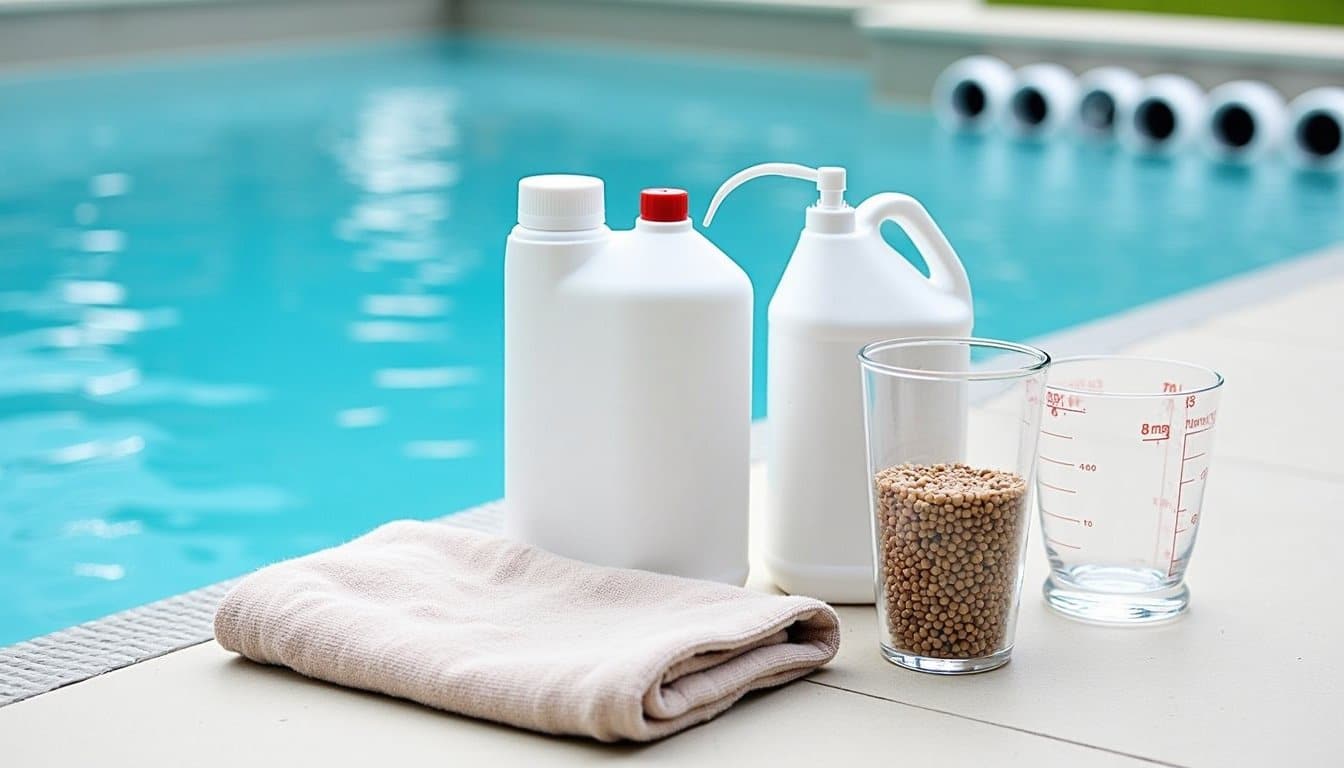 Hypochlorites represent the primary active ingredients in modern pool sanitization products, with sodium hypochlorite and calcium hypochlorite being the two predominant forms. You’ll find sodium hypochlorite as a liquid solution containing 10-12% available chlorine, while calcium hypochlorite comes in granular or tablet form with approximately 70% available chlorine. Lithium hypochlorite is another option that resists hard water degradation better than other varieties. Due to various security protocols, certain websites with pool chemical information may have restricted access.
These hypochlorite types differ greatly in their applications and characteristics. Sodium hypochlorite provides immediate HOCl for disinfection but requires careful pH management around 7.5 for peak effectiveness. Calcium hypochlorite, alternatively, offers a longer shelf life and works well in saltwater pools, though it’ll increase your pool’s calcium hardness levels. When choosing between these chlorine forms, you’ll need to take into account factors like your pool’s surface type, existing calcium levels, and preferred maintenance schedule. Using fast-acting liquid chlorine for regular maintenance allows for quick distribution when poured in front of pool jets.
Understanding Stabilized Chlorine Labels
When examining pool chlorine labels, you’ll encounter specific terminology that indicates whether the product contains cyanuric acid as a stabilizing agent. Understanding chlorine label interpretations helps you identify stabilized chlorine benefits and make informed purchasing decisions. Stabilized chlorine products are most effective for outdoor swimming pools exposed to direct sunlight.
Reading pool chlorine labels carefully reveals key information about stabilizing agents, helping pool owners choose products that match their needs.
Key indicators on labels include:
- Terms like “stabilized,” “sun shield,” or “UV protected” confirm cyanuric acid presence
- Chemical abbreviations “HAC” or “CYA” directly reference the stabilizing compounds
- Percentage breakdowns showing approximately 90% chlorine with 10% stabilizer content
You’ll notice warnings stating “not for shocking” on stabilized products, as they’re unsuitable for shock treatments. For precise monitoring, check that stabilizer levels remain within 20-50 ppm range, as higher concentrations can reduce chlorine’s effectiveness and require partial water replacement. Using stabilized chlorine products can provide reduced maintenance needs since they don’t require as frequent additions to maintain proper sanitization levels.
Decoding Chemical Formulas on Pool Products
Understanding chemical formulas on pool products requires familiarity with molecular structures and their reactive properties. When you’re examining product labels, you’ll notice compounds like sodium hypochlorite (NaClO) and calcium hypochlorite (Ca(ClO)₂), which undergo specific chemical reactions in water. NaClO breaks down into HOCl and NaOH, while Ca(ClO)₂ produces HOCl and CaCl₂. Regular maintenance checks are crucial to ensure proper chemical balance and prevent equipment damage. The pH level significantly influences these chemical reactions, as pH controls chlorine strength in indoor pools without cyanuric acid.
For ideal chlorine efficiency, you’ll need to take into account how these compounds interact with your pool’s chemistry. Stabilized chlorines like dichlor (C₃H₅Cl₂N) and trichlor (C₃H₅Cl₃N) contain cyanuric acid, which affects their dissolution rates. Salt chlorine generators follow a different pathway, converting NaCl through electrolysis to produce Cl₂ gas, which then forms HOCl in water for sanitization. The minimum requirement for effective sanitization is 1.0 ppm chlorine to prevent the growth of algae and harmful bacteria.
Active Ingredients in Pool Sanitizers
When you’re examining pool sanitizer labels, you’ll need to identify key active ingredients like calcium hypochlorite, sodium hypochlorite, or PHMB hydrochloride to understand their sanitizing mechanisms. You’ll find these chemical compounds listed with specific concentrations, such as PHMB at 20% in Baquacil® or varying levels of available chlorine in Cal-Hypo products. Beyond the primary sanitizing agents, you’ll discover supplementary components like quaternary ammonium compounds, stabilizers, and pH adjusters that work together to maintain proper pool chemistry. For safety during handling, it’s essential to wear personal protective equipment when working with these chemicals. If you experience website access issues while researching these products online, you may need to contact the site administrator for assistance. Using advanced formulations, these sanitizers effectively destroy harmful bacteria and algae while being gentle on pool surfaces.
Common Chemical Compound Names
Three primary categories of chlorine compounds dominate the pool sanitizer market: stabilized chlorine (TCCA and DCCNa), non-stabilized chlorine (hypochlorites), and salt-based systems that generate chlorine through electrolysis.
When you’re examining chlorine stability factors and chemical reaction dynamics, you’ll find these common compounds on product labels:
- Trichloroisocyanuric acid (TCCA) and sodium dichloroisocyanurate (DCCNa) – stabilized options containing cyanuric acid for UV protection
- Sodium hypochlorite, calcium hypochlorite, and lithium hypochlorite – unstabilized forms that dissolve at different rates
- Sodium chloride (salt) – used in chlorine generators to produce hypochlorous acid through electrolysis
Each compound’s chemical structure determines its dissolution rate, pH impact, and effectiveness in maintaining proper sanitization levels. Understanding these differences helps you select the most appropriate product for your pool’s specific needs. Regular shocking helps eliminate pool odors that occur when organic matter depletes the chlorine. While these compounds are effective sanitizers, they can produce chlorine byproducts that may cause eye and skin irritation in swimmers. Salt-based systems are gaining popularity as they provide softer water while maintaining effective sanitization.
Understanding Active Sanitizing Components
Pool sanitizer effectiveness hinges on its active ingredients’ chemical composition and concentration levels. You’ll find three primary categories of sanitizing compounds, each with distinct chemical interactions and sanitizer efficacy profiles:
| Sanitizer Type | Active Component | Concentration |
|---|---|---|
| Chlorine-Based | Trichlor | 90% available |
| Bromine-Based | Bromine Tablets | 65% available |
| Non-Chlorine | PHMB | 20% available |
When selecting a sanitizer, you’ll need to evaluate the stabilization chemistry. Chlorine-based products require cyanuric acid for UV protection, while bromine self-stabilizes through its regenerative cycle. Non-chlorine alternatives like PHMB operate through different chemical mechanisms, targeting organic contaminants without producing chlorine byproducts. Calcium hypochlorite shock provides rapid sanitizing action when heavy-duty treatment is needed. Each compound’s effectiveness depends on proper pH maintenance and accurate concentration monitoring through specific testing methods.
Pool Product Label Analysis
Chemical composition labels on pool sanitizer products reveal vital information about active ingredients and their concentrations. You’ll find these key components clearly stated on product labels, which directly impact pool product effectiveness and chlorine stability.
When analyzing pool product labels, focus on:
- Active ingredient percentages – like Baquacil’s 20% poly(hexamethylenebiguanide) hydrochloride or varying concentrations in chlorine-based products
- EPA registration numbers – important identifiers that confirm proper regulatory compliance and testing
- Inert ingredient content – typically comprising 80% of formulations, these stabilizers affect chlorine stability and product performance
Understanding label information helps you make informed decisions about sanitizer selection and proper dosing. Product labels also contain vital safety warnings, disposal instructions, and manufacturer details that guarantee proper handling and application of pool chemicals.
Different Forms of Chlorine Compounds
When selecting pool sanitizers, you’ll encounter two main categories of chlorine compounds: hypochlorites (sodium hypochlorite NaOCl and calcium hypochlorite Ca(ClO)₂) and stabilized chlorines (trichloro-s-triazinetrione C₃H₃Cl₃N₃O₃ and dichloro-s-triazinetrione C₃H₂Cl₂N₂O₂). The hypochlorite products provide immediate sanitizing action but lack UV protection, while stabilized chlorines contain built-in cyanuric acid for prolonged effectiveness in outdoor pools. Each compound’s chemical structure determines its specific properties, from the high alkalinity of sodium hypochlorite to the neutral pH of dichlor, affecting how you’ll need to balance your pool’s chemistry. The solid form compounds have a significant advantage in storage and handling, with a longer shelf life compared to liquid alternatives.
Common Hypochlorite Product Names
Hypochlorite-based sanitizers come in several distinct chemical forms for pool maintenance. The three primary compounds you’ll encounter in pool products are:
- Sodium hypochlorite (liquid bleach) at 3-15% concentration, commonly used in automated feeding systems
- Calcium hypochlorite in granular or tablet form, offering superior chemical stability for non-aqueous applications
- Trichloroisocyanuric acid (TCCA) in slow-release tablets or granules, providing sustained active chlorine delivery
Product labeling clearly indicates the hypochlorite forms and concentrations, helping you select appropriate dosing methods. Sodium hypochlorite solutions require careful handling due to gradual decomposition, while calcium hypochlorite and TCCA maintain better stability in dry form. For effective pool sanitization, each compound releases hypochlorite ions, ultimately forming hypochlorous acid as the primary sanitizing agent.
Stabilized Chlorine Chemical Names
Stabilized chlorine compounds primarily consist of two distinct triazine-based chemicals: Trichloro-S-Triazinetrione (Trichlor) and Sodium Dichloro-S-Triazinetrione (Dichlor). You’ll find Trichlor in 3-inch tablets (C₃Cl₃N₃O₃), specifically designed for outdoor pools due to its built-in UV protection and controlled release properties. Dichlor (C₂Cl₂N₂NaO₃) comes in granular form, offering rapid dissolution for shock treatments.
Both compounds are triazine derivatives that enhance chlorine stability through integrated cyanuric acid release. You’ll recognize Trichlor products labeled as “stabilized chlorine tablets,” while Dichlor appears in products like Di-Zap granules. These stabilized formulations are particularly effective in maintaining consistent sanitization levels, with Trichlor excelling in outdoor applications and Dichlor performing efficiently in warm-water environments like spas.
Safety Information on Chemical Labels
Pool chemical labels contain essential safety information mandated by the Environmental Protection Agency (EPA) to protect users from potentially hazardous exposure. Safety data includes inhalation risks from chlorine gas, contact hazards for skin and eyes, and reactivity warnings for organic materials. The labels provide critical hazard awareness through standardized formatting and clear emergency protocols.
Key safety elements you’ll find on compliant labels:
- EPA registration and establishment numbers verifying product legitimacy and manufacturing source
- Specific storage requirements for maintaining chemical stability in cool, dry, ventilated areas
- Detailed first aid guidance for exposure incidents, including emergency contact information
When handling pool chemicals, always verify these safety components on labels, as missing or vague information may indicate unapproved, potentially dangerous products.
Cyanuric Acid and Related Compounds
After understanding safety label requirements, you’ll need to master the chemistry of cyanuric acid (C₃H₃N₃O₃), a key stabilizing compound in chlorinated swimming pools. One of the primary cyanuric acid benefits is its ability to protect chlorine from UV degradation, maintaining effective sanitization levels between 30-50 ppm.
You’ll encounter this compound in two tautomeric forms: the prevalent triketo form (isocyanuric acid) and the triol form. Isocyanuric acid stability is superior in solution, making it the dominant structure for pool applications. The compound’s pH-dependent behavior, with three distinct deprotonation steps (pKa values: 6.88, 11.40, 13.5), affects its reactivity. While it’s moderately soluble in water (1,500 mg/L at 25°C), you should monitor levels carefully, as concentrations above 80 ppm can cause scaling issues.
Ph Adjusters and Chemical Balancers
To maintain your pool’s pH balance, you’ll need two primary chemical categories: pH increasers like sodium carbonate and pH reducers like sodium bisulfate or muriatic acid. You’ll achieve ideal swimming conditions by keeping pH levels between 7.2 and 7.8, testing 2-3 times weekly, and making incremental adjustments rather than large chemical doses. When applying pH adjusters, you’ll need to monitor total alkalinity simultaneously, as these parameters are interconnected and influence your pool’s overall chemical stability.
Pool Ph Balance Essentials
Maintaining proper chemical balance in your swimming pool requires a systematic understanding of pH adjusters and their interactions. The key to success lies in mastering pH measurement methods and alkalinity testing techniques through a methodical approach.
Your essential pH management strategy should include:
- Testing total alkalinity first (target 80-120 ppm) using sodium bicarbonate for adjustments
- Measuring pH levels (ideal range 7.4-7.6) with sodium carbonate to raise or sodium bisulfate to lower
- Monitoring cyanuric acid levels (30-50 ppm) to protect chlorine effectiveness
You’ll need to test chemicals after each adjustment, waiting 30 minutes between applications. When using sodium bisulfate, add one cup per 10,000 gallons to lower pH by 0.5-1.0 units. For alkalinity adjustments, use one pound of baking soda per 10,000 gallons to increase levels by 10 ppm.
Chemical Dosing Best Practices
Proper chemical dosing forms the cornerstone of effective pool maintenance, requiring precise measurements and systematic application protocols. You’ll need to maintain chlorine levels between 1.0-3.0 PPM, monitoring them 2-3 times weekly during peak seasons.
For chlorine application, you’ll find different methods based on your product type. Dissolve stabilized granules in water for vinyl/fiberglass pools, or sprinkle directly for other surfaces. When using liquid chlorine, mix it with water and broadcast after pH adjustment. Remember to wait 2 hours before adding algaecide to prevent chemical interference.
Your dosing frequency should include weekly shock treatments to eliminate chloramines, especially after heavy pool use. Always follow manufacturer guidelines for proper measurements, and maintain detailed records to track chemical balance trends and identify potential issues requiring adjustment.
Commercial vs. Residential Pool Chemicals
While both commercial and residential pools rely on chlorine-based sanitization, they differ considerably in their chemical treatment approaches and maintenance requirements. Commercial chlorine applications typically utilize unstabilized products like calcium hypochlorite or liquid chlorine, while residential chlorine often comes in stabilized tablet form.
Key distinctions include:
- Testing frequency – commercial facilities test hourly for free/combined chlorine, whereas residential pools may only test weekly
- Sanitizer selection – commercial pools avoid trichlor to prevent CYA buildup, preferring Cal-Hypo or liquid chlorine with automated feeders
- Dosing precision – commercial pools require strict adherence to the 4g chlorine per person-hour rule due to high bather loads
These differences reflect the more demanding operational requirements and regulatory oversight of commercial facilities compared to residential settings.
Essential Chemical Measurements and Units
Chemical measurements serve as the foundation for effective pool water management, building upon the distinct approaches used in commercial and residential settings. Understanding chemical measurement basics starts with knowing key units and their ppm significance in maintaining proper sanitization levels.
| Parameter | Recommended Range |
|---|---|
| Free Chlorine | 1-3 ppm residential |
| pH Level | 7.2-7.8 |
| Total Alkalinity | 60-120 ppm |
| Cyanuric Acid | 30-50 ppm |
You’ll need to monitor these parameters using various testing methods, from basic test strips to advanced ORP sensors. For accurate measurements, always wait 30 minutes after chemical additions before testing. When calculating dosages, use your pool’s volume in gallons or liters and round up chemical amounts to guarantee adequate sanitization levels. Regular testing intervals depend on pool usage, with high-traffic pools requiring daily checks.
Frequently Asked Questions
Why Do Some Pool Chemicals Have a Strong Vinegar-Like Smell?
If you’re detecting a vinegar-like smell in pool chemicals, you’re likely experiencing chemical reactions unrelated to chloramines, which actually produce different odors. While chlorine compounds create distinct bleach-like or ammonia-type scents, vinegar smells typically come from separate cleaning products or acidic solutions used in pool maintenance. Don’t confuse these odors with chloramine indicators, as they signal different chemical conditions in your pool water.
Can Pool Chemicals Be Mixed With Household Cleaning Products?
Never mix pool chemicals with household cleaning products, as this violates essential pool safety guidelines and creates dangerous chemical reactions. You’ll risk producing toxic gases like chlorine or chloramine when combining pool chlorine with common cleaners containing ammonia or acids. These reactions can cause severe respiratory distress, chemical burns, and potentially fatal outcomes. Always store and use pool chemicals separately from household cleaners to prevent accidental mixing.
How Long Do Unopened Pool Chemicals Remain Effective?
Your pool chemicals’ shelf life varies greatly by type and storage conditions. You’ll find that dry granular chlorine maintains chemical stability for 3-5 years when unopened, while tablets last 2-3 years. Unstabilized liquid chlorine won’t last as long, losing half its potency within 6 months. For maximum effectiveness, you’ll need to store your chemicals in airtight containers away from sunlight and extreme temperatures. Always check for physical signs of degradation before use.
What Causes Pool Chemicals to Change Color During Storage?
You’ll notice color degradation in stored pool chemicals primarily due to temperature fluctuations and moisture exposure. When you expose chemicals to high temperatures (>95°F), it triggers unintended reactions that affect chemical stability. If you’re storing products in damp conditions, moisture initiates hydrolysis reactions that alter the compound’s appearance. Additionally, you’ll find that prolonged thermal stress and natural aging processes can cause discoloration as chemicals break down over time.
Do Generic Brand Pool Chemicals Work as Well as Name Brands?
You’ll find that generic pool chemicals generally don’t match name-brand efficacy due to their lower active ingredient concentrations, typically 40% compared to 70% in premium brands. While you’ll see initial cost savings, the need to use more product and frequent rebalancing ultimately negates these benefits. You’re likely to spend more long-term when factoring in increased maintenance cycles, potential equipment damage, and the higher volume of chemicals required for equivalent results.