
To design an Olympic-size swimming pool, you’ll need to meet precise dimensional requirements: 50.000 meters in length (+0.010/-0.000m tolerance) and 25.00 meters width with 10 lanes. You must maintain water temperature between 25-28°C and install sophisticated chemical monitoring systems for ideal pH and chlorine levels. Critical features include competition-grade timing systems, proper circulation rates of 625 m³/h, and adequate lighting of 1500+ lux. These specifications represent just the foundation of competitive pool engineering standards.
Precise Pool Dimensions and Tolerances
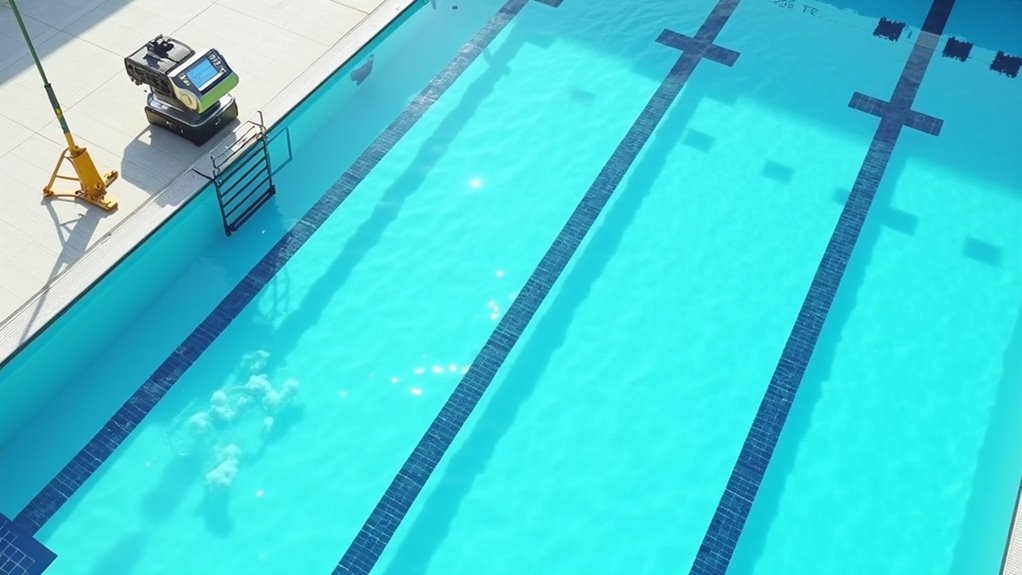
When constructing an Olympic-size swimming pool, precise dimensional specifications and strict tolerances are paramount to meet international competition standards.
You’ll need to guarantee the pool length measures exactly 50.000 meters with timing equipment installed, allowing for a +0.010 to -0.000 meter tolerance when using touch pads. The width must be 25.00 meters for permanent installations, accommodating 10 lanes of 2.5 meters each. Pool depth uniformity is critical, requiring a minimum of 2.50 meters for Olympic events, with specific requirements of 1.35 meters depth at starting blocks extending 6.0 meters from the wall. The water must be maintained at controlled temperatures between 25°C and 28°C for competition requirements. Most facilities in the United States opt to build short-course pools instead due to their lower operational costs and maintenance requirements.
For measurement protocol compliance, you must verify dimensions at points between 0.3 meters above and 0.8 meters below the water surface. World Aquatics strictly enforces these specifications, and any deviation can disqualify your venue from hosting international competitions. The deeper water levels help create optimal swimming conditions by reducing wave turbulence throughout the pool.
Lane Configuration and Competition Standards
You’ll find that Olympic swimming pool lanes must meet precise width requirements of 2.5 meters each, with the exception of outer lanes, which can be 2.4 meters in permanent facilities. Standard Olympic configurations utilize 10 lanes total, where eight central lanes are designated for competition while two outer lanes serve as turbulence-reducing buffer zones. The strategic placement of buffer zones and standardized lane widths guarantees ideal racing conditions by minimizing water displacement effects between competitors. This design works in conjunction with the pool’s optimal depth of 3 meters to ensure minimal turbulence during competitions. The lanes are separated by firmly stretched ropes that feature color-coded floats to help swimmers stay oriented during races.
Lane Width Requirements
While competitive swimming demands precise specifications, lane width requirements stand as a critical element in Olympic pool design. You’ll need to guarantee ideal lane spacing that meets World Aquatics’ standards for swimmer safety protocols and competitive integrity.
Standard competition lanes must be 2.5 meters (8.2 feet) wide. Permanent pools can have 2.4-meter outer lanes (0 and 9) with 0.1-meter buffer space. Temporary pools require all ten lanes at 2.5 meters plus 0.5-meter outer spaces.
Proper lane width directly impacts performance by reducing turbulence between swimmers. The design ensures consistent measurements across the 50-meter length of international competition pools. While eight lanes are used for competition, the full ten-lane configuration provides essential buffer zones that minimize wave interference. This design guarantees fair conditions and enables accurate timing systems for world-class competition.
Buffer Zone Standards
Building upon lane width specifications, buffer zone standards represent a fundamental advancement in Olympic pool design. You’ll need to incorporate dedicated buffer lanes (0 and 9) in your 10-lane configuration to ensure ideal wave absorption considerations. These outer lanes play a pivotal role in maintaining competitive fairness and enhancing performance potential. The design must accommodate a depth of 2 meters at a minimum throughout the pool structure. The pool must maintain water temperature between 25-28°C for optimal competitive conditions.
| Feature | Specification |
|---|---|
| Standard Width | 25 meters |
| Lane Width | 2.5 meters |
| Buffer Location | Lanes 0 & 9 |
| Temp. Pool Width | 26 meters |
| Overflow Rate | 100-125% |
| Lane Total | 10 lanes |
Your maintenance procedures must guarantee buffer zones meet the same dimensional standards as competition lanes. When designing the facility, you’ll need to integrate proper gutter systems that can handle overflow rates of at least 100-125% of pool recirculation to effectively manage wave action in buffer areas.
Water Temperature and Quality Management
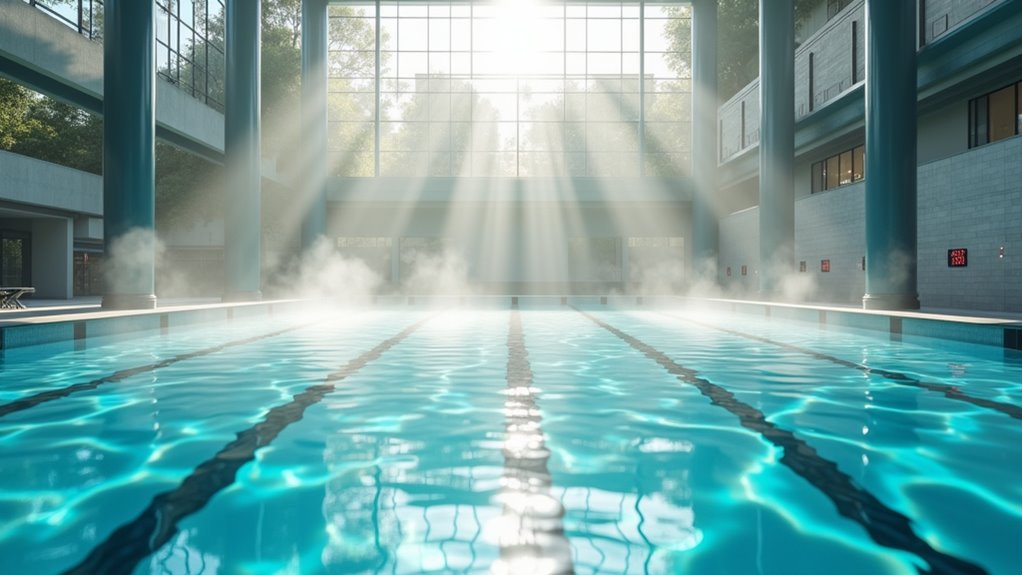
Maintaining Olympic pool temperatures between 25-28°C requires sophisticated control systems that you’ll need to integrate with multi-zone sensors and automated heating/cooling units. These precise temperatures prevent athlete overheating during intense competition and training sessions. Minimum lighting of 1500 lux must be maintained above the pool to ensure optimal visibility for athletes and officials. You must implement a precise chemical dosing protocol to maintain pH levels, chlorine content, and salinity below 3g/liter while continuously monitoring water quality parameters through real-time analytics. Your circulation system should optimize flow rates at 220-250 m³/h to eliminate dead zones and guarantee uniform temperature distribution across all competition lanes. The pool must contain approximately 660,000 gallons of properly treated water to meet Olympic standards.
Temperature Control Systems Design
To achieve ideal athletic performance and regulatory compliance, Olympic swimming pool temperature control systems must maintain water at 25-28°C, with 27°C representing the perfect setpoint. You’ll need integrated heating and cooling solutions that account for seasonal variations in temperature while maintaining strict ±2°C tolerances.
Your temperature control system should include:
- Multi-parameter controllers with real-time monitoring capabilities, connecting to cloud-based platforms for precise tracking. Advanced systems now feature intuitive touch displays for simplified operation and monitoring of multiple parameters simultaneously. The integration of early warning systems helps detect equipment malfunctions before they impact water temperature control.
- Heat pump arrays working in conjunction with thermal storage tanks to balance daily and seasonal load fluctuations
- Smart automation systems that coordinate humidity monitoring strategies between water and air temperatures, maintaining air at 1-2°C above pool temperature
You’ll optimize efficiency by incorporating waste heat recovery and renewable energy sources, which can contribute up to 40% of your heating requirements while ensuring consistent performance year-round. The system must be capable of achieving a rate of 5-7°C change within a 24-hour period to accommodate varying demand and maintenance requirements.
Chemical Balance Maintenance Protocol
Beyond precise temperature control, proper chemical balance represents a cornerstone of Olympic pool management. You’ll need to maintain chlorine levels at 1-3 ppm while keeping pH between 7.2-7.8, with total alkalinity at 80-120 ppm for ideal stability. Use test strips or kits to verify these chemical levels accurately and efficiently. Implement continuous monitoring through automated sensors and conduct manual testing three times daily during peak usage.
Your chemical storage protocols must comply with international safety standards, while your maintenance team requires thorough chemical safety training. You’ll need to guarantee proper documentation of all chemical adjustments and testing results. Set up automated chemical feeders to deliver consistent chlorination, and establish rapid response protocols for water quality incidents. Monitor cyanuric acid levels (30-50 ppm) in outdoor pools to protect chlorine from UV degradation.
Circulation Performance Optimization
While Olympic pool circulation demands exacting standards, you’ll need to implement a thorough performance optimization strategy that integrates hydraulic systems, temperature control, and water quality management. Your system’s efficiency depends on precise coordination between high-capacity pumps and automated monitoring controls.
To guarantee circulation performance, focus on these critical elements:
- Install pump redundancy systems that maintain 625 m³/h flow rates while securing complete water turnover every 4 hours
- Integrate control system integration with real-time sensors for monitoring temperature stability at 28°C, turbidity levels, and flow rates
- Position multiple inlets and bottom drains strategically to eliminate dead zones and maintain uniform water movement throughout the 2,500 m³ volume
This inclusive approach guarantees consistent water quality and meets World Aquatics competition standards while optimizing energy efficiency.
Timing Systems and Electronic Equipment
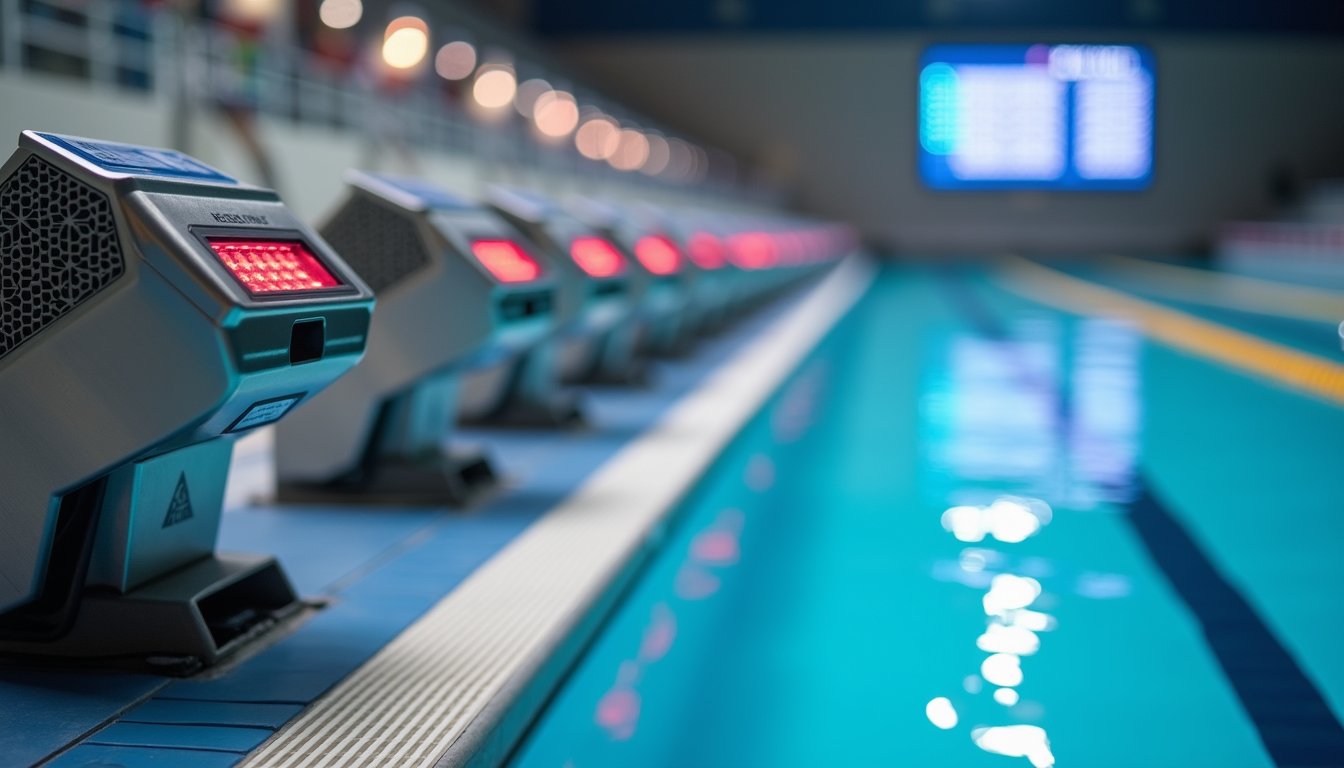
As competitive swimming demands precise measurements down to hundredths of a second, Olympic pools implement sophisticated dual-system timing architectures that combine primary and secondary timers with touchpad sensors and start systems. You’ll need to guarantee data integrity safeguards through multiple input ports with unique identification codes, while secure communication protocols enable reliable switching between main and backup systems.
Your timing setup must include OCP5 stainless steel touchpads for instant finish detection, supported by manual backup buttons. The start system should integrate precisely positioned audio speakers under blocks and synchronized strobe lights to minimize signal lag. To maintain FINA compliance, you’ll need extensive data management capabilities, including memory buffers for race data storage and event databases for real-time results reporting to scoreboards and broadcast systems.
Deck Safety and Surface Requirements
The surface material you select for your Olympic pool deck must provide reliable non-slip traction in both wet and dry conditions, with modern rubberized coatings offering superior grip and impact absorption compared to traditional materials. You’ll need to guarantee your deck width meets FINA’s minimum requirement of 3 feet for officials, while planning for expanded clearances of up to 15 feet at pool ends to accommodate diving and warm-up activities. Your deck design should incorporate proper drainage systems and regular maintenance protocols to maintain the surface’s non-slip properties and prevent hazardous water accumulation.
Non-Slip Material Selection
Selecting appropriate non-slip materials for Olympic pool decks demands rigorous consideration of both safety performance and durability requirements. You’ll need materials that maintain consistent traction when wet while withstanding constant exposure to chlorine, UV rays, and heavy foot traffic.
For ideal safety and performance, focus on these critical factors:
- Choose porous extruded pool mats or poured-in-place rubber surfacing that retains slip resistance when saturated and provides efficient drainage
- Install surfaces with antimicrobial properties to prevent fungi and mildew growth in consistently wet conditions
- Select materials meeting international Olympic standards for non-slip requirements up to 0.8 meters below water surface
You’ll find that high-grade materials like polyurethane coatings and rubberized surfaces offer the best combination of durability and safety, while requiring minimal maintenance to sustain their protective properties.
Deck Width Standards
Building upon proper surface materials, deck width specifications form a fundamental backbone of Olympic pool design safety and functionality. You’ll need to guarantee a minimum 2.5-meter width around the entire pool perimeter, meeting World Aquatics standards for competition venues.
Your deck surface specifications must prioritize unobstructed access, featuring smooth, crack-free surfaces with proper drainage to prevent water accumulation. Deck access considerations include emergency routes, equipment staging areas, and clear pathways for officials and athletes. You’ll need to preserve these areas free from permanent fixtures or temporary obstructions during events.
When planning your deck layout, account for technical installations like timing systems and display boards while ensuring sufficient space for lifeguards, coaches, and support staff. Regular compliance audits will verify your deck meets international safety and competition standards.
Athlete Accessibility and Support Facilities
Modern Olympic swimming facilities must integrate extensive accessibility features and support amenities to accommodate athletes of all mobility levels and abilities. You’ll need to guarantee comprehensive access through strategically placed wayfinding signage and family changing rooms that support athletes requiring physical assistance.
Key accessibility requirements include:
- Two pool entry methods, with at least one being independently operable – typically a pool lift or zero-depth entry
- Accessible changing facilities with non-slip flooring, wide doorways, and wheelchair-compatible showers equipped with grab bars
- Safety features including perimeter handrails, surveillance systems, and clearly marked depth shifts
You must also incorporate dedicated warm-up areas, medical support stations, and storage spaces for adaptive equipment near primary athlete routes to optimize training efficiency and emergency response capabilities.
Spectator Areas and Viewing Considerations
When designing spectator areas for Olympic swimming pools, you’ll need to account for substantial seating capacities ranging from 15,000-20,000 seats while guaranteeing ideal viewing angles for every attendee. Implement flexible seating arrangements through tiered configurations that provide unobstructed sightlines to the entire pool surface, requiring up to 20 feet of deck space for elevated sections.
You’ll need to integrate spectator amenity offerings strategically, including dedicated restrooms, concession areas, and merchandise stands that don’t interfere with circulation paths. Design separate access routes that prevent spectators from crossing wet deck areas, and safeguard ADA compliance throughout. Your acoustic and environmental controls must address humidity, heat, and noise concerns while maintaining comfort during extended events. Include clear wayfinding signage and sufficient emergency exits to manage large crowds efficiently.
Environmental Control Systems
Every Olympic swimming pool requires sophisticated environmental control systems that manage multiple interdependent variables. You’ll need to implement expansive air quality performance measures while maintaining strict temperature and humidity controls. The facility’s energy efficiency strategies must integrate heat recovery systems, variable speed pumping, and automated climate management.
Critical environmental control specifications include:
- Maintain relative humidity between 50-60% and keep ambient temperature 2-3°C above pool water temperature (24-28°C)
- Deploy double-pass plate heat exchangers achieving 84% sensible heat recovery
- Utilize double-glazed, argon-filled curtain walls (1.40 W/sqm K) to optimize passive solar gain
Your system should feature corrosion-resistant components, advanced filtration for chloramine removal, and zone-specific climate controls that adapt to different operational modes – from Olympic events to regular training sessions.
Emergency Response Infrastructure
A thorough emergency response infrastructure forms the backbone of Olympic pool safety, integrating sophisticated communication systems, life-saving equipment, and precisely coordinated staff protocols.
You’ll need to install strategically positioned AEDs, emergency phones with direct EMS links, and all-encompassing PA systems for facility-wide communication. Your evacuation planning must incorporate clearly marked exits and designated shelter areas, while maintaining unobstructed access routes for emergency responders. Install distinct alarm systems and whistle codes to signal diverse emergency types.
Position your emergency communication systems to enable rapid staff mobilization and external agency coordination. You’ll want to integrate digital monitoring with traditional alert methods, ensuring redundant coverage. Install backup power systems to maintain critical safety equipment during outages, and position spinal boards and primary-aid stations within quick-access zones.
Competition Technology Integration
Modern Olympic pools demand cutting-edge technology integration to meet international competition standards and deliver precise performance metrics. You’ll need to incorporate sophisticated electronic timing systems with touchpads at both ends, connected to digital scoreboards for instantaneous result display.
Electronic timing systems and touchpad technology are essential elements of modern Olympic pools, enabling precise performance measurement and immediate results.
Key technology components must include:
- AI-powered stroke analysis systems utilizing high-speed cameras for real-time 3D movement tracking and technique optimization
- Wearable sensor integration providing immediate performance feedback during training, measuring metrics like stroke count and kick efficacy
- Advanced data networks that compile race statistics, manage heat assignments, and upload results automatically
Your facility should also feature smart water quality monitoring systems and environmental controls that maintain precise temperature and chemical balance. These integrated systems guarantee fair competition conditions while maximizing athlete performance and safety.
Frequently Asked Questions
How Long Does It Typically Take to Construct an Olympic-Size Swimming Pool?
You’ll need to plan for 3-6 months total from design to completion for your Olympic-size pool construction timeline. While advanced modular systems can reduce build time to 36 days, architectural design factors and permitting typically add 3-10 weeks to your schedule. You’ll face longer durations if you’re using traditional concrete methods rather than prefabricated systems. Site conditions, weather, and complex mechanical installations will also impact your completion timeframe.
What Is the Average Cost to Maintain an Olympic Pool Annually?
You’ll need to budget between $250,000 to $500,000 annually to maintain an Olympic-size swimming pool. Operating costs include chemicals ($50,000-$100,000), utilities ($100,000-$150,000), water replacement ($10,000-$25,000), and equipment repairs ($25,000-$50,000). You can optimize energy efficiency through LED lighting, modern pump systems, and advanced filtration technology to reduce long-term expenses. However, you’ll still need to account for staffing and insurance costs beyond basic maintenance.
How Many Gallons of Water Are Required to Fill the Pool?
You’ll need approximately 660,000 gallons of water to fill an Olympic-size swimming pool, though this can vary slightly based on pool depth variations beyond the minimum 2-meter requirement. When you’re managing water temperature regulation between 25-28°C, it’s essential to maintain this precise volume. You’ll find that industry standards typically reference 660,000 gallons, though some conversion methods might calculate up to 660,430 gallons for absolute accuracy.
What Backup Power Systems Are Required for Critical Pool Operations?
Your industrial standby generators rated at 100+ kW with automatic transfer switches for your Olympic pool’s critical operations. Your backup generator requirements must handle 2-2.5x surge loads for pumps and equipment startup. You should install uninterruptible power supplies (UPS) for timing systems and controls, plus maintain N+1 redundancy. Guarantee your emergency power supply specifications include GFCI protection, proper grounding, and comply with NEC Article 680 and FINA guidelines.
How Often Must the Pool Be Drained for Major Maintenance?
You’ll need to drain your Olympic pool completely every 5-7 years for major maintenance, though your pool cleaning schedule and water filtration system maintenance should help extend this interval. Don’t drain more frequently unless you’re addressing critical issues like structural repairs, severe contamination, or major plumbing work. You can minimize full drains by implementing partial water replacement and maintaining rigorous chemical balancing throughout the year.