You’ll need to budget between $1.5 million and $3 million to build an Olympic swimming pool in 2025, with construction costs averaging $115-$300 per square foot. The investment includes essential components like the structural shell (25-40% of budget), mechanical systems (15-25%), and sophisticated filtration equipment capable of processing 660,000 gallons every 4 hours. Beyond construction, you’ll face annual operating costs of $450,000-$875,000; understanding these details will help you plan a successful facility.
Basic Construction Cost Breakdown
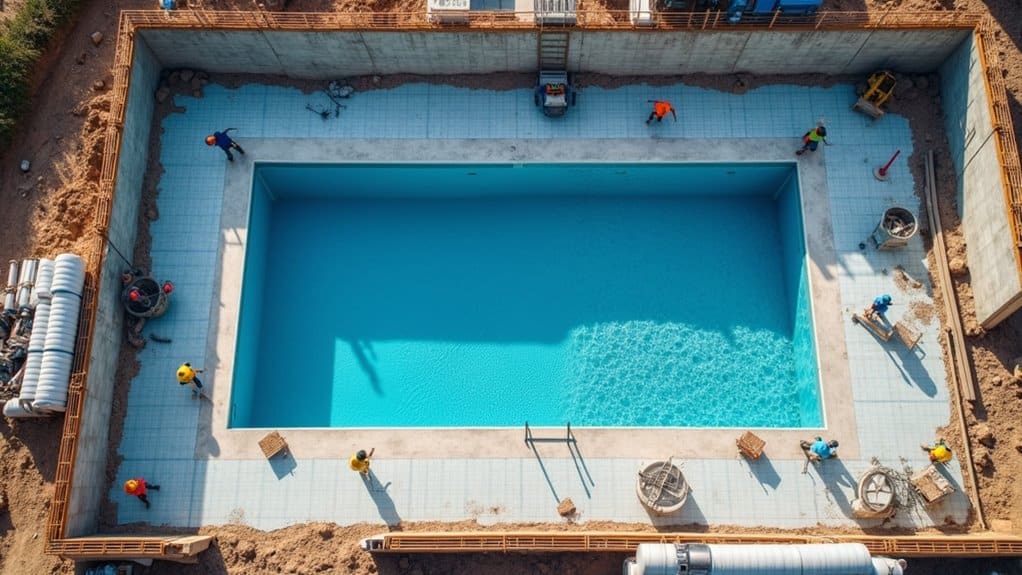
Construction costs for an Olympic swimming pool represent a considerable investment, with basic competition-ready facilities typically ranging from $1.5M to $3M. You’ll need to allocate 25-40% of your budget for the structural shell, excavation, and waterproofing systems. Higher costs are common in northeastern regions, where projects run 15-25% above national averages. Mechanical and plumbing installations consume another 15-25% of costs. For enhanced security, Cloudflare protection is often integrated into the facility’s digital infrastructure to safeguard operational systems.
The current market shows construction costs averaging $115-$300 per square foot, with recent material tariffs driving a 5% increase for 2024-2025. Labor costs and schedule considerations can substantially impact your final investment. Quality stainless steel construction is becoming increasingly popular due to its superior durability and lower maintenance requirements. While smaller 50m pools might cost as little as $300K-$500K, adding advanced features and municipal requirements can push costs beyond $8M. Be sure to factor in a 10-20% contingency for unforeseen conditions and include 10-15% for permitting and design fees.
Essential Technical Requirements
When building an Olympic swimming pool, precise technical specifications serve as non-negotiable requirements that determine both competitive validity and operational success. You’ll need to maintain exact dimensions of 50.000 meters in length and 25 meters in width, with stringent tolerances of +0.010, -0.000 meters. The pool must feature 10 lanes at 2.5 meters each and a minimum depth of 2.50 meters. The increased depth design pioneered at the Water Cube in Beijing helped minimize water turbulence during races. To ensure optimal competitive conditions, touch panels must be installed at both ends of the pool for accurate timing and scoring.
Your filtration efficiency depends on a sophisticated circulation system handling 2.5 million liters while maintaining water temperature between 25-28°C. Electrical load management must support 1500 lux lighting systems and automated chemical dosing equipment. You’ll require anti-wave technologies, including specialized lane ropes and gutter designs. All materials, from chemical-resistant tiles to reinforced concrete, must meet international durability standards while ensuring athlete safety and ideal performance conditions.
Location and Site Preparation Factors
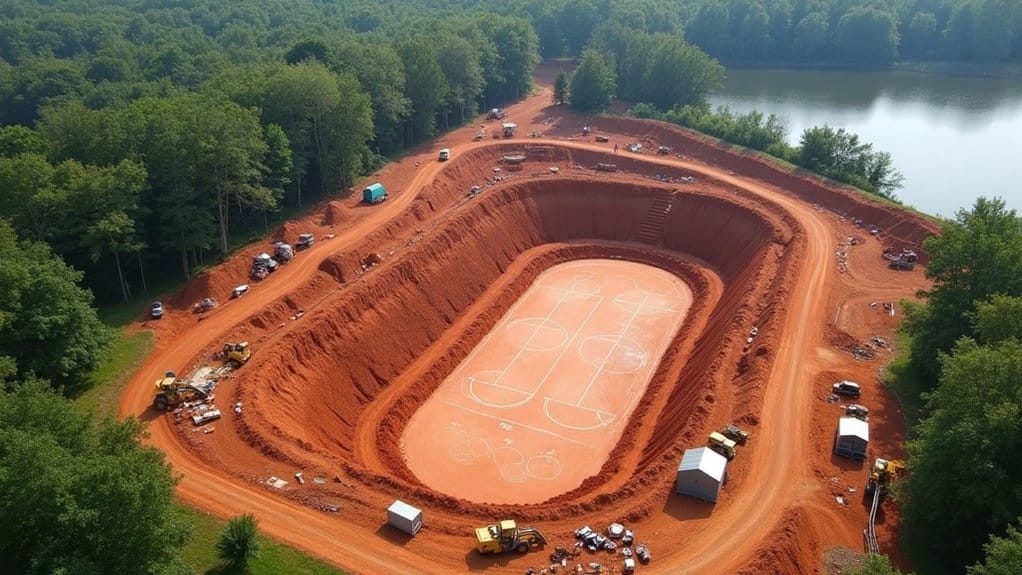
Before breaking ground on an Olympic swimming pool, you’ll need to carefully evaluate and prepare your construction site against multiple critical factors. Your site’s characteristics will greatly impact both initial costs and long-term operational success. Site layout constraints must be analyzed while ensuring stakeholder engagement throughout the planning process. A thorough soil analysis must be conducted to determine the ground’s ability to support the massive weight of the pool structure. The excavation depth must account for a minimum depth of 2 meters to meet Olympic standards. Ensuring proper advanced water circulation systems is essential for maintaining optimal water quality standards throughout the facility’s lifetime.
| Factor | Consideration |
|---|---|
| Infrastructure | Proximity to utilities, roads, and existing facilities |
| Soil Conditions | Stability, water table depth, geotechnical requirements |
| Accessibility | Equipment access, material delivery routes, parking |
| Compliance | Local permits, environmental regulations, FINA standards |
You’ll need to budget for site preparation tasks including vegetation clearing, excavation work, and installation of proper drainage systems. Remote locations typically incur higher transportation costs, while urban sites may require further demolition and traffic management expenses. Waterproofing and foundation requirements will vary based on local climate and soil conditions.
Equipment and System Specifications
Building an Olympic swimming pool requires careful attention to precise equipment and system specifications that meet international competition standards. You’ll need to install a high-capacity filtration system efficiency capable of processing 660,000 gallons every four hours through sand or regenerative media filters. The pool layout must include ten competition lanes to meet Olympic specifications. Water temperature regulation systems must maintain 77-82°F (25-28°C) for competitive conditions.
Your pool will require rigid starting platforms positioned 0.5-0.75 meters above water, equipped with non-slip surfaces and adjustable heel wedges. Essential timing equipment includes touch panels measuring 2.4 x 0.9 x 0.01 meters for accurate electronic timekeeping. The pool must include HPL pool gratings around the perimeter to ensure optimal drainage and prevent slipping hazards. You must also install lane ropes with specific tension requirements of 1-1.2 kN, properly marked at 15-meter intervals, and include automated chemical dosing equipment for precise pH and chlorine control.
Annual Operating Expenses
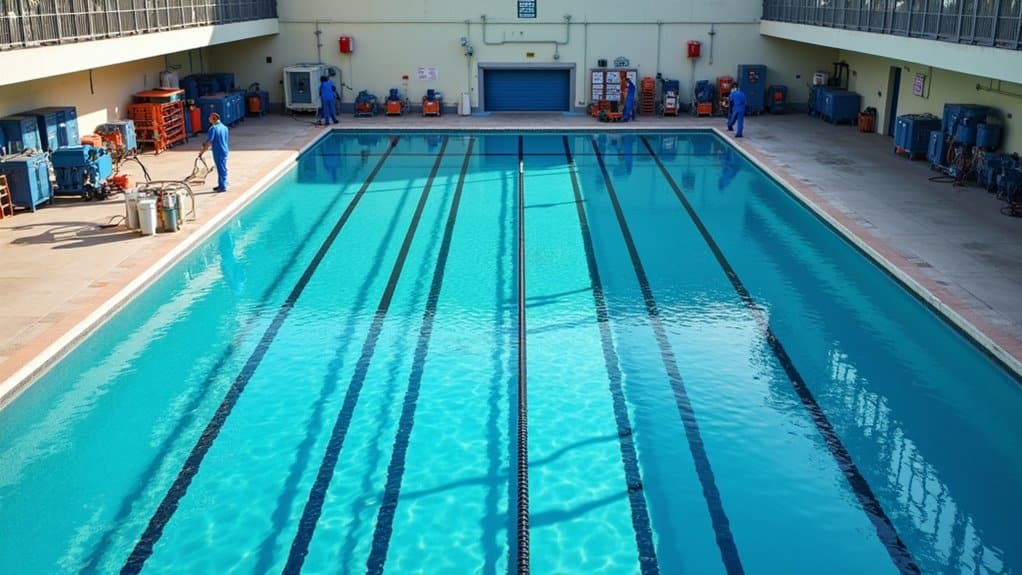
Beyond the initial construction and equipment specifications, operating an Olympic swimming pool demands substantial annual expenditures across multiple cost centers. You’ll need to budget $300,000-$500,000 for staffing costs alone, covering lifeguards, instructors, and facility management. Utilities represent another major expense, with electricity consuming $137,000-$366,000 annually, while water and heating costs vary by location and programming considerations.
Regular maintenance ranges from $6,500-$11,400 annually, though sustainability initiatives can help reduce long-term operational costs. Most facilities operate at a financial deficit, requiring significant municipal subsidies to remain operational. You’ll also face insurance premiums, licensing fees, and compliance expenses. In Mexico, typical maintenance runs about $500K pesos monthly for Olympic pools. Administrative costs, including marketing and program development, add to your budget. Some facilities may require annual interest payments exceeding $2 million when construction loans are necessary. Factor in periodic major repairs and emergency interventions, as deferred maintenance typically leads to more expensive solutions later.
Design Features and Premium Upgrades
When planning an Olympic swimming pool, essential design features and premium upgrades require careful attention to meet FINA’s international competition standards. You’ll need precise dimensions of 50m x 25m with 10 lanes, each measuring 2.5m wide, and depths ranging from 2-3m.
For exclusive finishes, you’ll want to invest in FINA-compliant porcelain or ceramic tiles featuring anti-slip surfaces. Consider adding customized branding elements through spectator seating made from stainless steel or UV-resistant composites. The pool’s technological infrastructure must include touch panels for timing, digital scoring systems, and automated pool covers.
Don’t overlook the importance of color-changing LED underwater lighting and high-grade Olympic pool coping. These premium elements amplify both aesthetic appeal and functional performance while ensuring your facility meets elite competition requirements.
Frequently Asked Questions
How Long Does It Typically Take to Build an Olympic Swimming Pool?
You’ll need to plan for 36 days to 12 months to build an Olympic swimming pool, depending on your construction timeline and project planning approach. If you’re using prefabricated stainless steel components, you can complete the build in as little as 36 days, similar to Paris 2024’s pools. However, if you’re constructing a permanent facility with complex infrastructure and spectator amenities, expect the timeline to extend beyond six months.
Can Olympic Pools Be Converted for Other Sports or Recreational Purposes?
Yes, you’ll find Olympic pools are highly adaptable for diverse activities through multi-purpose design considerations. You can transform them using movable bulkheads, adjustable depths, and modular features to accommodate water polo, synchronized swimming, diving, and recreational activities. The seasonal usage flexibility lets you host competitive events in peak seasons while converting spaces for community programs like aquatic fitness classes, swimming lessons, or even kayaking practice during off-peak periods.
What Happens to Olympic Pools After Major International Competitions End?
You’ll find Olympic pools typically follow several post-event utilization paths. They’re often converted into public recreational facilities or training centers for local athletes. Some venues are dismantled and relocated, especially modern modular pools designed for temporary use. In successful cases of repurposing facilities, you’ll see them transformed into community aquatic centers or competitive venues for regional competitions. However, without proper planning, some pools face abandonment or demolition due to unsustainable maintenance costs.
How Often Do Olympic Swimming Pools Need Major Renovations or Replacements?
You’ll need to plan for major renovations of Olympic pools every 20-30 years, though pool maintenance schedules vary by construction materials. If you’ve got a stainless steel pool, you might stretch this to 30+ years, while concrete or tile-lined pools typically need work at 20-25 year intervals. Your pool operating costs will increase with intensive usage, and you’ll face component replacements every 10-20 years for mechanical systems, deck finishes, and filtration equipment.
What Qualifications Do Contractors Need to Build Olympic-Standard Swimming Pools?
You’ll need specialized certifications like NSPF Certified Pool Builder and a valid general contractor’s license to build Olympic pools. Your technical expertise must cover advanced systems, including moveable bulkheads, wave-reducing gutters, and competition-grade filtration. You’ll also need proven experience with FINA standards, structural engineering knowledge for aquatic venues, and demonstrated competency in managing large-scale projects. Regulatory compliance and safety protocol expertise are essential requirements.