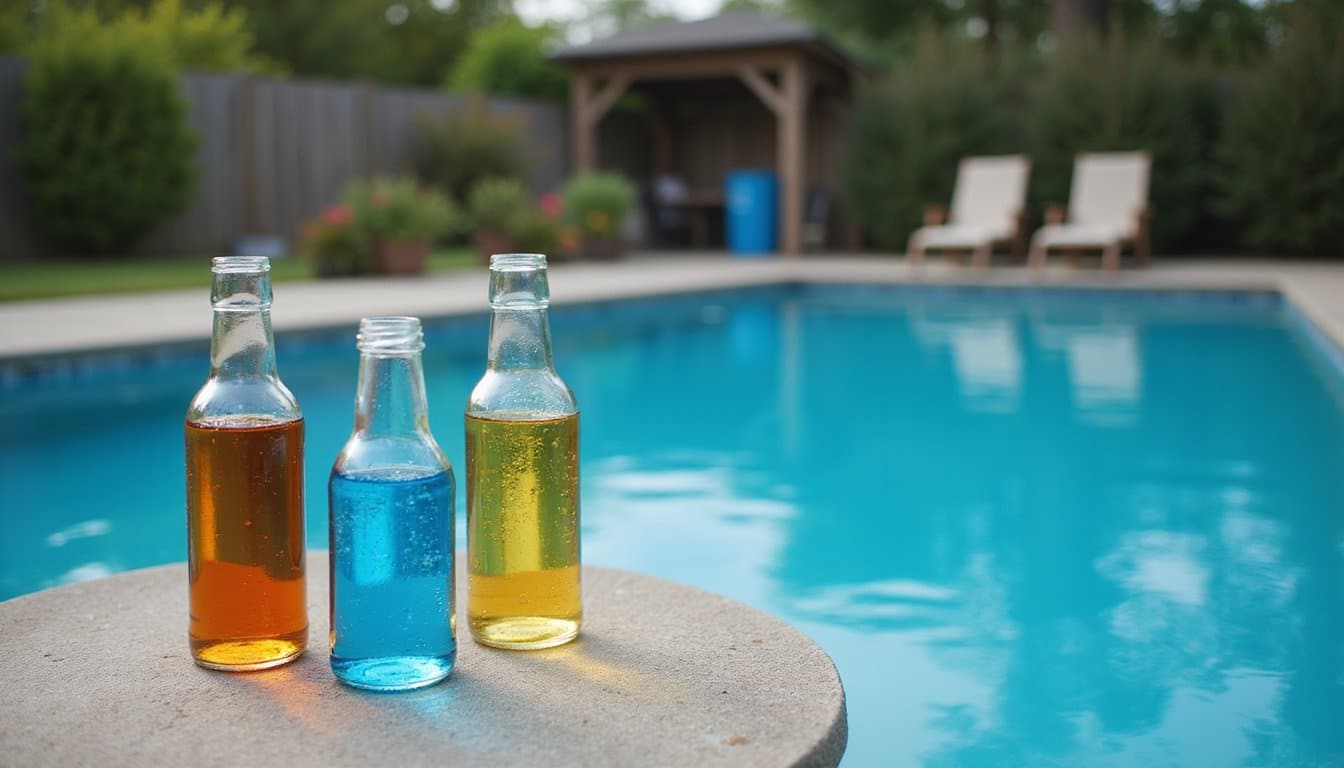
To add muriatic acid to your pool safely, you’ll need chemical-resistant gloves, splash goggles, and protective clothing before handling this corrosive substance. Always dilute the acid using a 10:1 water-to-acid ratio, never add water to acid. Pour the diluted solution into the deepest part of your pool while the pump runs for at least 30 minutes. Wait 6-8 hours before retesting, and the steps below will help you achieve perfect pH balance.
Gear Up Before You Handle Muriatic Acid
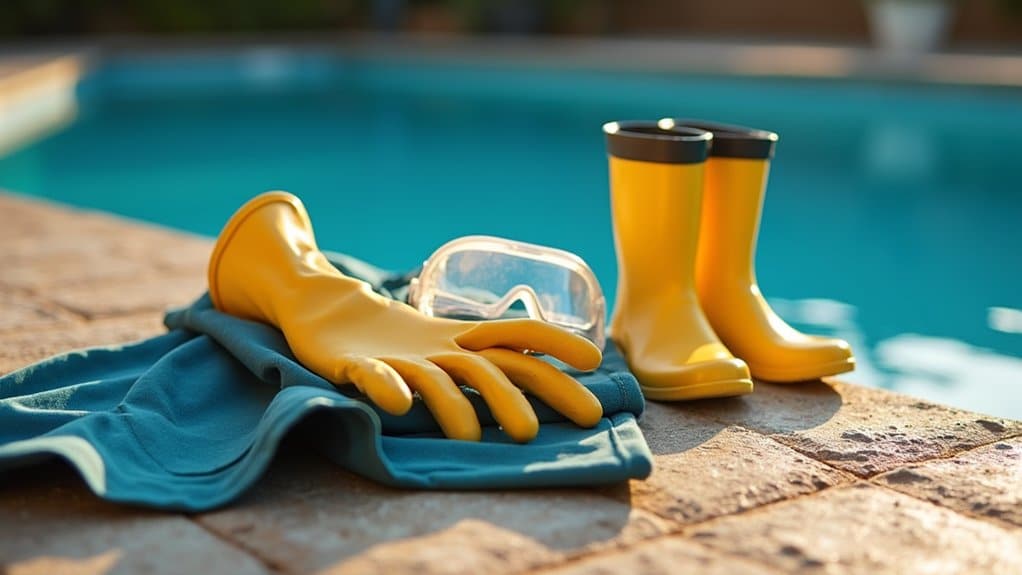
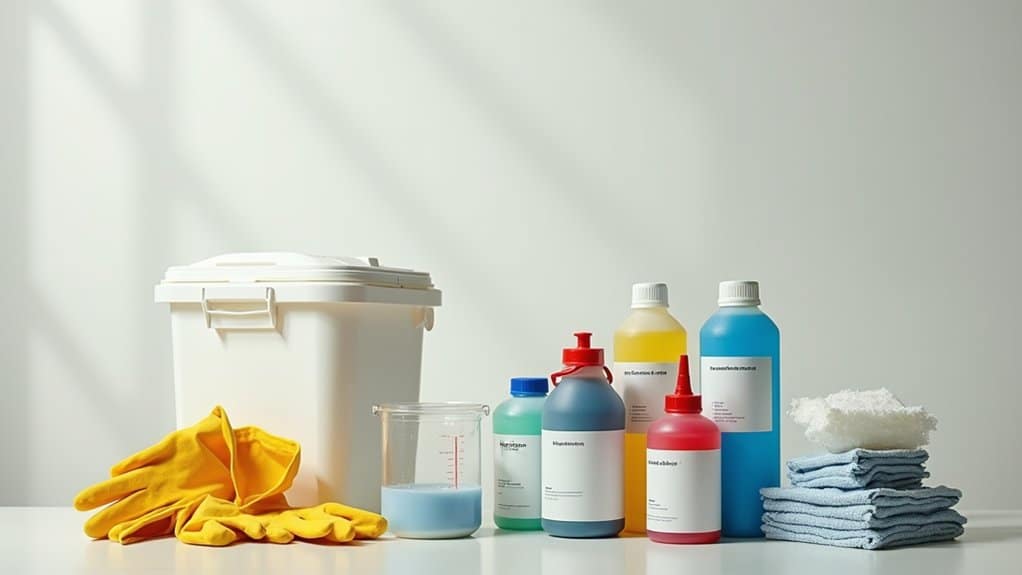
Before you open that bottle of muriatic acid, you’ll need to suit up with the right protective gear. Full-body coverage is essential, wear long sleeves, long pants, and a chemical-resistant apron made from acid-resistant materials. Rubber boots protect your feet from splashes.
Your eyes and face require splash goggles that fit securely without gaps. For concentrated acid, add a respirator for dual protection. Select thick, chemical-resistant gloves labeled specifically for muriatic acid use, extending past your wrists.
Work only in well-ventilated areas. If ventilation is inadequate, use a NIOSH-approved respirator. Keep a water source nearby for emergency flushing and have baking soda ready to neutralize spills. Inspect all equipment for damage before each use. Only trained staff members should be permitted to handle muriatic acid due to its hazardous nature. Remember to never mix muriatic acid with other chemicals, as dangerous reactions can occur.
Test Your Pool Water Before Adding Acid
Before you handle muriatic acid, you’ll need accurate readings of your pool’s current pH and total alkalinity levels. Use a reliable drop-based test kit or quality test strips to measure these parameters, collecting your water sample at elbow depth away from return jets. Test strips are a popular choice because they eliminate the risk of human error while still providing accurate and reliable results. Once you’ve recorded your results, you can calculate the precise amount of acid required to bring your water into the ideal range without overcorrection.
Check pH and Alkalinity
Testing your pool water accurately determines whether you need muriatic acid and how much to add. Before collecting your sample, run the pump for at least one hour to guarantee proper circulation. Collect water from the pool’s deep middle section, 12-18 inches below the surface, away from skimmers and return jets.
Perform pH testing two to three times weekly, targeting a range of 7.4-7.6. Conduct total alkalinity testing weekly, aiming for 80-120 ppm. Your chlorine levels must fall between 2.0-4.0 ppm before testing alkalinity, as higher concentrations interfere with results.
Use liquid drop test kits for the highest accuracy. Test samples immediately after collection to prevent composition changes. If pH levels shift, retest total alkalinity right away before calculating your acid dosage.
Use Reliable Testing Tools
Accurate test results depend on the quality of your testing equipment. You’ll want to choose between multi-parameter test kits and test strip options based on your accuracy needs. Liquid kits like Taylor 2000 provide in-depth measurements, while strips offer faster results for routine checks.
| Testing Method | Parameters Measured | Best Use |
|---|---|---|
| Taylor Liquid Kit | Chlorine, calcium hardness, CYA | Precise readings before acid addition |
| HTH 6-Way Kit | Chlorine, bromine, pH, alkalinity, hardness, CYA | Extensive water analysis |
| AquaChek Yellow Strips | Free chlorine, alkalinity, CYA, pH | Quick 15-second checks |
Store your kits in a cool, dark location and replace them yearly to maintain reliability. Collect water samples 18 inches below the surface for accurate readings before adding muriatic acid.
Calculate Acid Amount Needed
Getting your calculations right starts with establishing baseline measurements of your pool’s current chemistry. Before determining pool volume requirements, you’ll need accurate readings from measuring pool chemicals like pH and total alkalinity.
Use these dosage guidelines for precise acid calculations:
- For lowering total alkalinity by 10ppm: Add 20-25 ounces of muriatic acid per 10,000 gallons when levels exceed 150ppm.
- For reducing pH from 8.2 to 7.6: Apply 3.5 cups per 10,000 gallons to reach ideal range.
- For pH drops from 8.4 to 7.6: Use 1/4 gallon per 10,000 gallons for this larger correction.
Scale these amounts proportionally based on your pool’s volume. Start with half the calculated dose to prevent over-correction. You can always add more acid after retesting following a complete water turnover cycle.
How to Dilute Muriatic Acid Safely
Before mixing muriatic acid, you’ll need an acid-resistant plastic bucket and a wooden stirring stick to handle the corrosive solution safely. Always add acid to water, never the reverse, using a standard 10:1 dilution ratio, which means pouring approximately one quart of acid into a bucket half-filled with five gallons of water. Pour the acid slowly into the water while stirring gently to prevent splashing and guarantee proper dilution before adding the mixture to your pool. Before preparing muriatic acid for pool use, gather an acid-resistant plastic bucket and a non-metal stirring stick to manage the corrosive solution safely, then follow the standard 10:1 dilution rule by adding acid to water, never the reverse, such as slowly pouring about one quart of acid into five gallons of water while gently stirring to prevent splashing. When determining how much muriatic acid to add to pool at one time, base your dosage on pool volume, current pH, and total alkalinity to avoid overcorrection and maintain balanced water chemistry.
Always Add Acid Slowly
When handling muriatic acid, you’ll need to follow a strict dilution protocol to prevent dangerous chemical reactions. The acid dilution ratio pool experts recommend is 1:10, one part acid to ten parts water. Never reverse this order, as adding water to acid causes violent, potentially explosive reactions.
When diluting muriatic acid, follow these critical steps:
- Fill your bucket with water first, then slowly pour the acid into the water while stirring gently.
- Add the diluted mixture in small increments, starting with one quart to half a gallon at a time.
- Walk around the pool’s perimeter as you pour, ensuring even distribution throughout the water.
Retest your water after each addition before proceeding with additional treatments.
Use Proper Dilution Ratio
How precisely you measure and dilute muriatic acid determines both your safety and the treatment’s effectiveness. The standard ratio is 10 parts water to 1 part acid, always following the “acid to water” principle.
When learning how to mix muriatic acid with water, fill a 5-gallon bucket halfway with water first. Then slowly add approximately 1 quart of acid while stirring gently with a plastic or wooden stick. Never reverse this order, as adding water to acid causes dangerous splashback.
For accurate dosing, use glass measuring cups and consult manufacturer instructions. Water movement distribution throughout your pool requires running the pump for at least 30 minutes after treatment. Wait 6-8 hours before retesting, and apply additional half-gallon doses if needed.
Choose Acid-Resistant Containers
Proper dilution technique means little if your containers can’t withstand muriatic acid’s corrosive nature. You should always retain muriatic acid in manufacturer-issued containers, which provide accurate labeling and withstand internal pressure. Never transfer acid to incompatible containers, as this risks dangerous chemical reactions.
When diluting, you’ll need acid-resistant buckets made from chemical-resistant plastic. Follow these critical steps:
- Fill your bucket with water first before adding acid to minimize splashback.
- Position a hose nearby for immediate rinsing if spills occur.
- Keep baking soda within reach to neutralize accidental splashes.
Dedicate specific containers solely to acid handling and rinse them thoroughly after each use. Inspect all containers regularly for cracks, leaks, or heat damage before handling. Cross-contamination between chemicals creates serious hazards you can easily prevent.
Pour Diluted Acid Into the Deepest Part of Your Pool
Because muriatic acid is denser than water, you’ll need to pour your diluted mixture into the deepest section of your pool to prevent concentrated acid from settling on surfaces and causing damage.
Pour diluted muriatic acid into your pool’s deep end to prevent dense acid from settling and damaging surfaces.
Deep End Pouring Acid Technique
Keep your pump running when adding acid to guarantee immediate circulation throughout the pool. Walk slowly around the deep end perimeter while pouring the diluted mixture gradually. This method avoids localized pH drops that can etch plaster or damage vinyl liners.
Avoid dumping acid in a single column, instead, distribute it evenly as you move. Pour at a steady, controlled pace to minimize splashing and fume exposure. Walk upwind during application to evade inhaling vapors.
Wait 30 minutes before retesting pH levels, allowing the circulation system to fully integrate the acid throughout your pool’s volume.
Run Your Filter for Even Acid Distribution
Turning on your pool’s filtration system before adding muriatic acid guarantees the chemical disperses evenly throughout the water column. Proper filter circulation prevents acid from pooling in stagnant areas, which can damage surfaces and create dangerous pH imbalances. Keep your pump running continuously for 4-8 hours after adding acid.
Follow these steps for effective distribution:
- Set your filter to “filter” mode, avoid recirculate unless specifically directed.
- Perform pressure monitoring by noting your starting PSI after a backwash cycle.
- Backwash again if pressure rises 8-10 PSI above normal during circulation.
Don’t allow swimmers to enter during this period. Inspect filter O-rings afterward and lubricate as needed. Continue running until pH levels stabilize completely.
Retest Your Pool Until pH Hits 7.2, 7.6
After your filtration system has circulated the muriatic acid for the recommended 4-8 hours, you’ll need to verify that the chemical adjustment achieved your target range. Use a liquid test kit for accurate pH readings, confirming levels fall between 7.2, 7.6.
If pH remains above 7.6, add small incremental doses while wearing pool chemical safety gloves. Retest after each addition, allowing 4 hours of circulation between adjustments. When working with additional acid, guarantee proper acid fumes ventilation by staying upwind.
pH below 7.2 causes equipment corrosion and swimmer discomfort. Continue testing daily until readings stabilize consistently within range. External factors like rain, heavy pool use, or temperature shifts can alter pH post-adjustment. Retest after weather events to maintain optimal balance and prevent costly chemical corrections.
Fix an Over-Acidified Pool Fast
If your pool’s pH plummets below 7.0 after adding too much muriatic acid, you’ll need to act fast to prevent equipment corrosion and surface damage. Turn off your pump immediately to stop acidic water from circulating through vulnerable components.
Follow these safe pool maintenance practices to neutralize the overdose:
- Add three 4 lb boxes of 20 Mule Team borax directly into the skimmer to raise pH from 6.8 to 7.8 without clouding.
- Alternatively, dissolve soda ash in a bucket before distributing it across the deep end.
- Wait until the correction chemicals disperse fully before restarting circulation.
When handling pool chemicals, always wear eye protection. Counter the acid within two hours for best results, then retest after eight hours of circulation.
When You Can Swim After Adding Muriatic Acid
How soon can you safely enter the water after adding muriatic acid? Wait at least 30 minutes, though extending to one hour provides an additional safety margin. This wait time after adding muriatic acid allows proper dispersion throughout your pool.
Wait at least 30 minutes after adding muriatic acid before swimming, extending to one hour provides an extra safety margin.
Understanding how to add muriatic acid to pool water safely includes recognizing that undispersed acid creates dangerous hot spots. These concentrated areas can cause skin burns and eye irritation.
Run your pump continuously during this waiting period. Full circulation guarantees even chemical distribution and eliminates localized acid concentrations.
Before swimming, retest your water chemistry. Confirm pH levels fall within the 7.2-7.8 range. If readings remain outside acceptable parameters, wait longer and retest every 3-4 hours until balanced chemistry is achieved.
How to Store Muriatic Acid Safely
Keeping muriatic acid locked away in its original container prevents accidental exposure and chemical degradation. You’ll want to store it in a cool, well-ventilated area below 95°F, away from direct sunlight and moisture. Position containers off the floor but not on high shelves to minimize spill risks.
Follow these chemical handling procedures for safe storage:
- Maintain pool chemical storage separation by keeping muriatic acid away from oxidizers, chlorine products, and dry chemicals to prevent toxic gas formation.
- Use secondary containment trays to catch potential leaks and keep a water source nearby for spill neutralization.
- Post warning signs and store laminated Safety Data Sheets in an accessible location near your storage area.
Always comply with local fire codes and OSHA guidelines.
Frequently Asked Questions
Can I Use Muriatic Acid in a Vinyl Liner Pool?
Yes, you can use muriatic acid in a vinyl liner pool, but you must handle it carefully. Always dilute the acid at a 1:10 ratio (acid to water) before adding it. Pour the mixture slowly into the deep end, away from walls and skimmers. Run your pump during application to guarantee even distribution. Never pour undiluted acid directly into the pool, it’ll cause fading, wrinkling, or deterioration of your liner.
How Often Should I Add Muriatic Acid to My Pool?
You’ll typically add muriatic acid weekly or bi-weekly for residential pools, though frequency depends entirely on your pH readings. Test your water 2-3 times weekly during swimming season, increasing to daily during heavy use or hot weather. Add acid only when pH rises above 7.6, and always retest 4-6 hours after treatment. Heavy bather loads, splashing, and high temperatures accelerate pH rise, requiring more frequent adjustments.
What Happens if Muriatic Acid Splashes on Pool Decking?
If muriatic acid splashes on your pool decking, it’ll immediately begin etching the surface. You’ll notice white, chalky residues forming, and concrete or stone materials will develop pitting and discoloration. The acid corrodes grout lines, damages sealed coatings, and causes cracking in painted surfaces. You should rinse the area immediately with large amounts of water to neutralize the reaction and prevent permanent structural damage that requires costly resurfacing.
Can I Add Muriatic Acid at Night Instead of Daytime?
You can add muriatic acid at night without issue. No guidelines prohibit nighttime application. However, you’ll need to guarantee adequate lighting to prevent spills or splashes during handling. Keep your pump running to circulate the acid evenly and avoid surface damage. Maintain proper ventilation to disperse fumes safely. You should still wait at least 30 minutes before reentering and retest pH levels after a few hours of circulation.
Does Water Temperature Affect How Muriatic Acid Works in Pools?
Water temperature doesn’t markedly affect how muriatic acid releases hydrogen ions, it works promptly regardless of pool temperature. However, temperature does influence your pool’s overall pH stability. Warmer water hastens CO2 outgassing, causing pH to rise faster, which means you’ll need more frequent acid additions. Cooler water decelerates these reactions. You should always test pH levels before dosing and maintain total alkalinity between 80-120 ppm to buffer temperature-driven fluctuations effectively.