To do chemicals in your pool the smart and safe way, you’ll want to test water at least twice weekly and always adjust total alkalinity (80, 120 ppm) before dialing in pH (7.2, 7.6). Choose chlorine for outdoor pools or bromine for hot tubs and indoor setups. Wear gloves, goggles, and protective gear every time you handle chemicals, and never mix different types. Each step below breaks down the full process so you can stay ahead of problems.
Pick the Right Pool Chemicals: Chlorine vs. Bromine
When you’re choosing between chlorine and bromine for your pool, understanding how each sanitizer works makes all the difference. A chlorine sanitizer like sodium hypochlorite oxidizes contaminants on contact, delivering rapid algae elimination. Bromine pool sanitizer ionizes pollutants by breaking apart molecules, and its bromamines retain sanitizing power, unlike chloramines, which cause irritation.
For effective pool water chemistry, consider your setup. Bromine tablets pool treatment excels in hot tubs and indoor pools because bromamines don’t off-gas harsh fumes. Chlorine works better outdoors, where airflow disperses chloramines naturally. Bromine stays effective at higher pH levels and warmer temperatures, simplifying pool water quality management. Chlorine’s cheaper upfront, but bromine requires less frequent dosing, making your choice dependent on environment, budget, and comfort priorities. Many pool supply websites employ automated security systems that detect and block suspicious activity, so if you find yourself unable to browse products, patience and a quick message to support can get you back on track. When selecting a chlorine type for hot tub use, dichlor is recommended as it provides a balanced formulation, while trichlor should be avoided due to its corrosiveness in warm water.
Balance Pool Chemicals Starting With Alkalinity and pH
You should always adjust total alkalinity before tackling pH, since alkalinity acts as a buffer that stabilizes pH and prevents erratic fluctuations known as “pH bounce.” Aim to bring your alkalinity into the 80, 120 ppm range first, using sodium bicarbonate to raise it or muriatic acid to lower it, then test and correct your pH. Your target pH should fall between 7.2 and 7.6, as levels outside this range reduce chlorine’s effectiveness and can damage pool equipment or irritate swimmers’ skin and eyes.
Alkalinity First, Then pH
| Step | Action |
|---|---|
| 1 | Test alkalinity and pH levels |
| 2 | Adjust total alkalinity first |
| 3 | Run pump 4, 6 hours, retest |
| 4 | Correct pH to 7.4, 7.6 |
Ideal pH Range Tips
Test at least twice weekly to maintain proper pH testing frequency, and always retest after rain or heavy bather use. For pH adjustment, use soda ash to raise levels below 7.2 and muriatic acid to lower levels above 7.8. Apply chemicals with your pump running for even distribution. These pH balancing methods prevent costly damage and keep your water balanced between treatments.
Store and Handle Pool Chemicals Safely
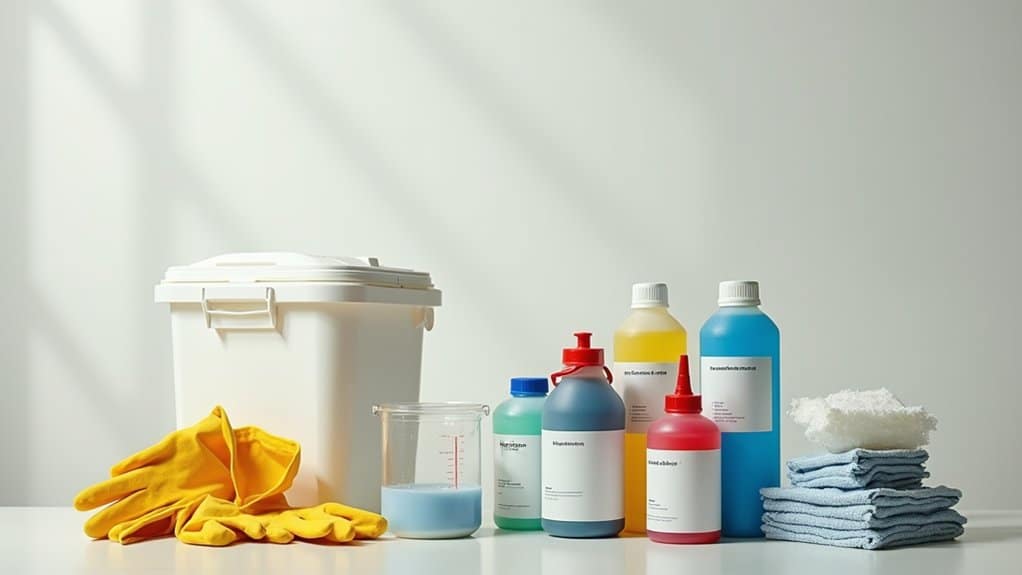
You need a dedicated storage area that’s cool, dry, well-ventilated, and locked away from children, pets, and incompatible household products. Always wear protective safety gear, including gloves and eye protection, before handling any pool chemicals, and keep Safety Data Sheets accessible near your storage space. Never mix different chemicals together or reuse containers, since combining incompatible products like chlorine and muriatic acid can produce toxic gases or violent reactions.
Proper Storage Area Setup
Lock the area to restrict access from children, pets, and unauthorized individuals. Maintain accessible Safety Data Sheets for every product. Sound pool chemical storage, pool chemical safety, and pool chemical handling start here.
Wear Protective Safety Gear
Suiting up in the right protective gear before touching any pool chemical isn’t optional, it’s the single most important step you’ll take to prevent burns, respiratory damage, and long-term health complications.
| Protection Zone | Required Gear | Key Requirement |
|---|---|---|
| Hands | Chemical-resistant gloves (nitrile/neoprene) | Replace monthly or at first sign of cracking |
| Eyes & Face | Safety goggles and face shields | Use face shields for acids and strong chlorine |
| Body | Protective clothing with liquid-impervious aprons | Avoid absorbent fabrics that trap chemicals |
Don’t overlook respiratory protection, use N95 masks for light exposure and cartridge respirators for acid work. For footwear and slip prevention, wear rubber-soled, closed-toe shoes and rinse them after every session. Keep backup gear accessible at all times.
Never Mix Different Chemicals
Even with the right gloves, goggles, and respirators in place, protective gear alone won’t save you from a violent chemical reaction caused by improper mixing or storage. Pool chemicals require strict separation by hazard class. Follow these chemical storage guidelines to prevent dangerous interactions:
- Separate calcium hypochlorite from chlorine tablets trichlor and dichlor chlorine granules, never store chlorine products together.
- Keep oxidizers like pool shock treatment away from acids such as muriatic acid.
- Store each product in its original labeled container with a tight seal.
- Use dedicated scoops for each chemical to prevent cross-contamination.
- Never combine old and new batches of the same product.
Dispose of deteriorating or unlabeled pool chemicals through your local hazardous materials program or manufacturer procedures.
Fix Cloudy Water and Algae With the Right Pool Chemicals
| Product | Best Use |
|---|---|
| Clarifier pool chemical | Mild haze; binds fine particles for pool filtration system support |
| Pool flocculant treatment | Severe cloudiness; settles debris for vacuum-to-waste removal |
Run your pump continuously for 24, 48 hours to maximize water clarity improvement. Backwash filters daily during treatment. Lower pH to 7.0 before shocking for maximum disinfection strength. You’ll typically see full clearing within 24, 48 hours when you follow each step methodically.
Prevent Pool Chemical Problems Before They Start
Build these habits into your routine:
- Store chemicals in cool, ventilated spaces using original sealed containers
- Wear goggles, gloves, and masks during every handling session
- Never mix different chlorine types or add water to chemicals
- Dose only when swimmers are out and circulation is running
- Inspect containers regularly for leaks, damage, or unclear labels
Test Your Pool Chemicals on the Right Schedule
In fall, reduce testing to one to two times weekly. Winter requires checks every two to four weeks. Spring demands two to three tests weekly after reopening.
This schedule strengthens your pool maintenance routine and simplifies pool chemistry troubleshooting before problems escalate. Consistent testing keeps the pool water sanitation process effective, ensuring chlorine stays between 1, 3 ppm and pH remains within 7.2, 7.8.
Ready to Turn Your Backyard Into Something Extraordinary?
Your dream outdoor space deserves more than a standard pool, it deserves a design built around your lifestyle and vision. At Cristallo Pools, our award-winning team specializes in custom pool construction, spa additions, complete backyard makeovers, and concierge maintenance, delivering resort-style results that go far beyond what typical pool contractors offer. Call +1 (561) 766-0353 today and let us bring your vision to life.
Frequently Asked Questions
How Does Cyanuric Acid Protect Chlorine From Breaking Down in Sunlight?
Cyanuric acid protects your pool’s chlorine by bonding to hypochlorous acid through weak nitrogen-chlorine bonds, forming chlorinated isocyanurates that resist UV breakdown. Without it, you’d lose half your chlorine in just 17 minutes of direct sunlight. When contaminants enter the water, chlorine detaches from the cyanuric acid to sanitize, then another molecule takes its place. You’ll want to maintain stabilizer levels between 30 and 50 ppm for ideal protection.
What Gallons-Per-Minute Pump Rate Does My Pool Size Actually Need?
You calculate your pump’s required GPM by dividing your pool’s total volume by your target turnover time in minutes. For a 30,000-gallon pool with a 6-hour turnover, you’d need approximately 83 GPM. Most residential pools (20,000, 35,000 gallons) typically require 30, 60 GPM for an 8, 10 hour cycle. You’ll also need to verify your pipe diameter supports that flow, 1½-inch pipes max out at 45 GPM, while 2-inch pipes handle up to 73 GPM.
How Long After Adding Chemicals Is It Safe to Swim Again?
You should wait 20, 30 minutes after adding most balancing chemicals like pH adjusters, alkalinity increaser, or algaecide. For chlorine tablets, granules, or liquid chlorine, wait 2, 4 hours until levels reach 1, 3 ppm. After shock treatments, you’ll need to wait 8, 24 hours because chlorine spikes to extremely high concentrations. Always run your pump during chemical addition, then retest your water before swimming to confirm safe, balanced levels.
Do Fiberglass Pools Require Different Calcium Hardness Levels Than Concrete Pools?
Yes, fiberglass and concrete pools require different calcium hardness levels. You’ll want to maintain 175, 225 ppm for fiberglass pools and 200, 275 ppm for concrete or plaster pools. Concrete surfaces leech calcium when levels drop too low, causing etching and pitting. Fiberglass doesn’t contain calcium, so it’s more resilient to lower levels. However, you shouldn’t ignore calcium entirely, low levels can still cause aggressive water that damages metal components.
How Quickly Does Chlorine Lose Effectiveness Without Stabilizer on Sunny Days?
Without cyanuric acid stabilizer, you’ll lose up to 90 percent of your chlorine’s effectiveness within just two hours of direct sunlight exposure. UV rays rapidly break down unprotected chlorine molecules through photodegradation. To prevent this, you should maintain stabilizer levels between 30 and 50 ppm in outdoor pools. If you’re using unstabilized chlorine, apply it during nighttime hours to maximize its sanitizing power before sun exposure begins.