
To determine your ideal pool size, calculate 15-20 square feet of surface area per active swimmer and guarantee your pool occupies no more than one-third of your usable yard space. You’ll need a minimum of 1,200 square feet of total backyard area with 10-foot clearances from property lines and structures. Factor in your family’s specific activities, from lap swimming to recreational use, and consider depth variations for different life stages. Understanding supplementary space requirements for mandatory features will help you optimize your pool design.
Essential Pool Size Formulas and Measurements
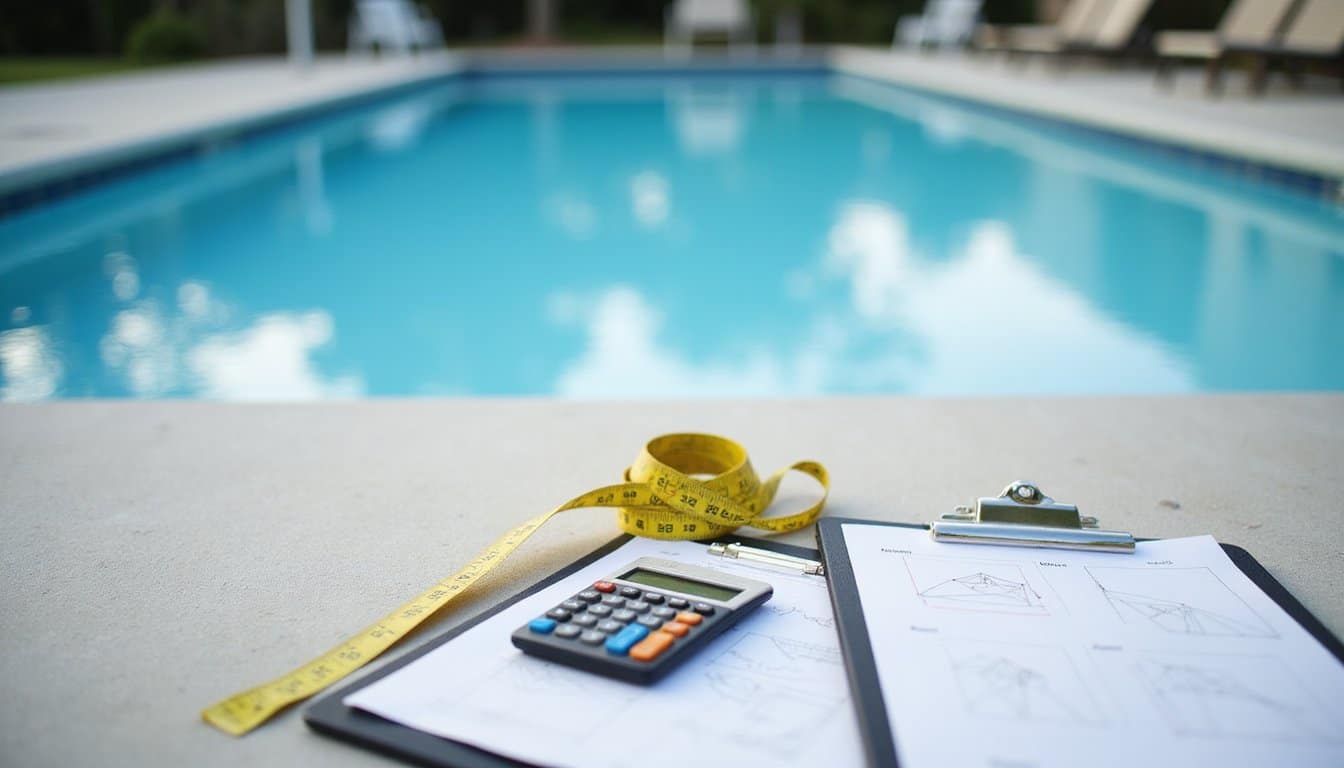
Calculating your pool’s precise dimensions is the foundation of proper pool ownership and maintenance. You’ll need these measurements to ascertain chemical dosing requirements and select the right pump and filter size for your pool.
For rectangular pools, multiply length x width x average depth x 7.48 to find the volume in gallons. If you have a circular pool, use π × (diameter / 2)² × average depth x 7.48. Oval pools require a slightly different approach: (π × length × width × average depth) / 2 × 7.48. Accurate calculations are essential since smart data tools have proven to be the most reliable method for determining pool volume.
Always measure twice using a quality measuring tape to guarantee accuracy. For irregular or kidney-shaped pools, divide the area into simpler geometric shapes first. When dealing with varying depths, you should treat sections separately for more precise volume calculations. Remember to calculate the average depth by measuring both shallow and deep ends, as this considerably impacts your final volume calculation.
Understanding Your Backyard’s Space Limitations
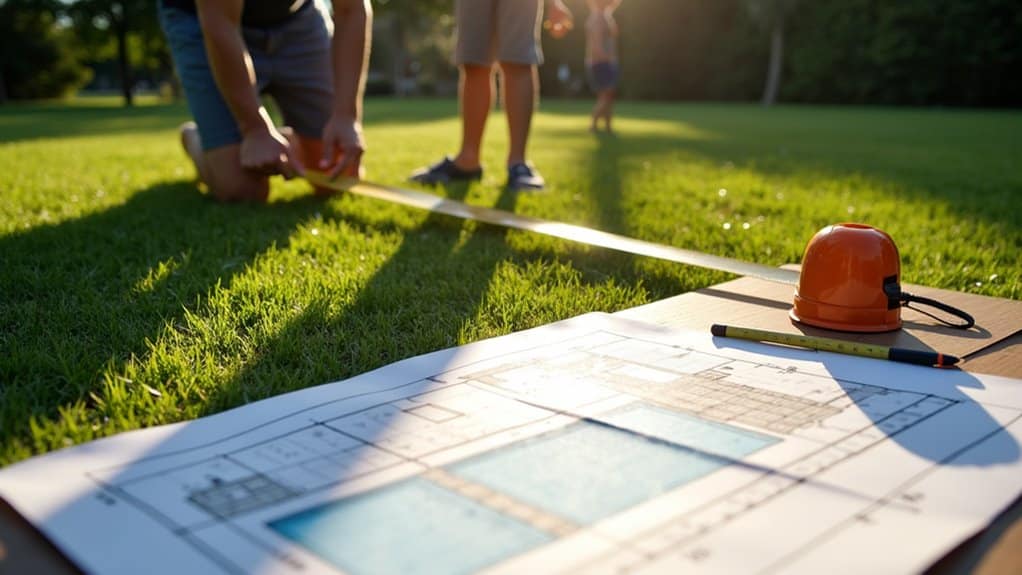
Every successful pool installation begins with a thorough evaluation of your backyard’s spatial constraints. Your pool orientation planning must consider both natural elements and structural limitations while ensuring your backyard terrain integration maintains functionality and aesthetic appeal. Consider incorporating vertical landscaping elements alongside your pool to maximize limited space while adding natural beauty. Custom shapes allow you to create a unique pool design that perfectly fits your available space. Today’s flexible pool designs make it possible to install pools in even the most challenging backyard spaces.
- You’ll need at minimum 1,200 sq ft of usable space, with your pool ideally occupying one-third of your total yard area
- Maintain a 10-foot clearance from property lines, power lines, and existing structures
- Account for mandatory features like fencing, decking, and access pathways
- Consider sun exposure and wind patterns when determining prime pool placement
Before finalizing dimensions, evaluate your yard’s slope, shape irregularities, and existing features. You’ll want to factor in space for entertainment areas, landscaping elements, and safety requirements while ensuring the design complements your property’s natural flow and meets local building codes.
Family Activities and Pool Usage Requirements
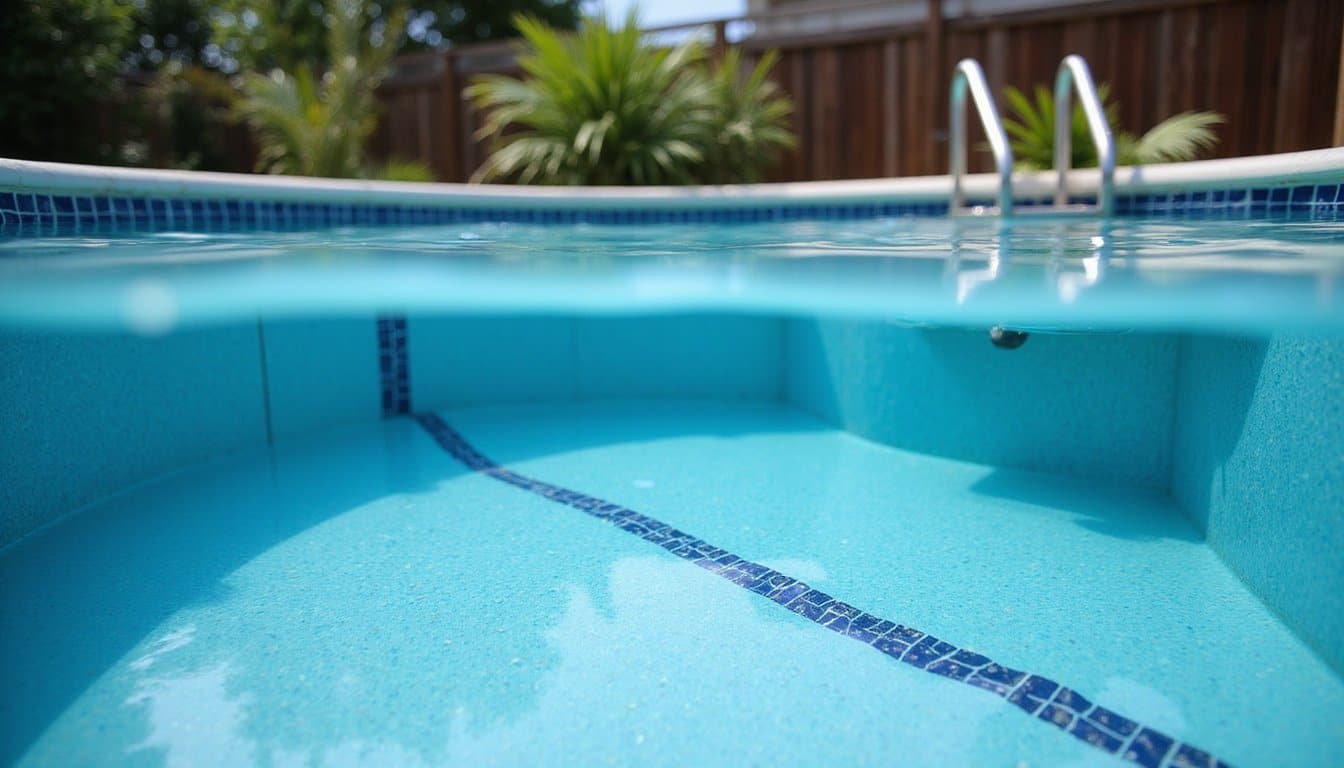
When calculating your ideal pool size, you’ll need to contemplate your family’s primary swimming patterns, whether they’re focused on lap swimming, water games, or casual recreation. The general rule suggests allocating 15-20 square feet of pool surface area per active swimmer to safeguard comfortable movement and prevent overcrowding. With 8% of households in America having swimming pools, there’s plenty of precedent for successful family pool planning. Creating a pool environment that promotes socialization can strengthen community bonds while providing a recreational outlet for your family. You’ll also want to plan distinct activity zones with appropriate depths, typically including a shallow area for children, a recreational middle section, and potentially a deeper end for advanced swimmers or diving boards if local codes permit. Considering the vast majority of pools in the United States are private residential pools, families have significant flexibility in customizing their backyard designs.
Swimming Patterns Matter Most
To determine your ideal pool size, understanding your family’s swimming patterns and activities should be your primary focus. Your generational use patterns and cultural activity preferences will considerably impact the dimensions you’ll need. Consider how different maturity groups in your family will use the pool simultaneously and which features support their specific needs. Similar to how warm climate regions have higher pool ownership rates, your local weather will influence optimal sizing decisions. With 31,006 employees working in the pool industry nationwide, professional guidance for sizing is readily available.
Since drowning risk for toddlers is highest in home pools, proper dimensions that enable close supervision are essential.
Key swimming patterns to evaluate:
- Lap swimming requires at least 25 feet of unobstructed length, while recreational use favors varied depths
- Evening and weekend usage peaks demand larger surface areas for family gatherings
- Multi-generational access needs influence entry points and depth variations
- Cultural preferences and swimming skill levels affect zone requirements and safety features
Factor in your family’s supervision patterns and safety requirements when calculating dimensions, especially if you have children ages 1-4 or elderly family members who’ll use the pool regularly.
Space Per Family Member
Three essential calculations determine your ideal pool dimensions: total users, square footage per person, and activity space requirements.
You’ll need to allocate 15 square feet of pool surface per person as a baseline measurement. For your relative family size, multiply your typical number of swimmers by 15 to determine minimum space needs. If you’re planning for guests, include them in your calculations to avoid overcrowding. For optimal enjoyment, selecting a size based on your pool’s primary purpose will ensure it meets your specific needs.
Your family’s activity level considerations will influence final dimensions. For active families who enjoy pool games, you’ll want to exceed the minimum requirements. A family of four who frequently entertains might need a 16 x 32 ft pool (512 sq ft) rather than a smaller option. Consider life stage too, children need more shallow areas, while teens and adults require additional swimming space. Most pool fun takes place in the shallow end where families interact more comfortably. The 2-to-1 ratio of length to width provides the most versatile and aesthetically pleasing design for most family activities.
Activity Zones and Depth
Pool depth zones serve as the foundation for family-friendly swimming experiences. When planning your pool’s layout, you’ll need to shift between different activity zones that accommodate various water activities while maintaining safety features throughout. Proper changeover points between depths guarantee comfortable movement for swimmers of all skill levels.
Key depth requirements for family activities include:
- Shallow end (3 feet) for children’s play and lounging
- Mid-depth zone (4-5 feet) for water games and casual swimming
- Deep end (7.5-8 feet) for diving activities
- Entry points with steps or ladders for safe access
You’ll want to guarantee each zone meets local safety regulations while supporting your family’s preferred activities. Remember that deeper pools require higher maintenance costs, so balance your desired features with practical considerations when finalizing your design.
Pool Depth Planning and Safety Guidelines
When planning your family pool’s depth specifications, understanding essential safety guidelines guarantees both compliance with regulations and ideal swimming conditions for all users. Your pool excavation guidelines should account for a minimum shallow end depth of 33 inches, while ensuring walls remain vertical for depths up to 42 inches. For deeper sections, maintain vertical walls for at least 5 feet below water level or 3 feet with curved shifts.
Pool enclosure requirements mandate fencing if your pool exceeds 18-24 inches in depth. Install barriers at least 48 inches high, measured from the exterior side. At the shallow-to-deep point of change, which must be at least 6 feet from the shallow end wall, you’ll need to install a 4-inch contrasting floor stripe and safety rope with colored buoys positioned 1 foot in the direction of the shallow side.
Finding the Right Balance: Space vs. Budget
When planning your pool’s dimensions, you’ll need to ponder that costs typically range from $50-200 per square foot, depending on materials and features you select. Your pool’s size directly affects operating expenses through chemical usage, heating requirements, and equipment maintenance, making it vital to balance initial construction costs with long-term ownership expenses. You can optimize value by incorporating space-efficient designs that focus on your primary usage needs, such as choosing an L-shaped pool that accommodates both lap swimming and casual recreation while minimizing square footage.
Cost Per Square Foot
Understanding the cost per square foot of pool construction represents a pivotal initial step in planning your family’s aquatic investment. You’ll find that local construction costs and material price comparison heavily impact your project’s bottom line, with typical ranges spanning $50-$250 per square foot.
Key cost considerations include:
- Vinyl liner pools offer the most economical option at $50-$80 per square foot
- Standard designs without customization average $80-$125 per square foot
- Premium gunite installations can reach $175-$250 per square foot
- Size efficiency improves considerably above 400 square feet
Your material selection drives both initial and long-term costs. While vinyl liner pools provide the lowest entry point at $25,000-$65,000, concrete options offer superior durability despite higher upfront costs of $50,000-$150,000+. Consider how these factors align with your budget and long-term ownership plans.
Size Impacts Operating Expenses
Three critical operating expenses scale directly with your pool’s size: maintenance costs, energy consumption, and chemical requirements. Larger pools demand more chemicals for water balance, increased pump runtime, and extended cleaning efforts, substantially impacting your monthly operating expenses.
Your long-term budget planning should account for how pool dimensions affect utility bills. A larger pool requires more water to maintain proper levels and consumes more electricity through extended pump operation. You’ll need to factor in seasonal variations, as even during lower-usage periods, basic maintenance remains necessary.
To optimize costs, consider implementing energy-efficient equipment like variable-speed pumps and LED lighting. Installing a pool cover can reduce chemical usage and water evaporation, helping you maintain control over size-related expenses while ensuring your pool remains properly maintained.
Maximize Value Through Design
Designing your ideal pool requires careful balance between available space and budget constraints to optimize both functionality and value. Focus on material selection that amplifies long-term returns while fitting your immediate budget. Geometric shapes typically offer the best value per square foot, with lower construction and maintenance costs.
Consider these value-maximizing design elements:
- Multi-level decking to create distinct zones while preserving yard space
- Energy efficiency features like automatic covers and efficient pumps that reduce operating costs
- Corner installations that utilize existing fencing and preserve central yard areas
- Integrated spas or shallow lounges that increase year-round usability
When planning your pool’s footprint, keep in mind that smaller designs often allow for higher-end materials within the same budget while maintaining essential functionality. This approach optimizes both immediate costs and long-term property value.
Calculating Maximum Occupancy and Surface Area
Before selecting your ideal pool dimensions, you’ll need to calculate both the surface area and maximum occupancy to guarantee safe, comfortable swimming for your family. Key pool planning considerations include using the standard 15 square feet per person rule to determine safe capacity. For rectangular pools, multiply length by width; for circular pools, use πr².
| Pool Size (ft) | Surface Area (sq ft) | Max Occupancy |
|---|---|---|
| 12 × 24 | 288 | 19 swimmers |
| 16 × 32 | 512 | 34 swimmers |
| 20 × 40 | 800 | 53 swimmers |
| 8 × 15 | 120 | 8 swimmers |
To maintain guest safety protocols, never exceed these maximum occupancy numbers. Your pool’s surface area should align with your typical gathering size, whether you’re planning for intimate family use or frequent entertaining. Recall that deep areas may require additional space per swimmer for heightened safety.
Zoning Regulations and Property Setbacks
When planning your backyard pool, local zoning regulations and setback requirements must guide your placement decisions. You’ll need to consider both utility placement and environmental factors while adhering to municipal codes that specify minimum distances from property lines and structures.
Key setback requirements you must follow:
- Maintain at least 5 feet from side and rear property lines
- Avoid front yard placement, which typically faces your home’s main entrance
- Keep clear of public utility easements unless you have written approval
- Safeguard proper distance from adjacent structures like garages and sheds
Remember that corner lots have special classifications, with only one side designated as the front yard. Before proceeding with installation, obtain necessary building permits and undergo site plan reviews to verify compliance with local regulations. Violations can result in costly fines or mandatory pool removal.
Frequently Asked Questions
How Does Pool Shape Affect Heating Costs and Efficiency?
Your pool shape directly impacts heating costs and efficiency. Square and rectangular pools offer the most economical heating because they minimize surface area relative to volume. You’ll spend more heating curvilinear shapes like kidney or free-form pools since they typically have larger surface areas where heat loss occurs. If you’re prioritizing heating efficiency, choose rectangular designs; they’ll require smaller heaters and consume less energy to maintain desired temperatures.
Can Existing Trees Near the Pool Area Cause Maintenance Problems?
Yes, existing trees can create significant maintenance challenges for your pool. When roots grow beneath the pool, they’ll damage lining and plumbing systems, potentially causing expensive structural issues. The tree’s canopy blocks sunlight, reducing water temperature and increasing heating costs. You’ll also face ongoing cleanup from fallen leaves, needles, and organic debris that clog filters and affect water chemistry. Consider installing root barriers or removing problematic trees to protect your investment.
What’s the Minimum Distance Between a Pool and Outdoor Kitchen?
You’ll need to maintain a minimum distance of 5 feet between your pool and outdoor kitchen to meet basic pool safety requirements and guarantee comfortable traffic flow. This spacing allows for ideal landscaping design while providing essential clearance for both pool activities and cooking zones. Keep in mind that if you’re installing a grill, you’ll need at least 10 feet of clearance from any combustible materials for fire safety compliance.
How Do Different Pool Finishes Impact the Perceived Size?
Your pool’s finish dramatically affects its perceived size. Light, smooth finishes like white plaster or polished quartz will make your pool appear larger by maximizing light reflection. Pool surface textures also play a pivotal role, rough, busy patterns can make spaces feel smaller, while uniform finishes create unbroken sightlines that amplify spaciousness. Dark finishes increase visual pool depth perception but may reduce the apparent width and length of your pool.
Should Pool Size Change Based on Geographical Climate?
Yes, you’ll want to ponder regional climate factors when determining your pool size. In warmer climates, you might benefit from a larger pool that maintains cooler temperatures and accommodates extended swimming seasons. However, in areas with significant seasonal temperature variations, a smaller pool could be more practical and cost-effective. Your decision should balance climate-driven usage patterns with other factors like available space, maintenance requirements, and local building regulations.