You’ll need $2-5 million for a basic Olympic pool with essential features like 50×25-meter dimensions, timing systems, and reinforced concrete construction. For luxury installations, expect to invest $5-7+ million to add premium elements like smart home integration, infinity edges, and high-efficiency UV/ozone systems. Your annual operating costs will range from $60,000-$125,000, including maintenance and utilities. Understanding material choices and construction methods can profoundly impact your long-term investment outcomes.
Essential Features of Budget Olympic Pools
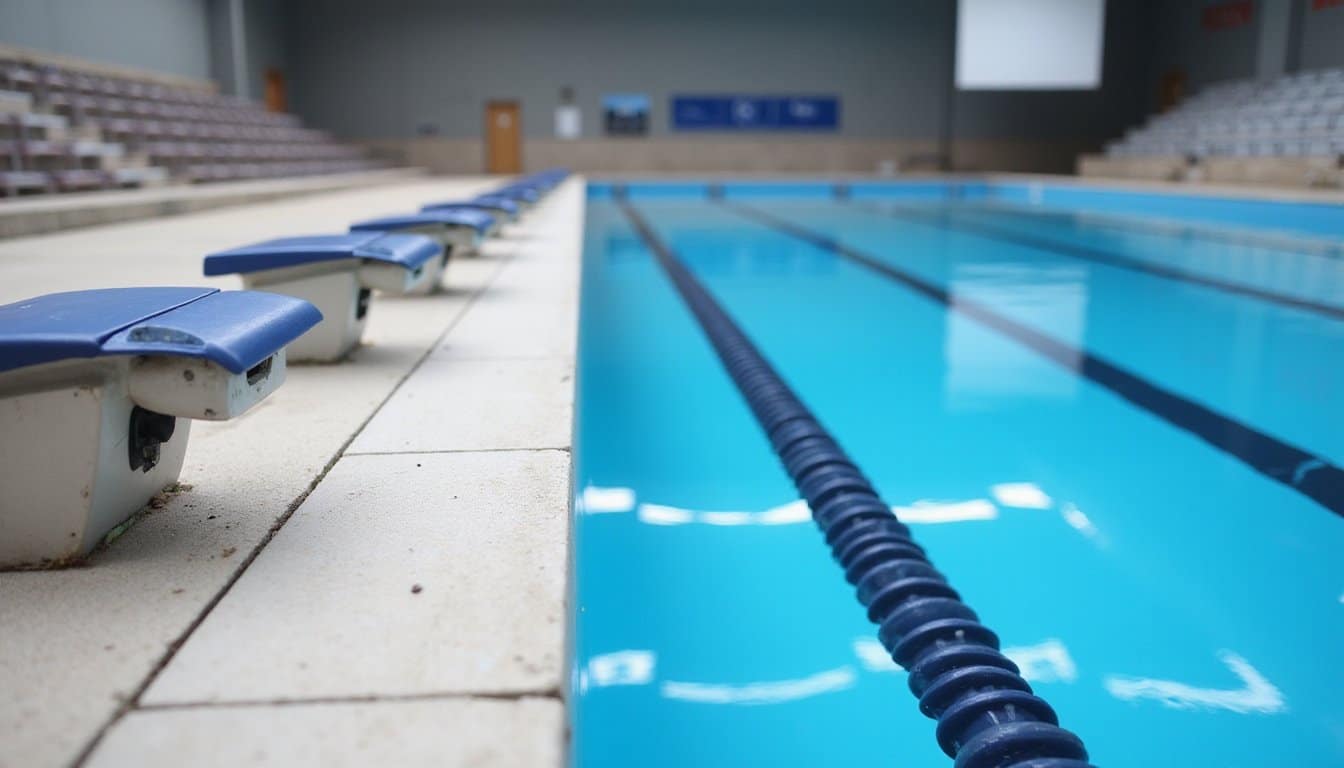
While Olympic swimming pools represent significant investments, budget-conscious facilities can still meet international standards through careful planning of essential features. You’ll need to maintain the mandatory 50×25-meter dimensions with strict tolerances (+0.010, -0.000 meters) and a minimum 2-meter depth. Short-course pools measuring 25 meters are also used in international events, though not Olympic ones. The basic setup includes reinforced concrete construction, standard 2.5-meter lane widths, and essential competition elements like starting blocks and timing systems. With a total capacity of 660,000 gallons, these pools require precise engineering to maintain competitive standards. Many competitive facilities install touch pads at both ends to accommodate accurate electronic timing.
To optimize pool energy efficiency, incorporate basic pool covers and standard heating systems maintaining 77-82°F. The facility security measures focus on non-slip surfaces and basic deck space requirements. Your filtration system must meet health standards, though you can opt for economy-grade waterproofing and tiles. Expect costs between $300,000-$500,000 for core functionality, excluding luxury amenities or advanced climate controls.
Premium Elements in Luxury Pool Installations
When designing luxury Olympic swimming pools, premium elements considerably increase project costs beyond the $1.5-2.5 million range. Smart home integration and sustainable design strategies dominate high-end installations, with automated systems adding $75,000-150,000 to base costs. Custom features like submerged benches and swim-up bars create unique entertainment spaces.
| Premium Feature | Cost Range |
|---|---|
| Smart Automation | $75K-150K |
| LED/Fire Features | $50K-100K |
| Vitality-Enhancing Zones | $100K-200K |
| Glass Mosaic Finish | $200K-400K |
| Sustainable Systems | $150K-300K |
You’ll need to factor in sophisticated water features, including laminar jets and cascading waterfalls, which improve the pool’s aesthetic appeal. The integration of infinity edges creates a stunning visual effect that merges the pool with surrounding landscapes. High-efficiency pumps and UV/ozone sanitization systems reduce operational costs while maintaining water quality. Premium finishes like glass mosaic tiles and natural stone coping create an unmatched luxurious appearance, though they’ll substantially impact your budget. The installation of wave-dampening lane lines and advanced overflow gutters ensures optimal competitive conditions by minimizing water turbulence.
Material Selection Impact on Long-Term Costs
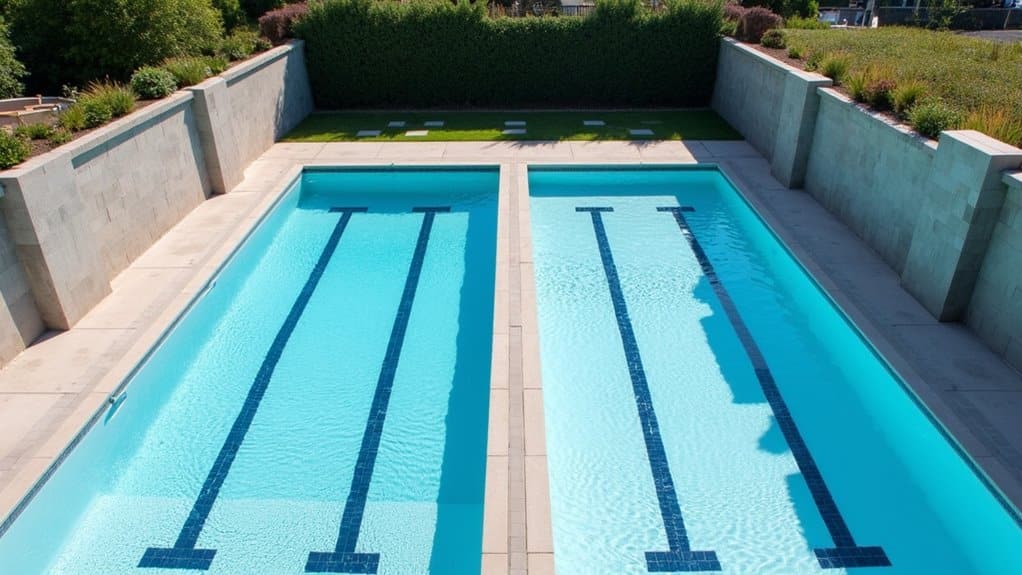
Material selection stands as a major cost determinant in Olympic pool construction, extending far beyond initial installation expenses. While stainless steel commands higher upfront costs, you’ll find its superior durability and minimal maintenance requirements offset the investment over decades of operation, particularly in high-traffic facilities. Proper ceramic tile installation requires extensive planning to ensure lasting durability and optimal competition conditions.
Modern structural resin pools offer an intermediary cost option while delivering excellent durability. You’re looking at significant long-term expense variations between materials. Traditional shotcrete or gunite construction methods offer proven durability for concrete installations. Concrete pools require costly resurfacing every 10-15 years and show vulnerability to environmental impact, while fiberglass offers improved energy efficiency through better temperature retention and reduced chemical usage. Vinyl-lined options, though cheaper initially, accumulate expenses through frequent liner replacements. Consider that stainless steel’s corrosion resistance and longevity beyond 40 years make it increasingly attractive for commercial installations, despite higher initial costs.
Construction Cost Breakdown and Major Expenses
Breaking ground on an Olympic swimming pool entails substantial expenditures across five major cost categories: site preparation, shell construction, equipment systems, facility infrastructure, and finishing elements.
Building an Olympic pool requires significant investment distributed across five essential areas, from initial groundwork to final decorative touches.
Your crew and equipment costs will vary significantly based on site conditions and local labor rates. Building in the Northeast region will increase overall costs by 15-25% compared to other locations. Challenging terrain and soil quality can lead to higher excavation costs. For enhanced security against cyber threats, implementing Cloudflare protection is recommended for facility management systems. Permitting and compliance fees can range from $15,000 to $40,000, impacting your initial budget allocation.
Key cost components you’ll need to ponder:
- Site preparation and excavation: $50,000-$150,000
- Concrete/gunite shell construction: $500,000-$1.5 million
- Essential systems (filtration, heating, timing): $120,000-$330,000
For indoor facilities, you’ll face additional HVAC requirements of $100,000-$350,000, while outdoor venues demand magnified weatherproofing and UV-resistant materials. Your total project cost typically ranges from $2-5 million, depending on specifications and location.
Annual Maintenance and Operating Expenses
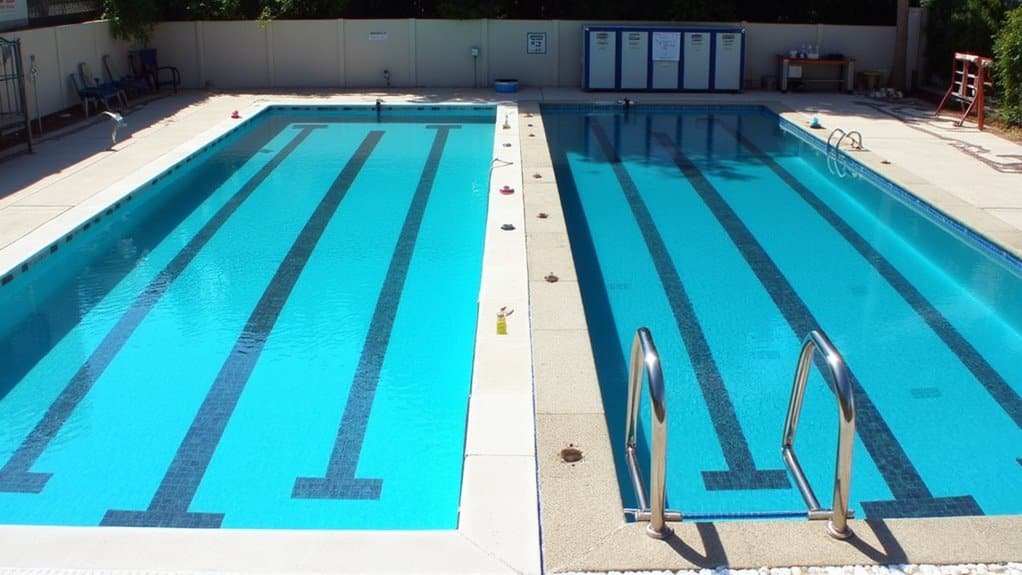
Operating an Olympic swimming pool requires substantial ongoing investment beyond initial construction costs, with annual maintenance expenses typically ranging from $60,000 to $125,000 for professional facilities. You’ll need to budget for extensive maintenance contracts that include daily chemical optimization, equipment monitoring, and professional cleaning services. For online inquiries about maintenance services, note that some provider websites may have security measures in place that restrict certain types of form submissions. Similar to residential concrete pools that need resurfacing every 10-15 years, Olympic pools require periodic resurfacing maintenance to maintain structural integrity.
Energy efficiency becomes vital with large-scale filtration systems and circulation demands, as electricity costs can exceed $5,000 monthly. Chemical expenses for Olympic pools are considerably higher than residential installations, requiring precise balancing and automated monitoring systems. Working with experienced pool professionals can help identify potential issues before they become major expenses. Your annual operating budget should account for water replacement, heating costs in seasonal climates, and periodic equipment repairs. Insurance premiums and regulatory compliance add further to yearly expenditures, while specialized maintenance staff and ongoing training represent additional operational considerations.
Price Comparison Across Different Pool Categories
You’ll find dramatic price variations across pool categories, with basic above-ground installations starting at $1,600 while full Olympic-spec facilities can reach $3 million. The cost differential stems primarily from construction materials, with vinyl and fiberglass options offering budget-friendly solutions at $25,000-$85,000, compared to premium stainless steel and competition-grade concrete installations that command $300-$300 per square foot. Your choice between standard residential, lap pool, or competition-grade installations will considerably impact both initial investment and long-term maintenance costs, which range from $500 annually for basic pools to several thousand for Olympic facilities.
Basic Vs Premium Costs
When evaluating swimming pool investments, the cost differential between basic and premium installations varies dramatically across categories, from simple above-ground setups to competition-grade Olympic facilities. Local market conditions and specialized contractors profoundly influence your final costs, with premium upgrades often doubling baseline prices.
Consider these key price differentials:
- Above-ground pools jump from $1,600-$7,500 basic to $8,000-$12,000 for luxury kits
- Vinyl in-ground installations escalate from $25,000-$65,000 to $70,000-$95,000 with custom shapes
- Olympic facilities surge from $1.5M-$3M basic to $7M-$7.75M for premium municipal builds
Premium features like infinity edges, high-end finishes, and automated systems can add $5,000-$50,000+ to your base cost. Competition-grade amenities, including movable bulkheads and stadium seating, represent the highest tier of investment across all categories.
Maintenance Cost Breakdown
The vast majority of pool owners underestimate their total maintenance expenditure by 30-40%, with costs varying considerably across different pool categories. When following contractor recommendations for maintenance schedules, you’ll need to account for both routine and specialized care.
| Service Type | Olympic Pool | Standard Pool |
|---|---|---|
| Monthly Service | $350-600 | $80-150 |
| Opening/Closing | $2,000+ | $350-650 |
| Annual Repairs | $1,000-5,000 | $150-800 |
| Chemical Systems | $400+ monthly | $50-120 monthly |
You’ll find Olympic pools require substantially higher maintenance investments compared to standard residential pools. Their sophisticated filtration systems, extensive water volume, and specialized equipment demand more frequent servicing and professional expertise. Your annual maintenance budget should account for utilities ($6,000+), chemical treatments, and potential emergency repairs to meet competition-grade standards.
Frequently Asked Questions
How Long Does It Typically Take to Build an Olympic-Sized Pool?
You’ll need to plan for 6-12 months to build a traditional concrete Olympic-sized pool, though pool construction timeline varies based on your chosen method. If you’re using fast-track modular systems, you can reduce this to 2-6 weeks. Your pool infrastructure requirements, including permitting, site preparation, and mechanical systems, will greatly impact the schedule. Weather conditions and local regulations can extend these timeframes, so factor these into your project planning.
Can Olympic Pools Be Converted for Other Sports or Recreational Activities?
Yes, you’ll find Olympic pools are highly adaptable for multiple uses. With modular design elements, you can convert these facilities for water polo, artistic swimming, or diving competitions. You can also transform them to host aquatic exercise programs and community recreational events. Through adjustable floor systems and removable bulkheads, you’re able to modify water depths and pool configurations. Post-competition, you’ll often see these venues serving as public recreation centers or multi-purpose aquatic facilities.
What Certifications Are Required for Hosting International Swimming Competitions?
You’ll need World Aquatics (formerly FINA) certification as the primary governing body regulation for hosting international events. The pool accreditation process requires verified compliance with technical specifications, including precise measurements for pool dimensions, water quality standards, and timing systems. You must also secure facility insurance, implement anti-doping protocols, and guarantee all technical officials hold valid certifications. Local authority safety codes and emergency action plans are mandatory requirements.
How Often Do Olympic Pools Need to Be Completely Drained?
You’ll need to completely drain your Olympic pool every 3-7 years with proper water treatment. Your pool maintenance schedule can extend to the full 7 years if you’re diligent with chemical balancing and filtration. However, if you’re operating in areas with hard water, you’ll need to drain more frequently, typically every 3-5 years. Monitor your Total Dissolved Solids (TDS) levels; once they exceed 2,500 ppm, it’s time for a complete drain.
What Environmental Impact Considerations Affect Olympic Pool Construction and Operation?
You’ll need to address several key environmental impacts when building and operating Olympic pools. Energy efficiency requirements drive decisions about heating systems, filtration equipment, and climate control technologies. You must implement water conservation strategies through advanced hydraulics and precision monitoring systems. You’ll also need to ponder using sustainable materials like timber, incorporating modular designs for future reuse, and meeting strict IOC carbon reduction guidelines throughout construction and operation.