PPM stabilizer measures the concentration of cyanuric acid (CYA) in your pool water, expressed as parts per million. This metric tells you how many CYA molecules exist relative to one million water molecules. You’ll want to maintain 30-50 PPM for standard pools or 60-80 PPM for saltwater systems. CYA acts as sunscreen for your chlorine, preventing UV rays from destroying up to 90% of your sanitizer within hours. Understanding the factors that affect these levels helps you maintain ideal protection.
What Is Pool Stabilizer PPM?
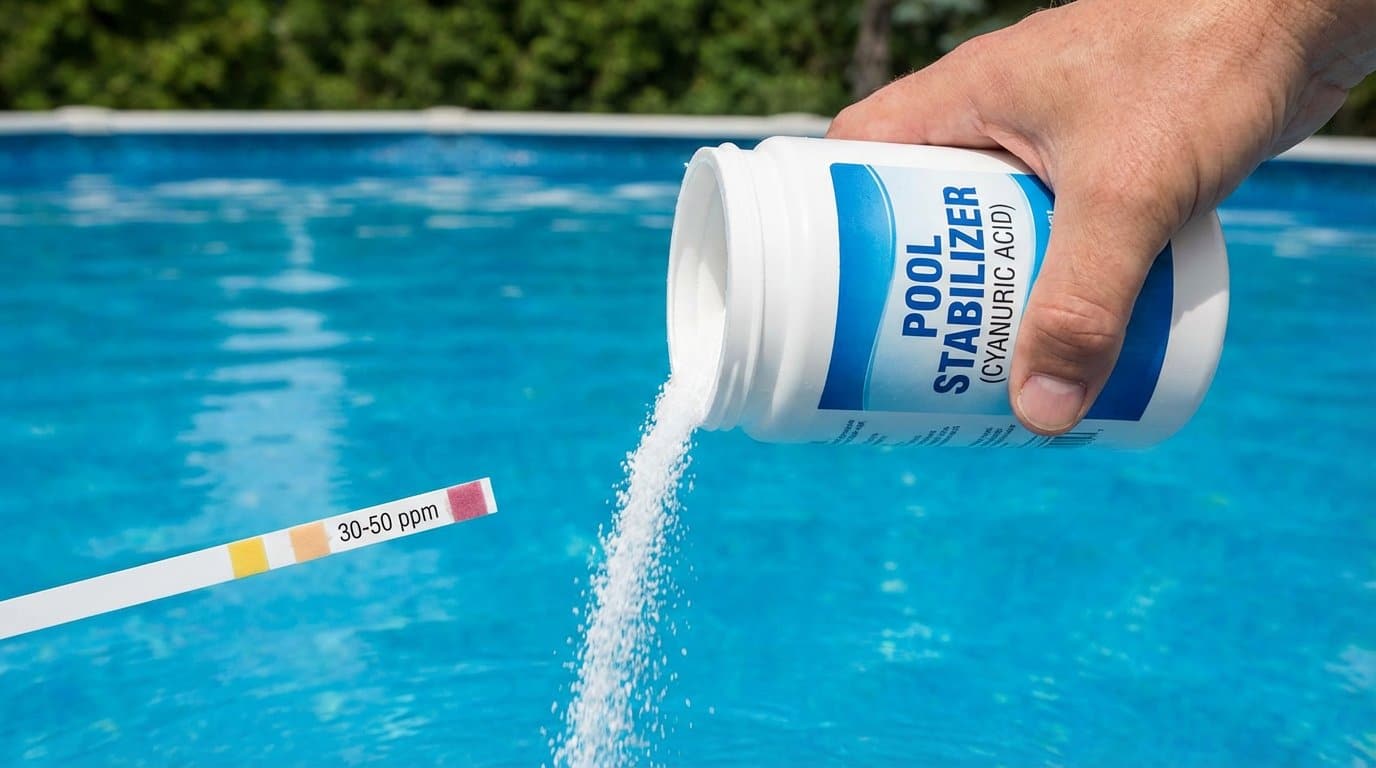
Pool stabilizer PPM measures the concentration of cyanuric acid (CYA) in your pool water, expressed in parts per million. This ppm stabilizer definition quantifies exactly how many CYA molecules exist relative to one million water molecules. You’ll find this measurement essential for evaluating chlorine protection levels. Pool stabilizer PPM indicates the concentration of cyanuric acid (CYA) in water, expressed in parts per million, precisely defining how many CYA molecules are present per one million parts of water. This measurement is critical when assessing chlorine protection efficiency, as pool conditioner cyanuric acid levels directly influence how effectively free chlorine is shielded from UV degradation and maintained within its optimal sanitizing range.
As a ppm water quality indicator, stabilizer concentration directly affects your chlorine’s performance and longevity. CYA acts as sunscreen for chlorine, shielding it from UV degradation. Without adequate stabilizer, you’ll lose up to 90% of your chlorine within hours of sun exposure. Insufficient stabilizer allows UV rays to quickly destroy your chlorine, leaving your pool vulnerable to bacteria and algae growth.
You can monitor stabilizer PPM using test strips or liquid test kits. This metric helps you balance chlorine effectiveness against potential over-stabilization, which can lock up chlorine and reduce its sanitizing power. Unlike chlorine, cyanuric acid is bio-accumulative and does not evaporate, meaning it continuously builds up in your pool water over time. The recommended CYA range for traditionally chlorinated pools is 30-50 ppm, while salt chlorinated pools require slightly higher levels.
The Ideal Stabilizer PPM Range for Your Pool
Two primary PPM ranges dominate professional recommendations for cyanuric acid levels: 30-50 PPM and 60-80 PPM. Your ideal stabilizer ppm range depends on your specific pool configuration and sanitization system.
| Pool Type | Recommended PPM Range |
|---|---|
| Standard Outdoor Pools | 30-50 PPM or 60-80 PPM |
| Saltwater Pools | 60-80 PPM (optimal: 80 PPM) |
| Indoor/Covered Pools | 0-15 PPM |
Salt pools perform best at 80 PPM, while Total Control systems require reduced levels of 30-50 PPM. Indoor pools need minimal stabilizer, approximately 15 PPM protects against metal corrosion without excess buildup.
You should test quarterly using reliable test kits or a ppm sensor pool monitoring system. Maintaining proper levels prevents chlorine degradation while preserving sanitization effectiveness.
How Stabilizer PPM Protects Chlorine From UV Rays
Without stabilizer protection, UV rays can destroy up to 90% of your pool’s free chlorine within two hours of direct sunlight exposure. Cyanuric acid forms chemical bonds with chlorine molecules, creating a protective shield that blocks solar radiation from breaking apart chlorite ions. This molecular barrier extends your sanitizer’s effective lifespan three to five times longer than unprotected chlorine, reducing both chemical waste and maintenance frequency.
UV Ray Chlorine Destruction
Functioning as a powerful oxidizer, ultraviolet radiation from sunlight rapidly destroys free chlorine molecules in unprotected pool water. The uv ray impact causes chlorine to break apart and release as gas into the atmosphere rather than remaining dissolved for sanitization. On bright days, you’ll lose up to 90% of your free chlorine within two hours of direct sunlight exposure.
Without adequate cyanuric acid protection, approximately one-third of your pool’s free chlorine degrades every hour under UV exposure. This accelerated breakdown, known as chlorine burn, forces constant chemical additions to maintain safe levels.
Proper stabilizer concentration delivers significant chlorine longevity extension, enabling your sanitizer to last three to five times longer than unstabilized chlorine. You’ll maintain effective disinfection levels even during peak sunlight hours.
Protective Shield Formation
Everything in your pool’s stabilizer system relies on a fundamental chemical interaction between cyanuric acid and free chlorine molecules. When you maintain proper ppm stabilizer levels, CYA binds loosely with hypochlorous acid, creating compounds resistant to UV degradation. This shield formation process fundamentally acts as sunscreen for your chlorine, blocking sunlight’s destructive effects.
The protective bond envelops chlorine ions, stabilizing them against photodegradation while preserving their sanitizing capability. Your stabilized chlorine becomes impervious to UV rays that would otherwise cause rapid dissociation and evaporation. This chemical shield makes chlorine last three to five times longer under direct sunlight exposure compared to unstabilized forms.
The bond remains intact until chlorine gets consumed through oxidation or disinfection processes, ensuring consistent sanitation throughout your pool’s water column.
Extending Sanitizer Lifespan
Proper stabilizer levels between 30-50 ppm can reduce your chlorine consumption by up to 80%, transforming how efficiently your pool maintains sanitation. This chlorine lifespan extension occurs because cyanuric acid binds directly to chlorite ions, shielding them from ultraviolet degradation.
The UV protection mechanism works by chemically holding free chlorine molecules, slowing their oxidation rates considerably. Without this protective bond, direct sunlight breaks apart chlorite ions within hours, leaving your pool vulnerable to contamination. Stabilized chlorine remains active for sanitization three to five times longer than unprotected chlorine.
You’ll notice immediate benefits in reduced dosing frequency and enhanced chemical efficiency. Your chlorine stays effective longer, maintaining consistent sanitation levels throughout the day. This targeted protection eliminates wasteful chlorine loss while preserving your pool’s antimicrobial capacity.
How to Test Pool Stabilizer PPM Levels
Three primary testing methods exist for measuring cyanuric acid levels in pool water: test strips, liquid reagent kits, and digital testers. Test strips stabilizer readings provide quick ballpark estimates but lack precision for critical adjustments. A liquid test kit CYA measurement delivers superior accuracy, with Taylor and LaMotte brands representing reliable options for home use.
To obtain accurate results, collect your sample elbow-deep, away from jets and skimmers. Fill the test vial to the designated mark, add reagent, then gently invert several times. Wait three to five minutes before reading, rushing produces false lows.
For black dot method kits, drain the cloudy liquid until the dot disappears, then read the ppm level on the vial’s scale under consistent natural lighting.
What Happens When Stabilizer PPM Drops Too Low?
Once your test results confirm low stabilizer readings, understanding the consequences becomes the next logical step. When your pool stabilizer level falls below ideal range, UV rays rapidly degrade chlorine, often within hours of sunlight exposure. Your salt chlorine generator strains to compensate, shortening cell lifespan while failing to maintain adequate sanitization. Once test results confirm low stabilizer readings, it’s important to recognize that insufficient CYA allows UV radiation to destroy free chlorine within hours of sunlight exposure, leaving water under-sanitized. This imbalance forces your salt chlorine generator to overwork in an attempt to maintain residual levels, accelerating cell wear and reducing overall system efficiency. In this situation, many owners ask do i add chlorine or stabilizer first, but correcting low stabilizer is typically the priority to ensure newly added chlorine remains protected and effective.
Low CYA creates conditions where algae blooms thrive and bacterial growth accelerates. You’ll notice increased chemical costs as chlorine dissipates faster than production rates allow. Filter cleaning frequency rises, and overall maintenance demands multiply.
Following proper CYA measurement procedures helps you catch declining levels early. Splash out, heavy rain, and partial draining commonly reduce stabilizer concentrations. Without intervention, your pool becomes vulnerable to contaminants, potentially triggering health department concerns from chemistry that mimics poor maintenance practices.
What Happens When Stabilizer PPM Climbs Too High?
When your stabilizer PPM climbs too high, chlorine bonds so tightly with excess cyanuric acid that it can’t effectively kill bacteria and algae. You’ll notice your pool water turning cloudy or hazy even though test strips show adequate chlorine levels, a telltale sign of overstabilization. This chlorine lock effect typically begins when CYA exceeds 70 ppm and becomes severe above 100 ppm, functionally rendering your sanitizer useless. When stabilizer PPM rises excessively, chlorine binds so strongly with surplus cyanuric acid that its ability to eliminate bacteria and algae declines sharply, even if test readings indicate adequate total chlorine. This is the core issue behind high stabilizer in pool water, where cloudy or hazy conditions develop despite “normal” sanitizer levels, a classic sign of overstabilization. The chlorine lock effect often begins above 70 ppm CYA and becomes severe past 100 ppm, significantly reducing active hypochlorous acid and compromising effective disinfection.
Chlorine Loses Sanitizing Power
Although your chlorine test readings might appear normal, heightened stabilizer levels can silently undermine your pool’s sanitizing power. When ppm stabilizer exceeds 200 mg/L, cyanuric acid binds excessively to free chlorine, creating chlorine lock. This phenomenon traps chlorine in an inactive state, rendering it ineffective against pathogens despite adequate test results.
The consequences of raised CYA concentrations manifest in three critical ways:
- Reduced kill rates, Bacteria elimination slows dramatically when CYA surpasses 70 ppm, extending pathogen survival time.
- Lowered ORP readings, Oxidation-reduction potential drops, indicating diminished sanitizing capability.
- Compromised water safety, Cryptosporidium, viruses, and bacteria persist longer, elevating health risks.
You must maintain free chlorine at 7.5% of your CYA level for effective sanitation. At 40 ppm CYA, you need 3 ppm free chlorine minimum.
Water Becomes Cloudy
Beyond compromised sanitation, heightened stabilizer levels produce visible water quality problems you can’t ignore. When high CYA concentrations exceed 100 ppm, chlorine binds too tightly to the stabilizer molecule, preventing proper oxidation of suspended particles. Your water develops a persistent cloud or haze that won’t clear despite balanced pH and alkalinity readings.
This murkiness occurs because ineffective sanitation allows organic contaminants to accumulate. High CYA vastly traps your chlorine, rendering it unable to break down the microscopic debris causing turbidity. You’ll notice the water remains cloudy even after shock treatments or chemical additions.
In sunny climates, levels above 100 ppm exacerbate this cloudiness considerably. One documented case required 40% water dilution to restore clarity when CYA reached 120 ppm, demonstrating how vastly raised stabilizer compromises visible water quality.
How to Raise Low Stabilizer PPM Safely
Raising low stabilizer ppm requires a methodical approach that balances accurate dosing with safe handling practices. Before making stabilizer adjustment decisions, you’ll need to test your current cyanuric acid levels and calculate your pool’s volume to determine precise dosage requirements.
Follow these steps for safe application:
- Dissolve 13 ounces of granular stabilizer per 10,000 gallons in a 5-gallon bucket of pool water to raise levels by 10 ppm.
- Pour the dissolved solution into your skimmer while the pump circulates for several hours.
- Retest after 24 hours, accounting for dilution effects on ppm from recent water additions.
Always wear protective goggles and acid-resistant gloves when handling cyanuric acid, as it’s corrosive and can damage vinyl liners.
How to Lower High Stabilizer PPM
When stabilizer ppm climbs too high, chlorine’s sanitizing power decreases markedly, leaving your pool vulnerable to algae and bacteria despite adequate chlorine readings.
Dilution Method
Partial draining remains the most economical approach. Drain approximately 3 feet using a pool cover pump, then refill with fresh water. This dilutes your cyanuric acid ppm measurement proportionally. Retest and repeat if necessary.
Chemical Reduction
Aluminum sulfate (alum) can reduce CYA by up to 50%. Maintain pH between 5.8-8.0 for ideal results, you’ll need double the dosage at pH 8.0. Avoid this method in saltwater pools or those with colored plaster.
Reverse Osmosis Filtration
RO systems filter water through semi-permeable membranes, effectively lowering CYA alongside calcium hardness. Reference stabilizer chart values to confirm levels below 40 ppm before resuming stabilized chlorine products.
How Chlorine Type Affects Your Stabilizer PPM
How substantially does your chlorine choice impact stabilizer ppm? Your selection between stabilized chlorine types and unstabilized alternatives directly determines CYA accumulation rates in your pool water.
Every chlorine product you add shapes your pool’s stabilizer levels, choose wisely to maintain optimal water balance.
Stabilized chlorine types contain cyanuric acid that releases during dissolution. Trichlor contributes approximately 0.6 ppm CYA for every 1 ppm of chlorine added. This ratio causes gradual ppm stabilizer elevation with repeated applications.
Consider these critical distinctions:
- Trichlor tablets deposit 55% CYA by weight, accelerating stabilizer buildup in outdoor pools.
- Dichlor granules add CYA alongside chlorine, creating accumulation risks during high-use periods.
- Unstabilized options (liquid chlorine, cal hypo) contribute zero CYA, maintaining existing ppm stabilizer levels.
For precise chemistry control, combine unstabilized shock treatments with stabilized maintenance chlorine. This strategy prevents chlorine lock while preserving UV protection.
Frequently Asked Questions
Does Pool Stabilizer Expire or Lose Effectiveness When Stored Long-Term?
Pool stabilizer doesn’t expire or lose effectiveness when you store it properly. Cyanuric acid maintains its chemical potency indefinitely, unlike liquid chlorine that degrades over time. You’ll want to keep it in airtight containers at 50-85°F, away from moisture and direct sunlight. If moisture causes clumping, your stabilizer remains chemically effective, you’ll just need to pre-dissolve it. Only discard stabilizer if you notice contamination, unusual odors, or color changes.
Can I Swim Immediately After Adding Stabilizer to My Pool?
You should wait 20 to 30 minutes before swimming after adding stabilizer to your pool. Run your pump and filter during this period to circulate the product evenly throughout the water. Unlike chlorine shock, which requires 8 to 24 hours, stabilizer dissolves slowly and doesn’t create dangerous concentrated hotspots. Test your water after the waiting period to confirm pH and chlorine levels remain balanced before entering.
Does Rain or Heavy Weather Affect My Pool’s Stabilizer PPM Levels?
Yes, rain and heavy weather directly affect your pool’s stabilizer ppm levels. Heavy rainfall dilutes cyanuric acid concentrations, potentially dropping them 5-10 ppm daily and pushing levels below the ideal 20-50 ppm range. Rain also introduces contaminants like bacteria, algae spores, and debris that increase chlorine demand, compounding the problem. You’ll want to test your stabilizer levels after storms clear and adjust accordingly to restore proper chemical balance.
How Often Should I Replace My Stabilizer Test Strips for Accurate Readings?
Replace your stabilizer test strips at the start of each pool season to confirm accurate readings. You’ll find that expired strips lose reagent effectiveness, producing unreliable color development. Check expiration dates before each testing session and discard any strips that’ve been exposed to sunlight or moisture. Store them sealed in their original packaging in a cool, dry location. Don’t use strips showing faded or stained components, as they’ll compromise your CYA measurements.
Will High Stabilizer Levels Damage My Pool Equipment or Liner?
High stabilizer levels won’t directly damage your pool equipment or liner. CYA itself isn’t corrosive to pumps, heaters, or surfaces. However, you’ll face indirect risks, chlorine lock reduces sanitation, potentially causing pH imbalances that trigger scaling on equipment. If your water chemistry skews aggressive from these imbalances, you may see metal fitting corrosion or liner dissolution from low calcium hardness. Monitor your overall chemistry, not just CYA, to protect your investment.