To maintain your pool year-round, you’ll need seven essential supply categories: reliable water testing equipment with digital meters, an exhaustive chemical maintenance kit, multi-season cleaning tools including brushes and nets, advanced filtration components, weather-specific pool covers, emergency repair parts, and seasonal safety gear. When properly selected and maintained, these supplies work together to guarantee pristine water quality and equipment longevity. Understanding each category’s specific role will help you maximize your pool’s performance throughout every season.
Essential Water Testing Equipment for Every Season
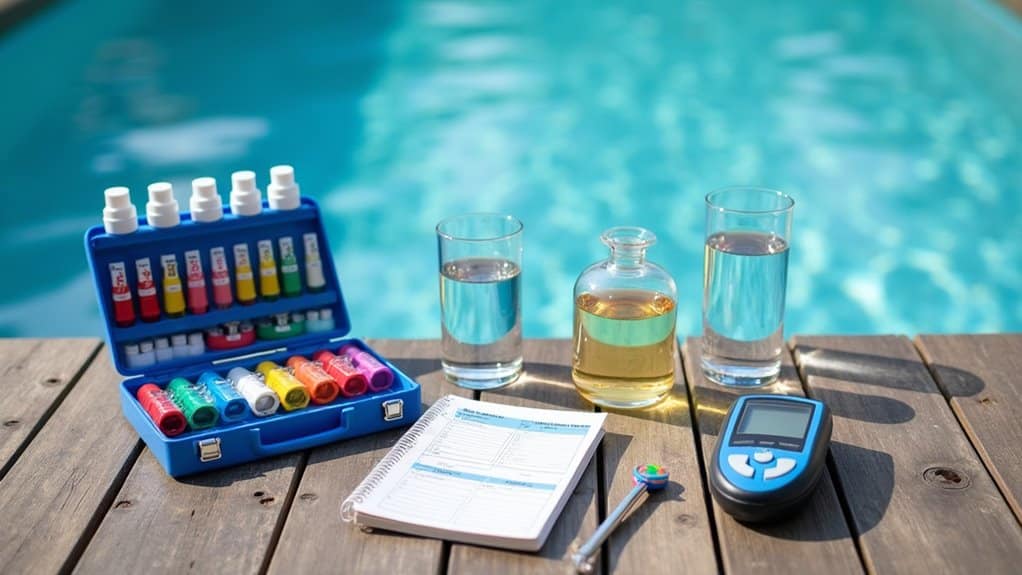
While maintaining proper pool chemistry requires year-round vigilance, you’ll need reliable water testing equipment to monitor and adjust chemical levels throughout every season. Your options range from basic test strips to advanced photometric systems for thorough water analysis techniques. Regular testing helps you respond to changes in weather, usage patterns, and shifting chemical demands before serious problems develop. Testing should be performed at least weekly to ensure proper maintenance of your pool water. Professional-grade test kits provide access to 39 unique products for comprehensive water analysis.
For quick daily checks, use AquaChek 4-Way or 7-Way strips to measure essential parameters like chlorine, pH, and alkalinity. When you need more precise readings, opt for liquid test kits with reagent drops or investigate digital test kit functionality through devices like the Solaxx SafeDip. These digital testers eliminate color interpretation guesswork and store your testing history.
For laboratory-grade accuracy, consider photometric testing systems that measure light transmission through water samples, providing exact readings for everything from chlorine levels to total dissolved solids.
Year-Round Chemical Maintenance Kit
Your year-round chemical maintenance kit requires a thorough set of testing tools, including a digital pH meter, ORP tester, and accurate test strips to monitor sanitizer levels and water balance parameters. You’ll need dedicated storage solutions with proper ventilation and temperature control to safely house your pool chemicals, keeping oxidizers separate from acids and ensuring all containers remain tightly sealed. Maintaining water balance helps prevent costly repairs and extends your pool’s lifespan through proper chemical balance. Maintaining an organized chemical storage system helps you track inventory levels and expiration dates while ensuring quick access to essential treatment products when needed. Using reliable test strips like the 4-in-1 test strips included in starter kits allows for convenient monitoring of your pool’s chemical levels throughout the seasons. Weekly testing of alkalinity levels between 80-120 ppm ensures your pool maintains stable pH levels throughout all seasons.
Essential Testing Tools Needed
Maintaining proper water chemistry requires a detailed testing kit equipped with essential tools for year-round pool maintenance. Your customized testing regimens should include both test strips for quick checks and liquid drop kits for precise measurements. Testing strips provide 15 second results when dipped in pool water for rapid assessment of chemical levels. While professional testing and analysis services are valuable, having reliable tools at home guarantees consistent water quality. A comprehensive 6-way test kit can help you monitor all crucial chemical parameters including chlorine, bromine, pH, alkalinity, hardness, and cyanuric acid levels.
Essential components for your testing arsenal:
- DPD reagents for accurate free and total chlorine measurements, preferably using FAS-DPD methodology for heightened precision
- Digital testing device for eliminating color-matching guesswork and providing thorough chemical profiles
- pH and alkalinity testing solutions, including phenol red indicators and specific reagents for maintaining proper water balance
Store your testing supplies in a cool, dark place and replace reagents annually to maintain accuracy. Remember to collect water samples 18 inches below the surface for the most representative results.
Balancing Chemical Storage Solutions
A well-organized chemical storage system forms the foundation of effective pool maintenance. To achieve optimal chemical storage, you’ll need a cool, dry, and well-ventilated space equipped with wall-mounted or lockable cabinets. Store your chemicals in sealed, clearly labeled containers, keeping incompatible substances separated to prevent hazardous reactions.
When complying with regulations, guarantee your maintenance kit includes EPA-approved chemicals and follows local ordinances. Your year-round kit should contain chlorine tablets, pH adjusters, alkalinity controllers, and stabilizers, all properly measured for your pool’s size. Keep these chemicals in their original containers and regularly inspect for expiration dates. Store algaecides and shock treatments separately from acid-based products, and maintain proper ventilation to prevent fume accumulation. Regular inventory checks will help you maintain safety and chemical efficacy.
Multi-Season Pool Cleaning Tools
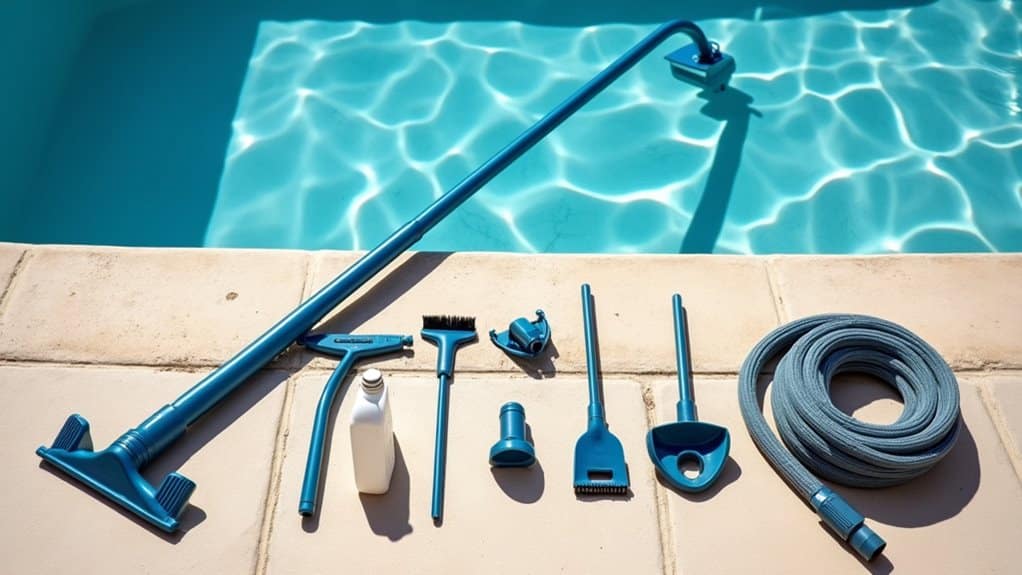
Your pool’s year-round maintenance relies on a combination of basic manual tools, including a quality brush with surface-appropriate bristles and a reinforced leaf rake for efficient debris removal. Having proper tools is essential since performance monitoring, like what Cloudflare provides for websites, helps identify potential maintenance issues early. Stainless steel brushes are ideal for concrete pools while softer nylon options work best for vinyl surfaces. You’ll optimize cleaning efficiency by supplementing these essentials with an automatic or robotic cleaner that provides consistent coverage and reduces manual labor throughout peak swimming seasons. When shifting to winter, you’ll need heavy-duty equipment like extended telescopic poles and specialized vacuum heads to maintain proper cleanliness during the off-season and prepare for spring reopening.
Essential Brush and Net
Pool brushes and nets serve as indispensable tools for year-round maintenance, functioning as the primary defense against debris accumulation and surface contamination. You’ll need durable brush handles and practical net designs that match your pool’s specific surface requirements. Choose nylon brushes for vinyl pools and stainless steel for concrete surfaces to guarantee effective cleaning without damage. A telescopic pole attachment enables efficient cleaning of hard-to-reach areas while reducing strain. Regular use of these essential cleaning tools helps maintain a hygienic and inviting swimming environment.
- Brush your pool’s surfaces weekly at minimum, increasing frequency during high-use summer months or after storms
- Use fine-mesh nets daily to remove floating debris before it sinks and causes filtration issues
- Maintain your tools by inspecting them regularly, rinsing after use, and storing them properly to prevent degradation
For maximum efficiency, select quick-attach mechanisms and ergonomic grips that’ll make your maintenance routine more manageable and effective throughout all seasons.
Automatic Cleaning Systems
While manual pool maintenance demands significant time and effort, automatic cleaning systems revolutionize the process by offering efficient, hands-free solutions for year-round upkeep. You’ll find three main types: suction-side cleaners for budget-conscious owners, pressure-side units ideal for leaf-heavy environments, and innovative robotic technologies featuring user-friendly programming capabilities for ideal coverage.
These systems deliver substantial benefits beyond time savings. You’ll reduce chemical usage and energy costs, as robotic cleaners operate independently at just pennies per hour. They’ll improve your water quality through enhanced circulation and superior filtration of fine particles. For the best results, choose based on your pool type; suction-side cleaners work well for above-ground pools, while in-ground pools benefit most from pressure-side or robotic options, especially for larger surfaces requiring thorough cleaning.
Winter-Ready Maintenance Equipment
Three essential categories of winter-ready equipment guarantee thorough pool protection during colder months: preventative tools, maintenance devices, and chemical management systems. Your winter arsenal should include freeze prevention devices like automatic pump activators and smart control systems that alert you to potential issues.
- Install water drainage solutions, including cover pumps and winter blowers, to prevent damage from water accumulation
- Deploy specialized equipment covers and skimmer plates to protect critical components from harsh weather
- Maintain chemical balance with winterizing products like algaecides and pool antifreeze
You’ll need winter plugs and blowers to clear plumbing lines, while water tubes and leaf nets help manage debris on pool covers. Document your winterization process with photos, and keep smart control systems active for real-time monitoring of your pool’s condition throughout the cold season.
Advanced Filtration System Components
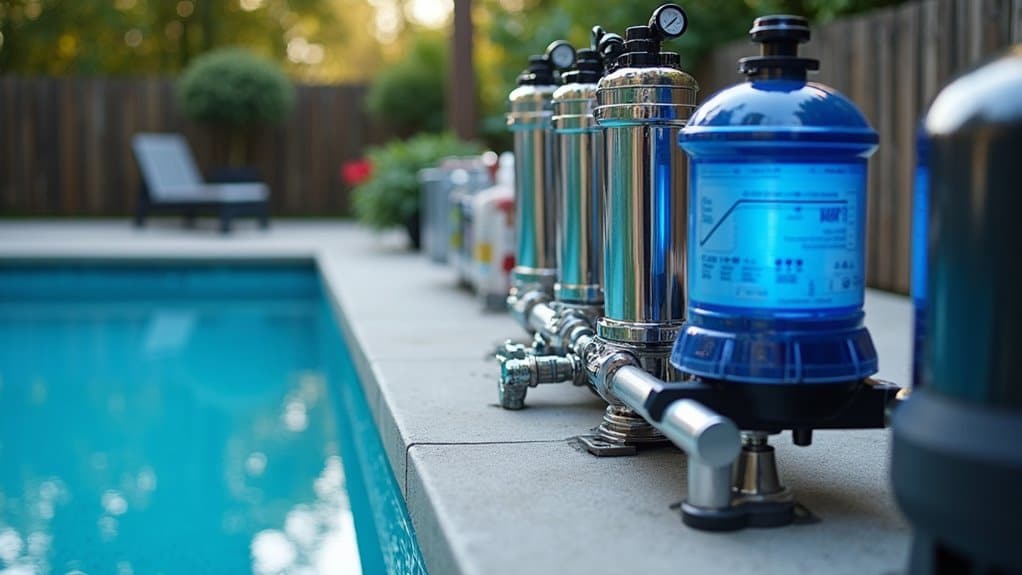
Modern pool filtration systems rely on several sophisticated components working in harmony to maintain crystal-clear water. Your filter media upgrades can dramatically improve performance, with zeolite capturing particles down to 2-5 microns and offering 90% better efficiency than traditional sand. Consider regenerative media system benefits for commercial or high-end applications, as they maximize filtration while minimizing waste.
Your system’s effectiveness depends on properly sized pumps matched to pool volume, efficient skimmers that reduce the main filter’s workload, and strategically placed return jets for ideal circulation. Monitor your pressure gauge regularly; it’s your early warning system for maintenance needs. The multiport valve lets you quickly switch between operational modes, ensuring your filtration system maintains peak performance throughout the swimming season.
Weather-Specific Pool Cover Solutions
Since weather conditions greatly impact pool maintenance, recalling that the right cover solution becomes essential for safeguarding your investment. Comprehending your climate’s demands will assist you in selecting between solid, mesh, hybrid, or automatic covers, each offering unique protective features for your specific situation.
- Solid covers block 100% sunlight and provide maximum safety, but you’ll need a pool cover pump for water removal
- Mesh covers offer excellent drainage and easier pool cover storage solutions, perfect for areas with frequent rainfall
- Automatic covers provide instant protection with the push of a button, ideal for regions with unpredictable weather
Your cover installation timeline should align with local temperatures; northern regions should install in early October, while southern areas can wait until early November. Recollecting that in-ground pools require larger overlap compared to above-ground installations for proper protection.
Emergency Repair and Replacement Parts
Maintaining a well-stocked inventory of emergency repair parts proves essential for addressing unexpected pool system failures. You’ll need essential plumbing components like PVC pipes, fittings, and pool-safe adhesives to quickly fix leaks. Keep spare O-rings, gaskets, and drain plugs handy for immediate seal repairs, while backup filter cartridges guarantee continuous water filtration.
For winterized electrical components, store extra pressure switches, flow meters, and motor capacitors. Don’t forget preventative corrosion treatment supplies, including lubricants for metal hardware and O-rings. Stock repair kits for your pool’s specific surface type, whether vinyl liner patches, epoxy for concrete, or tile adhesive. Critical safety items like anti-entrapment covers and drain grates should always be readily available to maintain compliance with safety standards.
Seasonal Safety and Protection Gear
Proper safety equipment stands as the cornerstone of responsible pool ownership, requiring an extensive array of protective gear that changes with the seasons. You’ll need to maintain thorough safety measures, including fencing that meets ASTM F2286 standards and alarms compliant with ASTM F2208 requirements.
Essential pool safety demands strict adherence to protective standards, from ASTM-compliant fencing to seasonal safety equipment maintenance.
- During seasonal pool leak inspections, guarantee your safety equipment includes properly positioned life rings (17-inch minimum diameter), rescue poles, and a cordless phone for emergency communications.
- When performing seasonal pool enclosure modifications, confirm that fencing reaches at least 60 inches high with self-closing gates and properly positioned latching mechanisms.
- Install and maintain GFCIs for all electrical equipment, while regularly testing pool alarms, inspecting depth markings, and guaranteeing warning signs remain clearly visible throughout changing weather conditions.
Frequently Asked Questions
How Often Should I Backwash My Pool Filter During Different Seasons?
Your filter maintenance schedule should adapt seasonally. Follow these backwash frequency guidelines: backwash every 1-2 weeks during summer due to heavy usage; every 2-4 weeks in spring when pollen’s abundant; every 3-4 weeks during fall as leaves accumulate; and every 4-6 weeks in winter. You’ll need to increase your backwash frequency if you notice high pressure readings, after storms, or when there’s excessive debris accumulation.
Can I Use Regular Household Cleaning Products in My Pool?
No, you shouldn’t use household cleaning products in your pool. Standard pool maintenance recommendations strictly warn against using these harsh chemicals, as they’re not formulated for pool chemistry. They can create dangerous chemical reactions, upset your pool’s pH balance, and cause skin irritation. Unlike pool-specific chemicals, household cleaners won’t properly disinfect your water and could introduce harmful substances that make your pool unsafe for swimming.
What’s the Ideal Water Temperature to Maintain Throughout Different Seasons?
You’ll want to maintain specific ideal water temperature ranges throughout the year for preferred swimming conditions. In summer, keep your pool at 78°F-82°F for most activities. During winter, if you’re using a heated pool, aim for 80°F-85°F. Spring and fall temperatures can range from 78°F-85°F. Recall that seasonal temperature fluctuations affect energy efficiency, so staying within 78°F-82°F year-round provides the best balance between comfort and cost-effectiveness.
How Long Should I Run My Pool Pump During Winter Months?
You’ll need to run your pool pump for 4-6 hours daily during winter months, which is less than summer’s typical 8-10 hours. When adjusting pump schedule for winter, consider your local temperature: if it drops below 35°F, run the pump continuously to prevent freezing. For temperatures above 65°F, you might need longer runtime. If you’re using a variable-speed pump during off season, you can adjust speeds to maintain efficiency while ensuring proper circulation.
When Is the Best Time to Replace My Pool Liner?
The best time to install your pool liner is during fall (September-November) when weather conditions are mild and pool usage decreases. You’ll benefit from off-season pricing and greater scheduling flexibility with contractors. If fall isn’t feasible, consider late winter (February-March) to guarantee readiness for swim season. Proper liner maintenance throughout the year will extend its lifespan, but plan replacement every 7-15 years depending on your liner material and usage patterns.