You’ll need between $150-$300 for a basic chemical startup package if you have a small pool (5,000-10,000 gallons), or $300-$600 for larger pools (10,000+ gallons). These costs include essential treatments like chlorine, algaecide, and pH balancers. Your location can affect prices by 20-25%, with higher costs in the Northeast and Midwest. DIY options start at $49.99 for basic kits, while professional services range from $150-$400. Understanding your pool’s specific material requirements will help optimize your chemical investment.
Basic Starter Kit Price Ranges and Components
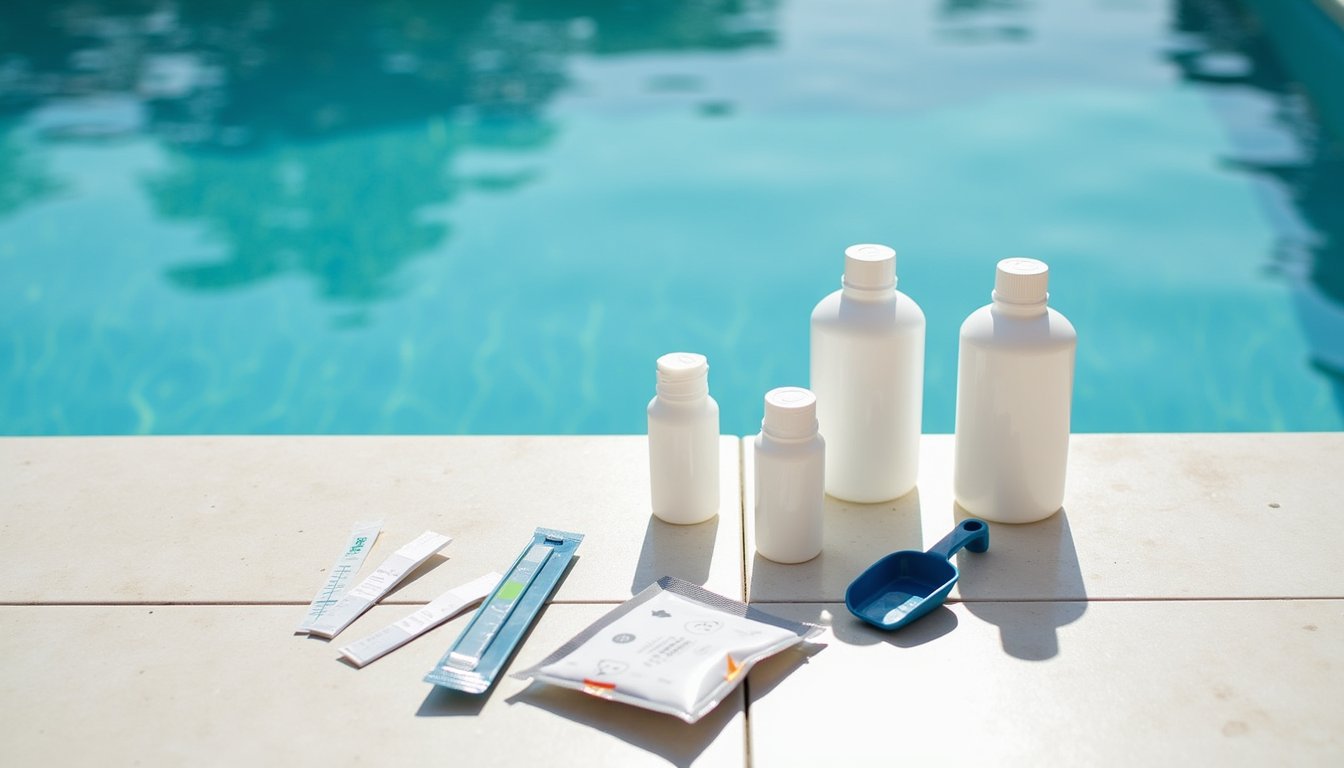
A basic pool chemical starter kit provides essential components for initial water treatment at varying price points. You’ll find starter kit benefits include thorough sanitization tools starting at $49.99 for pools up to 25,000 gallons, with prices adjusting based on brand and included chemicals. A comprehensive starter option like the Bestway kit costs $70.99 for complete care. Super kits for large pools are available at $58.49. For personalized assistance with kit selection, customers can contact pool specialists at 1.800.356.3025.
Essential components typically feature chlorine tablets or shock treatments, algaecide, water clarifier, and test strips for monitoring chemical levels. Your kit will include 10-20 test strips and detailed instructions for proper application. Most packages contain stain prevention products and sequestering agents to combat mineral deposits.
You’ll need to evaluate your pool’s specific requirements, as coverage may need adjustment for larger volumes. While basic kits work with both chlorinated and saltwater systems, including Pool Frog setups, specialized seasonal maintenance may require additional products.
Chemical Costs for Different Pool Sizes
Your pool’s size directly impacts the quantity and cost of chemicals you’ll need for proper maintenance. Small pools (5,000-10,000 gallons) require basic chemical packages ranging from $150-$300, while larger pools (10,000+ gallons) necessitate investments of $300-$600 for initial chemical setups. You’ll save money per unit when purchasing larger quantities, such as 50-pound chlorine tablet containers, which offer better value for bigger pools requiring sustained chemical treatment. For online purchases of pool chemicals, be aware that certain orders may trigger security restrictions to protect against potentially harmful chemical-related transactions. Many pool owners opt for starter kits that include essential chemicals like shock, algaecide, and test strips for a complete opening solution. Professional pool services typically complete the full opening within 1-2 days if the pool is in good condition.
Small Vs Large Pools
The upfront chemical costs for pools vary considerably based on water volume, with small pools under 15,000 gallons requiring $58-$80 for basic startup kits while larger pools need $58-$182 for premium chemical packages.
Small pool maintenance typically includes entry-level kits with Metal Out, clarifier, shock, and test strips. You’ll find DIY options more manageable due to precise measuring requirements and lower chemical volumes. For pools up to 10,000 gallons, a single start-up kit is sufficient. However, you must avoid over-application in compact spaces. Professional service providers charge hourly rates between $50-$100 for chemical balancing assistance.
Large pool challenges center on bulk chemical needs and increased testing frequency. You’ll need specialized solutions like combining multiple kits for pools over 20,000 gallons. Your costs will rise with higher algaecide concentrations and more frequent pH checks. DE or glass filters may require additional chemical regimens not included in standard packages.
Chemical Volume Price Scaling
Since chemical dosages directly correlate with pool volume, you’ll need to scale your purchases based on specific gallon requirements. Chemical scaling becomes evident when comparing a 10,000-gallon pool’s startup needs to larger installations, like 35,000-gallon pools that require nearly triple the chemical quantities.
For cost efficiency, consider that while a 10,000-gallon Doheny’s startup kit includes essential chemicals at a lower price point, larger pools demand proportionally more substantial investments. You’ll find that standard treatments scale accordingly: algaecide costs jump from $15 for small pools to $60 for larger ones, while chlorine treatments range from $15 to $80 based on volume. Bulk purchases, such as 50-pound chlorine tablet containers, often provide better value for larger pools, reducing your per-gallon chemical costs considerably.
Professional Opening Service Expenses
Professional pool opening services vary greatly in cost based on pool type and complexity, with above-ground pools ranging from $175-$225 and in-ground pools typically costing $250-$400. Labor costs for professional services average $60-$90 per hour, with first-time cleanings requiring 2-3 hours of work. In Islip and Scarsdale areas, expect to pay $360 to $390 for comprehensive pool opening services. Annual pool maintenance following the opening can cost up to $1,800. Regular chemical balancing and equipment inspections help ensure optimal pool function throughout the season.
Pool maintenance costs vary significantly, with professional opening services ranging from $175 for basic above-ground to $400 for complex in-ground systems.
- Mesh covers need additional vacuuming, increasing your total expense
- Solid cover cleaning and pump removal can add $125-$300
- Full-service openings include equipment setup, inspections, and initial chemical treatments
- Advanced features like lights, heaters, or saltwater systems drive up labor time
- Regional rates may exceed national averages, such as Passaic, NJ at $330-$350
You’ll need to factor in these variables when budgeting for your pool’s professional opening service, as equipment complexity and regional pricing greatly impact final costs.
DIY Chemical Package Options
For pool owners seeking cost-effective alternatives to professional services, DIY chemical starter kits offer significant savings while providing detailed opening solutions. You’ll find extensive packages ranging from $23 to $182, with most mid-range options around $101.
| Kit Type | Pool Size (Gallons) | Contents | Brand Examples | Price Range |
|---|---|---|---|---|
| Economy | Up to 10,000 | Basic chemicals, test strips | Bestway | $23-$45 |
| Standard | 10,000-20,000 | Chlorine, shock, algaecide | HTH, Pool Central | $45-$101 |
| Deluxe | 20,000-30,000 | Full chemical suite, Metal Out | Doheny’s | $101-$150 |
| Premium | 30,000-35,000 | Super shock, clarifier, extensive testing | In The Swim | $150-$182 |
| Multi-Pool | Variable | Scalable solutions | Various | Price varies |
When comparing DIY chemical options, consider your pool’s size and specific needs. Most kits include essential components like chlorine tablets, shock treatments, and testing supplies.
Material-Specific Chemical Requirements
Different pool materials demand specific chemical protocols to maintain their structural integrity and performance. Understanding chemical compatibility considerations helps you protect your investment while ensuring proper water chemistry. You’ll need to make seasonal chemical adjustments based on your pool’s construction material. Having essential pool chemicals readily available helps you quickly respond to material-specific maintenance needs. Testing the water frequently helps identify when to add clarifier treatments to improve filtration efficiency. Maintaining proper chemistry requires water testing 2-3 times weekly during peak swimming season.
- Plaster pools require higher calcium hardness levels (225-275 ppm) and careful pH monitoring to prevent etching
- Vinyl liners need lower chlorine levels and precise pH control to avoid material degradation
- Fiberglass shells demand strict alkalinity management to prevent surface blistering
- Salt systems require specialized borate treatments for pH stabilization
- Aggregate finishes need balanced calcium hardness to prevent scaling
For accurate chemical dosing, you’ll want to test weekly and maintain proper chemical levels according to your pool’s specific material requirements. Regular monitoring prevents costly damage while extending your pool’s lifespan.
Labor and Chemical Cost Breakdown
When opening your pool, you’ll face a choice between professional services costing $150-$400 or managing the process yourself with $80-$220 in chemical supplies. The DIY approach requires 2-4 hours of hands-on work to properly clean, balance chemicals, and maintain filters, while saving on the $50-$100 per hour labor charges from technicians. Your investment in either approach must account for essential materials including algaecide ($15-$60), chlorine ($15-$80), and shock treatment ($30-$50), regardless of who performs the service. Initial expenses can be higher for larger pools since they require more extensive cleaning and greater quantities of chemicals. Quality equipment and chemicals from reliable suppliers can help reduce long-term maintenance costs through better performance and consistency.
Service Vs DIY Expenses
Choosing between professional pool maintenance and DIY care requires a careful analysis of both upfront and ongoing expenses. When comparing DIY vs Professional options, you’ll find distinct cost vs convenience trade-offs. Professional services include chemicals and labor in their $1,200-$2,400 annual fees, while DIY requires $500-$1,500 in initial equipment purchases.
- Professional services bundle chemicals, testing, and labor into monthly payments
- DIY demands $540-$996 annually for chemicals plus $240-$600 for testing supplies
- Initial DIY investment includes safety gear, tools, and chemical starter kits
- Professional services include liability insurance and chemical safety compliance
- DIY requires 1-2 hours weekly for maintenance, while pros handle all tasks
The total first-year DIY investment often matches professional service costs, making your time availability and expertise level vital deciding factors.
Materials and Time Investment
Setting up your pool’s chemical regimen requires significant upfront investment in both materials and labor costs. You’ll need to budget $250-$400 for initial chemical packages, including essential treatments like algaecide ($15-$60/gallon) and chlorine shock ($30-$50/lb). Professional labor rates range from $50-$100 per hour, with costs varying based on pool size and contamination levels.
The chemical effectiveness of your treatment plan depends on your pool’s liner material. Concrete pools demand more chemicals ($750/year) compared to fiberglass ($175/year). Your maintenance frequency will affect ongoing expenses, with monthly baseline costs running $100-$200 for routine adjustments. Factor in potential filter system costs ($200-$1,500) and installation fees ($250-$1,700) when calculating your complete startup investment.
Budget-Friendly Chemical Solutions
Starting a pool’s chemical maintenance doesn’t require breaking the bank, as several cost-effective options can help minimize your initial investment. By focusing on cost saving alternatives and chemical efficiency, you’ll establish a foundation for sustainable pool care while keeping expenses manageable.
Smart pool maintenance starts with budget-friendly choices, creating a sustainable approach that balances proper care with cost-effective solutions.
- Choose liquid chlorine over tablets for immediate savings and better control over chemical levels
- Start with basic test strips ($15-$50) to monitor water chemistry yourself instead of paying for professional testing
- Purchase essential chemicals first (chlorine and pH balancers) and add others only when needed
- Consider bulk purchasing during off-season sales to secure better pricing on frequently used chemicals
- Invest in preventive maintenance to reduce the need for additional chemical treatments, addressing issues before they escalate into costly problems
These strategic choices will help you maintain proper water chemistry while keeping your initial investment within budget.
Premium Package Features and Benefits
You’ll benefit from professional warranty protection when investing in premium chemical packages that safeguard your pool equipment and surfaces against long-term damage. Your all-encompassing chemical coverage includes essential components like stabilized tri-chlor tablets, pH balancers, and specialized algaecides working together as an integrated treatment system. The premium package’s professional-grade formulations guarantee ideal water chemistry while extending equipment life through corrosion prevention and balanced sanitization. Investing in premium chemical packages keeps your pool in optimal condition and reduces the need for frequent repairs. Partnering with local pool maintenance services adds expert support and regular monitoring. Together, these steps enhance cleanliness, extend longevity, and ensure a pristine swimming environment.
Professional Warranty Protection
Professional warranty protection provides extensive coverage through premium packages that safeguard multiple pool components and systems. For warranty validation, you’ll need professional installation documentation and proof of purchase. Maintenance requirements include regular chemical balancing and equipment upkeep to maintain coverage validity.
- Extended structural protection for 10-30 years on pool shell and surrounding areas
- Enhanced coverage for saltwater components, including 3-year parts protection for chlorination cells
- Thorough protection for mechanical equipment with 1-year parts and labor coverage
- Premium packages offering extended terms for interconnected systems like controllers and pumps
- Third-party warranty options available for additional equipment protection beyond standard terms
Your geographic location and number of installed components may affect coverage terms. Remember to maintain detailed documentation of all maintenance activities and chemical levels to prevent claim denials.
Complete Chemical Coverage
Premium chemical coverage packages deliver extensive protection through strategically bundled sanitizers, pH balancers, and maintenance products. You’ll find significant chemical bundle advantages in these all-encompassing packages, including stabilized chlorine tablets for continuous sanitization effectiveness and multi-functional shock treatments that target organic contaminants.
| Component | Function | Duration |
|---|---|---|
| Tri-chlor Tablets | Sustained Sanitization | 5-7 days |
| pH Balancers | Chemistry Control | As needed |
| Algaecides | Algae Prevention | 15-30 days |
| Shock Treatment | Contaminant Removal | Weekly |
| Test Strips | Chemical Monitoring | Daily |
These bundles maximize protection through concentrated formulas that require fewer applications. You’ll benefit from non-foaming algaecides that allow immediate swimming and pH-neutral formulations that maintain consistent water chemistry. The inclusion of testing tools guarantees precise monitoring of sanitization levels.
Regional Price Variations for Pool Chemicals
While pool chemical costs vary nationwide, several key factors drive significant regional price differences that affect your upfront investment. Regional pricing fluctuates based on geographical demand patterns, transportation networks, and local market dynamics.
- You’ll pay 20-25% more in the Northeast and Midwest due to Canadian tariffs and higher rail shipping costs
- Coastal regions benefit from lower prices thanks to port access and international supply chains
- Rural locations face premium pricing from limited competition and higher delivery costs
- Urban areas typically see lower per-unit costs due to higher volume purchasing power
- Seasonal demand in regions like the Southwest creates price volatility during peak months
Your location’s infrastructure, supplier competition, and seasonal patterns directly impact chemical costs. Consider these regional variations when budgeting for your pool’s initial chemical investment.
Long-Term Chemical Investment Analysis
Three critical factors shape your long-term pool chemical investment: recurring costs, usage patterns, and equipment lifecycles. You’ll face annual chemical expenses ranging from $180 for small pools to $500+ for larger ones, with heavy usage driving costs up by 20-30%. Your automated systems and equipment will need replacement every 5-8 years, impacting your overall investment strategy.
To optimize your long-term spending, consider sustainability investments like saltwater systems or chlorine-free alternatives. While these solutions require higher upfront costs, they’re effective for chemical dependency reduction over time. You can further minimize expenses through bulk purchasing and eco-friendly supplier partnerships, which typically cut per-unit costs by 10-15%. Strategic planning of these elements will help you maintain cost-effective pool operations. Regular maintenance and water testing help extend the life of your pool systems and reduce frequent chemical purchases. By finding ideal pool chemical supplier partners who prioritize sustainable products, you ensure a steady, cost-effective supply. This proactive approach boosts efficiency while supporting environmental goals.
Frequently Asked Questions
How Long Does a Starter Chemical Kit Typically Last Before Needing Replenishment?
Your starter kit longevity typically ranges from 1-3 months, depending on your pool’s size and usage patterns. You’ll notice chemical depletion rates vary by component – chlorine tablets might last several weeks, while test strips get used up within 2-3 months of weekly testing. You’ll need to replenish shock treatments monthly during peak summer use. Algaecides may stretch longer if you maintain proper water balance, but you’ll generally need refills within a quarter.
Can I Mix Chemicals From Different Brands in My Pool Startup?
You can mix different brands of basic pool chemicals, but you’ll need to check chemical compatibility first. While chlorine-based sanitizers and pH balancers are generally interchangeable across brands, be cautious with algaecides and stabilizers. Always verify product formulations to avoid adverse reactions. For safety, don’t mix different brands of stabilizers (CYA), and maintain consistent testing when switching between manufacturers. Follow each product’s specific instructions for best results.
What Happens if I Skip Using a Stabilizer During Pool Startup?
You’ll face serious problems if you skip stabilizer during pool startup. Without it, your chlorine will rapidly break down from UV rays, requiring constant replenishment and wasting money. Your chemical balance will be unstable, leading to algae growth and cloudy water. You’ll need to run your filter longer and use more chemicals to compensate. The stabilizer benefits are essential – it protects your chlorine investment and maintains proper sanitization levels.
Are There Special Storage Requirements for Pool Opening Chemicals?
Yes, you’ll need to follow strict chemical safety protocols for pool opening chemicals. Store them in a cool, dry area below 95°F/35°C, away from direct sunlight and heat sources. Keep chemicals in their original, labeled containers and store them raised off the floor. Don’t mix different chemicals together, and make sure they’re in a well-ventilated space. You’ll also need to keep them locked away from children and pets in a designated storage area.
How Does Saltwater System Startup Differ From Traditional Chlorine Pools?
When starting a saltwater pool, you’ll need to dissolve pool-grade salt (around 3,000-4,000 ppm) before activating your chlorine generator. Unlike traditional chlorine pools that require immediate chemical balancing, saltwater benefits include a gentler startup process. You’ll still need to test and adjust pH and alkalinity, but you won’t handle harsh chlorine alternatives directly. The generator converts salt into chlorine automatically, making the initial chemical setup more straightforward.