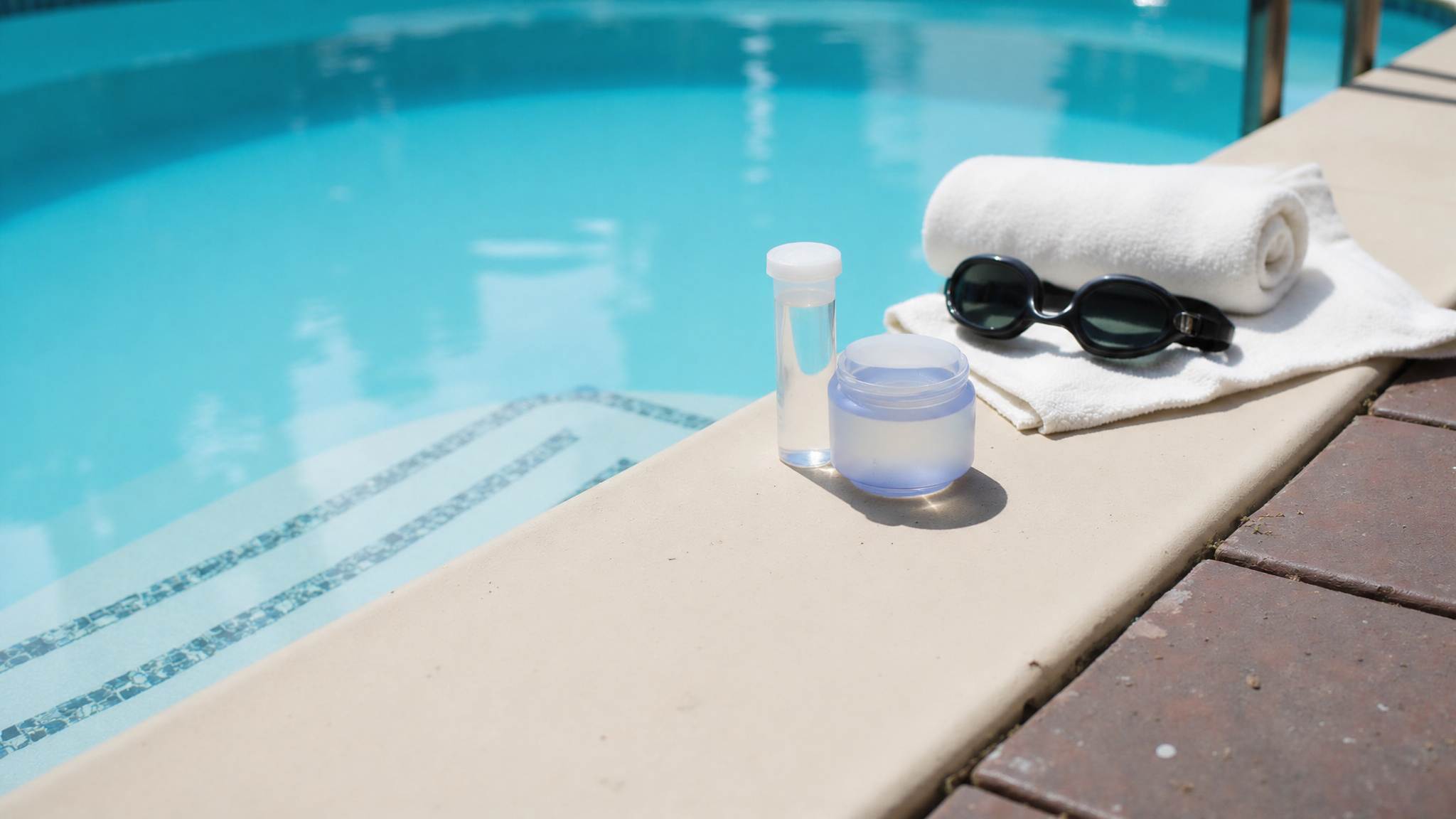
You’ll need to maintain five critical water parameters for a healthy pool. Keep your pH between 7.4-7.6, free chlorine at 1-3 ppm, and total alkalinity at 80-120 ppm. For outdoor pools, maintain stabilizer (CYA) levels at 30-70 ppm and calcium hardness between 200-400 ppm. Test pH and chlorine twice daily, with other parameters weekly. Understanding the interaction between these elements will help you master your pool’s chemistry. Additionally, it’s essential to regularly use common pool cleaning chemicals to keep your water clean and clear. Make sure the chemicals you add do not disturb the balance of the water parameters you’ve maintained. Consistent monitoring and maintenance help reduce excessive chemical use and support a healthier swimming environment.
Understanding Ph: the Foundation of Pool Balance
While many pool maintenance tasks can seem complex, maintaining proper pH levels serves as the cornerstone of pool chemistry and water safety. You’ll want to keep your pool’s pH between 7.4 and 7.6 for ideal disinfection and swimmer comfort, though some guidelines allow up to 7.8 for a wider safety margin. Your pool’s pH will naturally rise over time until it reaches its pH ceiling due to carbon dioxide loss. Total alkalinity levels help maintain stable pH balance.
Regular pH testing is essential, as levels can fluctuate due to environmental factors like rainfall, increased bather load, and chemical additions. When your pH rises too high, chlorine becomes less effective at killing pathogens, while low pH can cause equipment corrosion and eye irritation. Unbalanced pH can cause your vinyl liner to absorb water and develop unsightly wrinkles. For pH adjustment, use muriatic acid to lower high levels or soda ash to raise low levels. After any adjustments, wait 4-6 hours before retesting to guarantee accurate readings.
Chlorine Levels and Their Critical Role
Since effective pool sanitation depends on proper chlorine levels, maintaining the right concentration is essential for both safety and water quality. You’ll want to keep your pool’s free chlorine between 1-3 ppm, though levels up to 5 ppm can be acceptable when cyanuric acid (CYA) levels are properly balanced. The EPA recommends keeping free chlorine levels below 4 ppm in swimming pools. Testing should be performed at least twice per day to ensure proper maintenance.
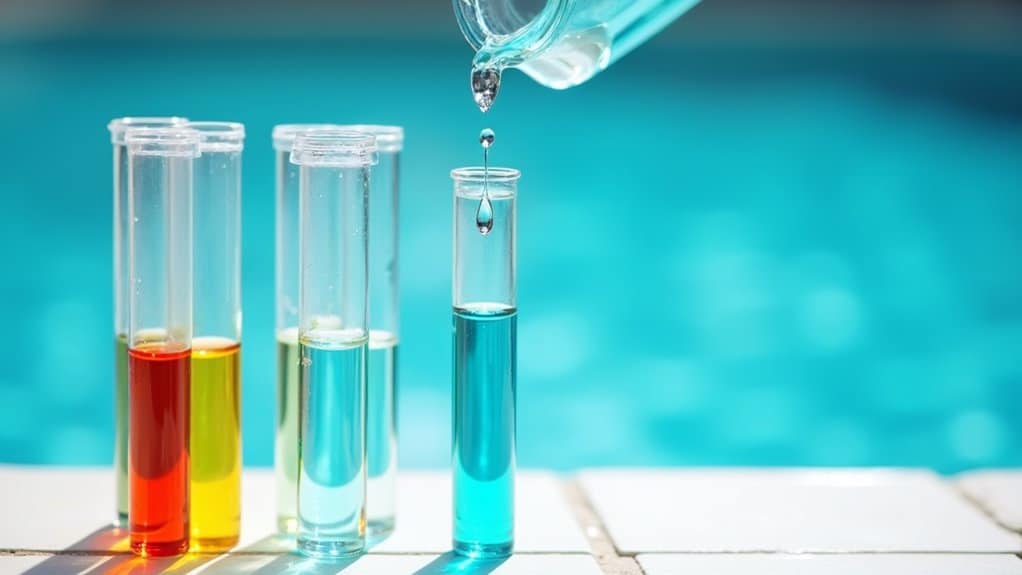
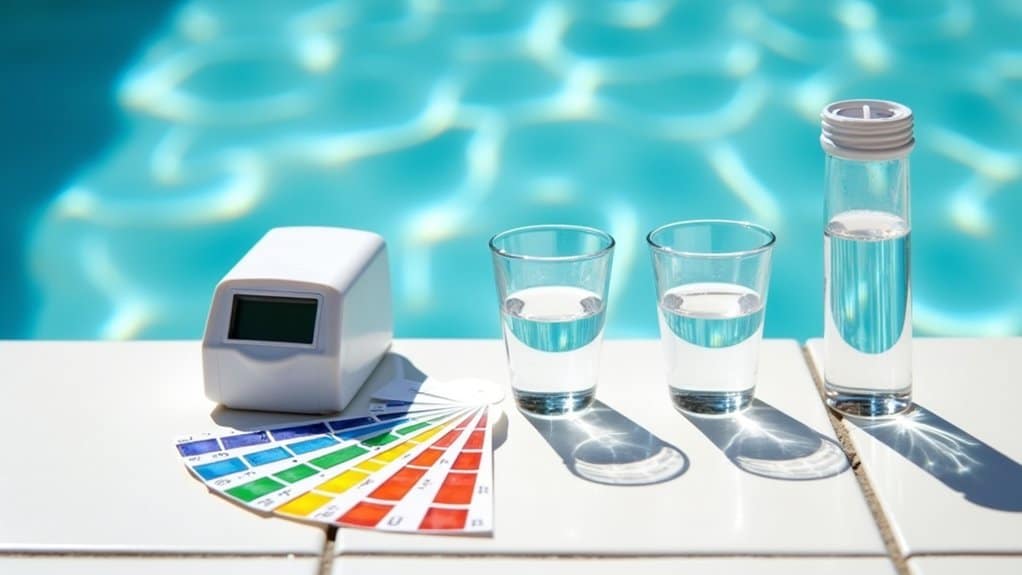
Regular chlorine testing using DPD or FAS methods will help you monitor these levels accurately. When making chlorine adjustments, consider your CYA concentration, which should stay between 30-50 ppm for ideal sanitizer efficiency. If levels exceed 5 ppm, you’ll need to take immediate corrective action, as high concentrations can cause eye irritation, respiratory issues, and equipment damage. A strong chlorine smell typically indicates your pool’s chemical balance needs adjustment. For outdoor pools, maintaining proper CYA levels prevents rapid chlorine dissipation from UV exposure. Additionally, regularly consulting a complete checklist for pool chemicals ensures all key water parameters such as pH, alkalinity, and chlorine are properly monitored and maintained. This practice helps keep your pool safe, enjoyable, and consistently healthy.
Total Alkalinity: Your Ph Buffer System
Total alkalinity (TA) works alongside chlorine as a fundamental pillar of pool chemistry, acting as your water’s primary pH buffer system. You’ll want to maintain TA between 80-120 ppm to guarantee peak pH stability and chemical efficiency. When your TA falls too low, you’ll experience pH bounce – unpredictable pH fluctuations that strain your chlorine’s effectiveness and increase maintenance demands. Your TA works by neutralizing acidic compounds to maintain consistent pH levels. High alkalinity levels can lead to scale formation on pool surfaces and equipment. Oils and sunblock from swimmers can cause elevated alkalinity in pool water.
Making alkalinity adjustments requires precision. To raise TA, add sodium bicarbonate gradually to avoid overshooting your target. For high TA situations, carefully apply muriatic acid to prevent severe pH drops. Always test your water within 24 hours after any corrections. Remember, you’ll need to address TA imbalances before attempting pH adjustments, as proper TA levels are essential for maintaining consistent pH control.
Stabilizer Levels: Protecting Your Chlorine Investment
Every outdoor pool requires cyanuric acid (CYA) stabilizer to protect your chlorine investment from rapid UV degradation. Without it, you’ll lose up to 90% of your chlorine within two hours, but proper CYA levels can extend chlorine lifespan by 3-5 times. For safe application, always dissolve in bucket before adding to your pool.
Maintain your stabilizer levels based on your pool type: 30-70 ppm for outdoor chlorinated pools, 50-70 ppm for saltwater systems, and lower levels for shady pools at 10-20 ppm. Regular stabilizer testing using test strips or CYA test kits is essential for best performance. When levels are too high, you’ll need to use double the shock dose for effective treatment. Be cautious, though – levels exceeding 70 ppm can reduce chlorine’s effectiveness and increase health risks. If your CYA rises above 100 ppm, you’ll need to partially drain and dilute your pool water to restore proper balance.
Essential Mineral Balance: Calcium and Salt Management
Managing calcium and salt levels forms another key layer of pool chemistry beyond stabilizer control. You’ll need to monitor calcium sources carefully, as regional tap water variations can greatly impact your pool’s hardness. When levels exceed the ideal range of 200-400 ppm, scaling issues can damage equipment and cloud water clarity. Chemical treatments offer only temporary solutions and won’t permanently reduce hardness levels. Vinyl and fiberglass pools require lower calcium levels compared to concrete pools. For online troubleshooting assistance, be prepared to provide your security details if access to pool maintenance websites becomes restricted.
Key calcium management strategies:
- Test monthly and after heavy rains to maintain proper levels
- Dissolve calcium chloride in water before adding to raise levels
- Use pool covers during storms to prevent rainwater dilution
- Drain and replace water to lower high calcium levels
- Balance pH and alkalinity to support calcium stability
Frequently Asked Questions
How Long Should I Wait to Swim After Adding Pool Chemicals?
You’ll need to follow specific waiting periods based on the chemicals you’ve added to guarantee proper chemical reactions and safety precautions. Wait 20-30 minutes for pH balancers, alkalinity adjusters, and clarifiers. For shock treatments, wait at least 24 hours or until chlorine levels drop below 5 ppm. Calcium chloride requires 2-4 hours, while algaecides need 15-30 minutes. Always check product labels and test water levels before swimming.
Can I Use My Pool Immediately After Shocking It?
No, you can’t swim immediately after shocking your pool. The safe swimming timeline depends on the type of shock treatment you’ve used. With traditional chlorine-based shocking procedures, you’ll need to wait at least 24 hours. Non-chlorine oxidizing shocks allow entry after just 15 minutes. Always test your water before entering – free chlorine should read 1-4 ppm and pH between 7.2-7.8 for safe swimming conditions.
Why Does My Pool Water Turn Green After Heavy Rain?
Your pool turns green after heavy rain due to several connected factors. The rain dilutes your pool’s chlorine levels while introducing organic contaminants and algae spores. In this weakened chemical environment, green algae quickly multiply, especially when combined with phosphates from rain runoff. The rain aftermath creates perfect conditions for algae blooms – diluted chemicals can’t effectively fight the sudden influx of contaminants, resulting in that telltale green color.
How Often Should I Backwash My Pool Filter?
You’ll need to backwash your pool filter based on both your filter type and pressure readings. For sand filters, backwash when the pressure gauge reads 8-10 psi above baseline or every 3-4 weeks. DE filters require more frequent backwashing, typically after 1-3 psi increase. Monitor your pressure gauge regularly and adjust your backwash frequency during high-use periods or after storms. Don’t over-backwash, as this can reduce filtration efficiency.
What Causes Cloudy Pool Water Even With Balanced Chemistry Levels?
Even with balanced chemistry, your pool’s cloudy water often stems from filtration issues and circulation problems. You’ll typically face this when your filter isn’t running long enough (aim for 8-12 hours daily) or when it’s clogged with debris. Poor water circulation and insufficient filter maintenance can trap microscopic particles in suspension. You’ll also want to check if you’re using too many chemical clarifiers, which can cause particle buildup and cloudiness.