
A swim spa’s worth depends on three variables: your upfront budget ($20,000, $60,000 installed), your monthly operating tolerance ($50, $300), and how often you’ll actually get in the water. You’ll spend roughly 35% less than an inground pool while gaining year-round usability across fitness, hydrotherapy, and recreation. If you’re committing long-term and using it consistently, the cost-per-session math works in your favor. Below, we’ll break down the exact specs and scenarios that determine your ROI.
What Does a Swim Spa Actually Cost?
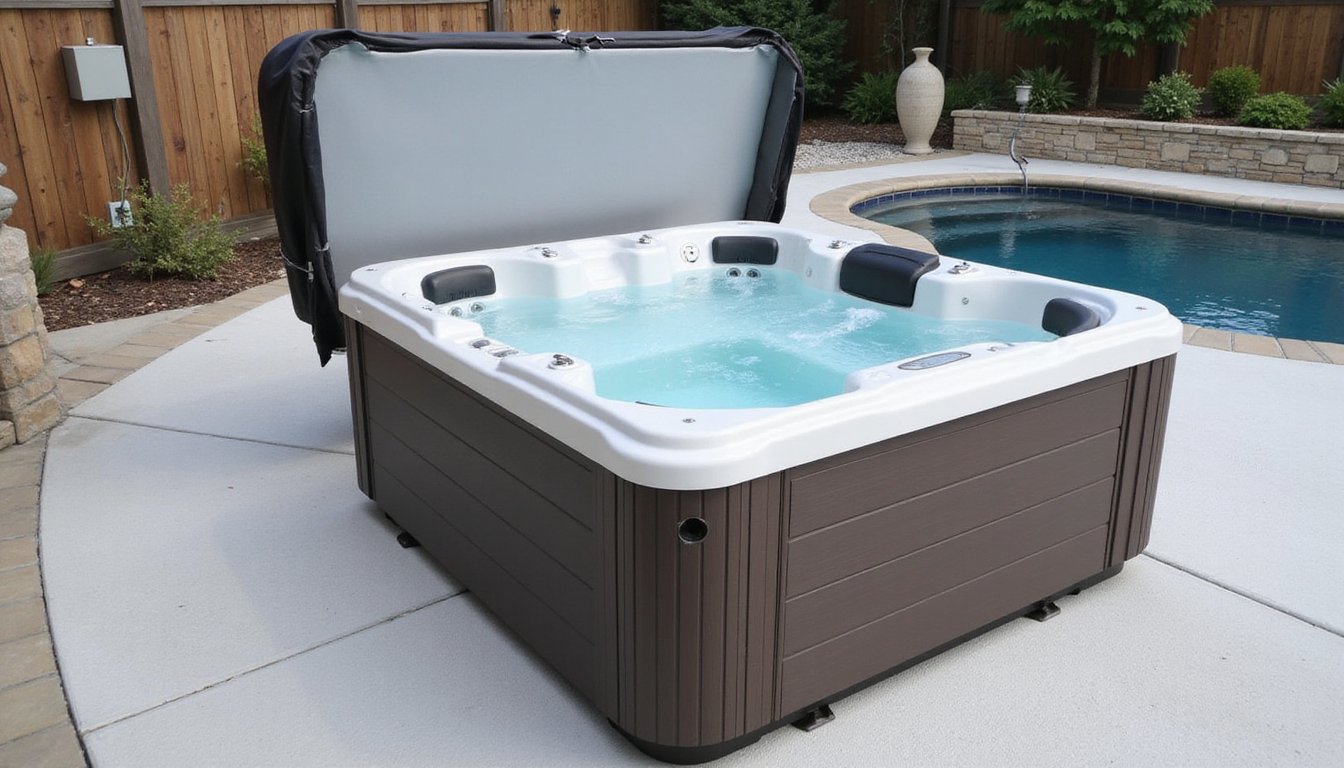
While swim spa pricing varies widely by brand, size, and feature set, most buyers should expect to spend between $20,000 and $60,000 for the unit alone. Entry-level models start around $7,000 to $17,000, mid-range units fall between $18,000 and $35,000, and premium configurations push $40,000 to $65,000+. Proper swim spa site preparation tips are crucial to ensure optimal installation and functionality. Assess the space where the swim spa will be placed to ensure it can accommodate the dimensions and weight of the unit when filled.
Beyond the base price, you’ll need to budget for delivery, typically $800 to $1,500, though crane access can exceed that. Professional electrical wiring is another essential expense, with costs typically ranging from an additional $800 to $1,600 depending on the distance from your electrical panel. Monthly operating costs run $50 to $100 on average, with some setups reaching $300+ depending on climate and usage frequency. That’s still below the $150 to $300 monthly range for inground pools. When you factor in these specs, swim spa value becomes clearer against traditional pool alternatives.
Swim Spa Installation Costs to Expect
Contractor labor rates average $50 to $150 per hour, scaling with structural complexity. You’ll want to budget installation independently from your unit’s purchase price. Overall costs range from basic setups to complex projects requiring crane services and heavy preparation, with total installation expenses reaching anywhere from $2,000 to $20,000.
Monthly Swim Spa Operating Costs
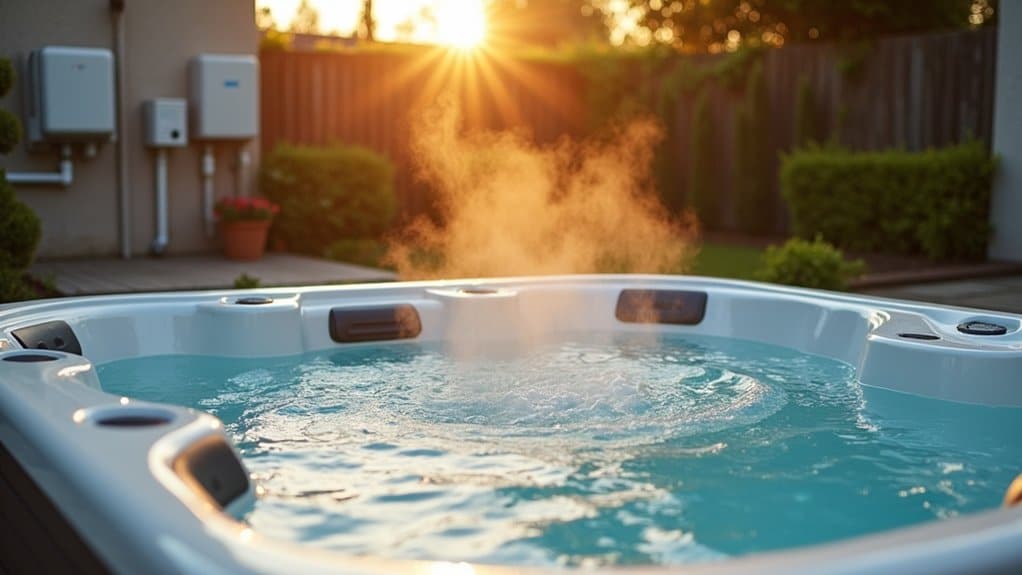
Annually, you’re looking at $1,000 to $3,600 total. Heat pump systems and premium insulation specs can push you toward the lower end. Proper wall insulation alone can reduce energy consumption by up to 40%.
Swim Spa vs. In-Ground Pool: Which Costs Less?
Knowing your monthly operating costs helps frame the bigger picture, but the real cost gap between a swim spa and an in-ground pool starts at purchase and widens through installation.
| Specification | Swim Spa | In-Ground Pool |
|---|---|---|
| Purchase Price | $15,000, $40,000 | $40,000, $100,000+ |
| Install Time | 1, 3 days | 7, 21+ days |
| Min. Footprint | ~400 sq ft | ~1,200 sq ft |
When comparing swim spa vs. in-ground pool costs, you’ll find swim spas run roughly 35% less upfront. Pool quotes also escalate quickly, fencing, excavation, decking, and utilities push totals into six figures. Swim spas ship as self-contained units with integrated plumbing, heating, and filtration, keeping your project scope narrow and your budget predictable.
Swim Spa Fitness and Recovery Benefits
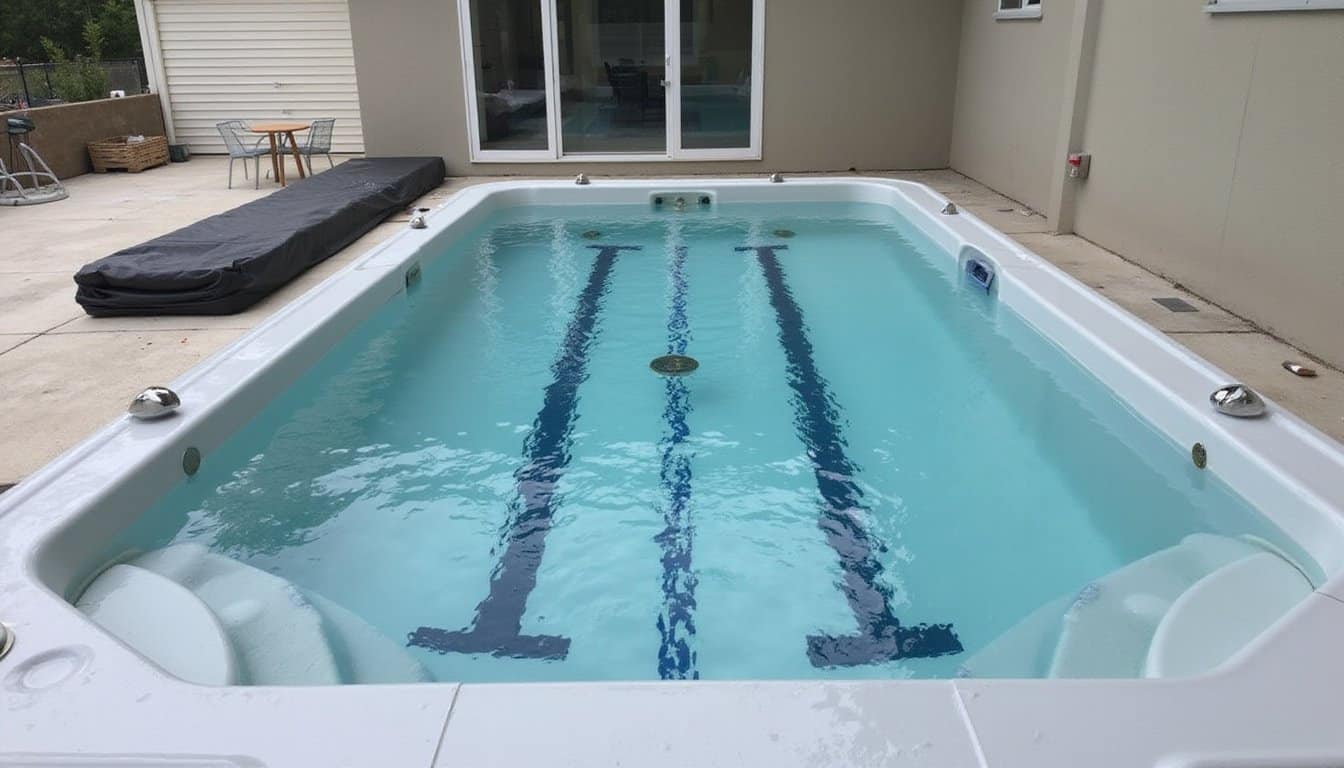
Because water buoyancy offloads up to 90% of your body weight, swim-spa workouts deliver full-body resistance training without the joint stress of land-based exercise. Adjustable currents let you scale cardiovascular intensity progressively, targeting endurance gains through 20- to 30-minute sessions multiple times per week.
The swim spa fitness and recovery benefits extend beyond conditioning. Warm water promotes circulation, reduces inflammation, and supports muscle recovery post-workout. Dual-zone models separate exercise and therapy areas at independent temperatures, so you can shift directly from swimming at 80°F to hydrotherapy at 104°F.
Targeted massage jets address soreness and stress reduction, while warm-water stretching improves flexibility and range of motion. Year-round access eliminates seasonal gaps, helping you maintain consistent training and recovery routines regardless of climate conditions.
How Year-Round Use Changes a Swim Spa’s Value
When you spread your swim spa’s $15,000, $60,000 purchase price across 365 usable days instead of a 3, 4 month summer window, your effective cost-per-session drops considerably. Heated water maintained between 80°F and 104°F lets you lock in a consistent exercise routine regardless of outdoor conditions, eliminating the seasonal gaps that disrupt training cycles. If you’re in a cold climate where traditional pools sit idle for six or more months annually, a swim spa’s insulated, year-round operation specification delivers measurably higher ROI per dollar spent. A detailed cost breakdown for endless pools installation will help you understand the long-term value of your investment. By evaluating the initial setup costs against the ongoing benefits, you can appreciate how the swim spa pays for itself over time.
Seasonal Cost Efficiency
Unlike seasonal pools that sit idle for months, a swim spa’s year-round operability fundamentally changes its cost-per-use equation. When you’re paying $50 to $100 monthly with proper insulation, you’re spreading fixed ownership costs across 365 days rather than three to four summer months. That’s seasonal cost efficiency at its core.
You’ll avoid winterization expenses entirely, no draining, no recommissioning, no costly seasonal restarts. Program filtration cycles during off-peak electricity hours to reduce per-kilowatt costs further. Adjust temperature settings seasonally: cooler in summer, warmer in winter. Install windbreaks to minimize heat loss in exposed installations.
Quality insulation and covers are spec-critical. Poor thermal retention spikes winter operating costs, undermining year-round value. With energy-efficient components, you’ll maintain stable water temperatures without utility surges, keeping annual heating between $500 and $800.
Consistent Exercise Routine
Cost efficiency only matters if you’re actually using the unit. A swim spa’s ROI scales directly with session frequency, heated, insulated construction enables a consistent exercise routine regardless of season or weather conditions.
Year-round access eliminates the seasonal downtime that reduces most pool investments to 3, 5 months of actual use. Here’s what consistent access enables:
- Structured weekly programming across swimming, resistance, flexibility, and recovery sessions
- Low-impact conditioning that sustains daily training without joint degradation
- Combined cardio, strength, and hydrotherapy in a single unit, removing equipment dependencies
- Sub-20-minute effective sessions that lower the friction threshold for maintaining frequency
Home proximity removes transit overhead. You’re more likely to maintain a 4, 5x weekly schedule when the facility is steps away.
Cold Climate Benefits
Because swim spas maintain heated, insulated water independent of ambient conditions, their operational window doesn’t collapse to the 90, 120 usable days that define most traditional pools in cold climates.
| Parameter | Swim Spa |
|---|---|
| Annual usable days | ~365 |
| Exercise temp range | 78, 85°F |
| Hydrotherapy temp range | 100, 104°F |
| Winter operation | Supported with insulation + cover |
| Year round hydrotherapy | Yes |
You’re amortizing your investment across 12 months rather than three. That shift fundamentally changes per-use cost calculations. When you drain seasonal value from a traditional pool, you’re paying full maintenance on a dormant asset. A swim spa eliminates that dead period. Winter operation requires prompt snow removal from covers and clear access paths, but the system remains fully functional at spec temperatures.
Will a Swim Spa Fit Your Yard?
How much space does your yard actually need? Will a swim spa fit your yard? That depends on exact dimensions. Most units measure 7, 8 feet wide by 10, 19 feet long, but the unit footprint isn’t your total requirement.
Most swim spas need far more yard space than their footprint suggests, plan for the full picture.
Apply these specifications to your site:
- Add 3 feet of clearance around all sides for maintenance and entry access.
- Verify your surface supports a 6-inch minimum concrete pad or equivalent load-rated deck.
- Confirm setback compliance with local zoning for property lines and utilities.
- Account for ancillary structures, steps, decking, or privacy screens, beyond base clearance.
An 8×14-foot spa requires roughly 14×20 feet once clearance’s factored in. Partially recessed or vault installations can reduce visual bulk in constrained layouts. Have a site professional validate structural and dimensional feasibility before purchasing.
When a Swim Spa Isn’t Worth It
Even if your yard clears every dimensional and structural requirement, a swim spa still may not be the right call. Low expected usage frequency is the primary disqualifier, if you’re swimming once a month, you’re paying $15,000, $60,000 for idle equipment.
Here’s when a swim spa isn’t worth it:
- Budget constraints: Base prices exclude installation, electrical upgrades, and ongoing maintenance. Total ownership cost exceeds advertised figures.
- Large-family needs: Limited capacity can’t support group recreation or multi-person swimming sessions.
- Short-term ownership: You won’t recoup installation costs if you’re selling within two to three years.
- Maintenance tolerance: Water testing, filter care, and seasonal energy demands still require consistent attention.
Match your usage pattern to the investment. Anything less than three to four weekly sessions weakens the value proposition.
Who Gets the Most Value From a Swim Spa?
Not every buyer extracts the same return from a swim spa, the unit’s value scales directly with usage frequency, functional needs, and space constraints. So, who gets the most value from a swim spa? These four user profiles consistently maximize ROI:
- Active households with limited yard footprint, you’re installing a multi-function exercise and relaxation unit where a full pool won’t fit, with indoor/outdoor flexibility and potential movability.
- Fitness-focused users, you’re leveraging adjustable resistance across training levels for low-impact, full-body aquatic conditioning at home.
- Recovery and hydrotherapy users, you’re combining post-workout therapy jets with warm-water immersion in a single accessible unit.
- Families seeking year-round recreation, you’re operating a heated, dual-purpose system that serves mixed-age exercise, play, and relaxation demands across all seasons.
Is a Swim Spa Worth It for You?
Cold-climate owners gain year-round training access that seasonal pools can’t match. If your goals prioritize low-impact fitness, hydrotherapy, and space efficiency over large-scale recreation, the specification aligns. If you need multi-swimmer capacity or competitive stroke development, a full-size pool fits better. Frequency of use remains the single strongest value predictor.
Bring Resort-Style Spa Living Home
Whether you’re investing in a lap pool, swim spa, or endless pool, expert design and installation make the difference between good and unforgettable. At Cristallo Pools in Jupiter, FL, our experienced team provides trusted Spa Additions with luxury craftsmanship and a personalized approach. Call +1 (561) 766-0353 today and start designing the perfect addition for your backyard.
Frequently Asked Questions
How Long Does a Swim Spa Typically Last Before Needing Replacement?
You can expect a well-maintained swim spa to last 15 to 20 years, though high-quality units can push up to 30 years at the shell level. You’ll likely replace pumps at 5, 10 years, heaters around 7, 10 years, and soft accessories every 3, 5 years. Lower-end models or poorly maintained units may fail within 5, 10 years. Frequent service calls and persistent structural cracks typically signal it’s time for full replacement.
Do Swim Spas Increase Your Home’s Resale Value?
Swim spas can boost your home’s resale value, but don’t expect dollar-for-dollar ROI. Industry estimates suggest a 5%, 15% increase, though that figure’s market-dependent, not guaranteed. Appraisers typically won’t credit the full installation cost; instead, you’ll see improved marketability and faster sale times. You’ll get the strongest returns in warm climates, luxury neighborhoods, and listings targeting fitness-oriented buyers. A poorly maintained unit, however, becomes a liability that deters offers.
How Loud Are Swim Spas During Operation?
Swim spas produce audible noise from pumps, jets, water turbulence, and blower systems during operation. You’ll notice a baseline pump hum, with volume increasing as you raise current intensity. Single-speed pumps run louder than variable-speed alternatives, and blower-assisted massage generates the highest decibel output. You can reduce noise through rubber pump isolation mounts, cabinet acoustic insulation, and variable-speed equipment upgrades, but you shouldn’t restrict ventilation enough to overheat components.
Can You Finance a Swim Spa Purchase?
Yes, you can finance a swim spa through several channels: dealer financing (often 0% APR for 24, 60 months), personal loans, home equity loans, HELOCs, or credit cards with promotional rates. Monthly payments typically range from $200, $600 depending on loan amount, term length, and creditworthiness. Dealer programs usually offer the fastest approval. Home equity options may provide lower rates but require collateral. Budget for APRs between 0%, 15% through most lending channels.
Do Swim Spas Require Special Electrical Hookups or Permits?
Yes, you’ll need a dedicated 240V circuit, typically rated at 50, 60 amps with a GFCI-protected breaker. Most units require hard-wiring with #6 AWG copper conductors routed through conduit to a spa-rated disconnect installed within line of sight and at least 5 feet from the unit. You’ll also need local permits and inspections in most jurisdictions. Hire a licensed electrician to guarantee code compliance and proper load calculation on your panel.