Indoor pool condensation occurs when your facility’s evaporation rate, typically 20, 40 pounds of moisture per hour, overwhelms your dehumidification and ventilation systems. Poor vapor barriers, thermal bridging, and insufficient air exchanges let humid air contact cooler surfaces below the dew point. You’ll notice window fogging, wet walls beyond splash zones, and eventually mold growth. Maintaining 40, 60% RH with properly sized dehumidifiers, 4, 6 air changes per hour, and sealed vapor barriers addresses most issues, and the strategies below break down each fix in detail.
Why Indoor Pool Condensation Happens
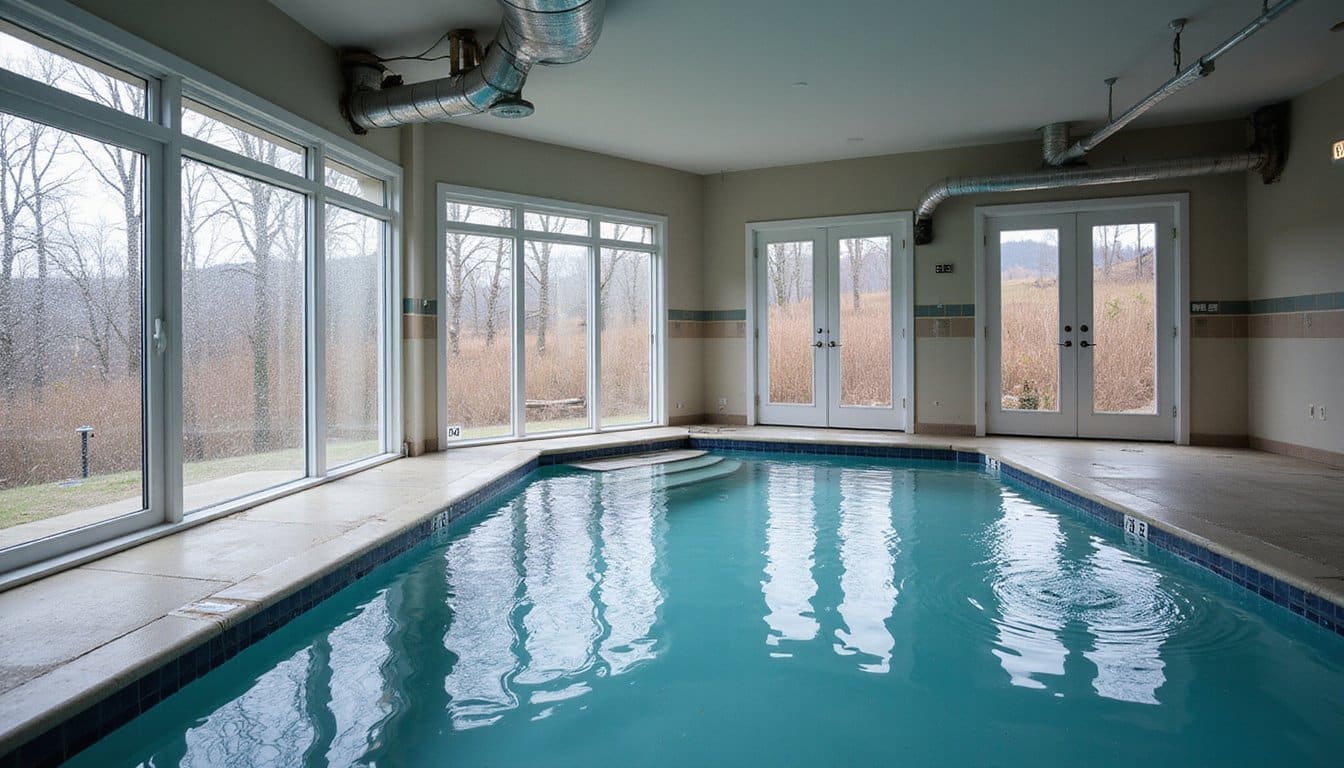
When warm, moisture-laden air contacts a surface that’s cooler than the dew point, water vapor condenses into liquid. In your pool room, continuous evaporation from the water surface drives humidity levels well above typical indoor ranges, often exceeding 60% RH without active control. This heightened moisture load means your air reaches saturation faster, and indoor pool moisture problems develop on any surface falling below the dew point. Maintaining air temperature around 1°C warmer than pool water helps reduce evaporation and limit the moisture driving condensation.
Windows, exterior doors, and poorly insulated roof assemblies are primary condensation zones due to their lower R-values. Warmer pool water temperatures accelerate evaporation rates, compounding the humidity load. Air movement over the water surface further increases moisture transfer. Without properly sized dehumidification and 4, 6 air changes per hour, you’re creating conditions where condensation is inevitable rather than occasional.
Five Causes of Indoor Pool Condensation
When condensation appears in your indoor pool space, it’s typically driven by one or more of five root causes that you can systematically diagnose and correct. Poor building construction, including damaged vapor barriers or inadequate insulation, allows moisture to migrate into wall assemblies and keeps surfaces below the dew point. Inadequate ventilation systems and insufficient dehumidification capacity compound the problem by failing to manage the moisture load your pool generates continuously. An air pressure imbalance in the pool area can also drive humid air into adjacent spaces, worsening condensation throughout the facility.
Poor Building Construction
A poorly constructed building envelope ranks among the most persistent causes of indoor pool condensation because structural deficiencies allow moisture to bypass every other control measure in the system. Missing or improperly installed vapor barriers, unsealed joints, and insulation gaps create pathways for humid air to reach cold structural surfaces where condensation forms undetected.
Poor building construction compounds these failures through thermal bridging, inadequate window airflow strategies, and unconditioned hidden spaces above drop ceilings. You’ll find moisture accumulating in wall cavities, roof assemblies, and around poorly sealed doors and windows, areas where persistent condensation drives mold growth, material rot, and metal corrosion. Chlorine-laden moisture accelerates hardware deterioration further. Without addressing these envelope deficiencies directly, your dehumidification system can’t compensate for the structural moisture load. Any surface that drops below the indoor pool dew point, which typically ranges from 62-69°F, will actively collect moisture regardless of how well the HVAC system performs.
Inadequate Ventilation Systems
Even if your building envelope is flawless, an inadequate ventilation system will still drive condensation by failing to manage the moisture load at its source. Inadequate ventilation systems typically exhibit one or more critical failures: insufficient outdoor air intake, poor exhaust capture, weak air distribution, pressure imbalances, or mechanical blockages.
When outdoor air intake drops too low, moisture and chloramines accumulate unchecked. If your exhaust isn’t capturing humid air from the water surface, that moisture lingers and settles on cooler surfaces. Poor air distribution creates stagnant zones where condensation forms on windows and walls. Positive pressure pushes moisture into adjacent building cavities, compounding indoor pool moisture issues. Each failure undermines ventilation and condensation control. Addressing these system deficiencies is essential to breaking the cycle driving persistent condensation.
Insufficient Dehumidification Capacity
Though your ventilation system and building envelope may both perform well, insufficient dehumidification capacity alone can push indoor humidity past the point where condensation takes hold. When your unit can’t remove moisture fast enough, relative humidity exceeds the 50, 60% target range, and surfaces drop below dew point.
Insufficient dehumidification capacity stems from several factors: worn components, corroded coils, clogged filters, or failed refrigerant circuits that degrade performance over time. Changed load conditions, higher bather counts, increased water temperatures, or extended operating schedules, can also exceed original design parameters. Even a functional unit underperforms when filters aren’t replaced quarterly or coils aren’t cleaned routinely. You’ll need to verify your system’s rated capacity against current moisture loads and either upgrade equipment or restore performance through targeted maintenance.
Signs Your Indoor Pool Has a Condensation Problem
How quickly can you tell if your indoor pool’s humidity control is failing? Indoor pool water vapor problems manifest through predictable, measurable indicators before structural damage occurs.
| Warning Category | Early Signs | Advanced Signs |
|---|---|---|
| Surface Moisture | Window fogging, droplets on glass | Wetness spreading beyond splash zones into adjacent rooms |
| Material Degradation | Premature corrosion on door hardware | Mold growth, coating failure, structural deterioration |
| HVAC Performance | Overflowing condensate drain pans | Failed exhaust fans, blocked air intakes, poor distribution |
You’ll notice condensation first on windows and skylights, they’re your coldest surfaces. If you’re seeing moisture on exterior walls or ceilings, your dehumidification system can’t keep pace with evaporation loads. Don’t ignore corroding hardware; it confirms prolonged exposure requiring immediate system evaluation.
Best Humidity and Temperature Settings for Indoor Pools
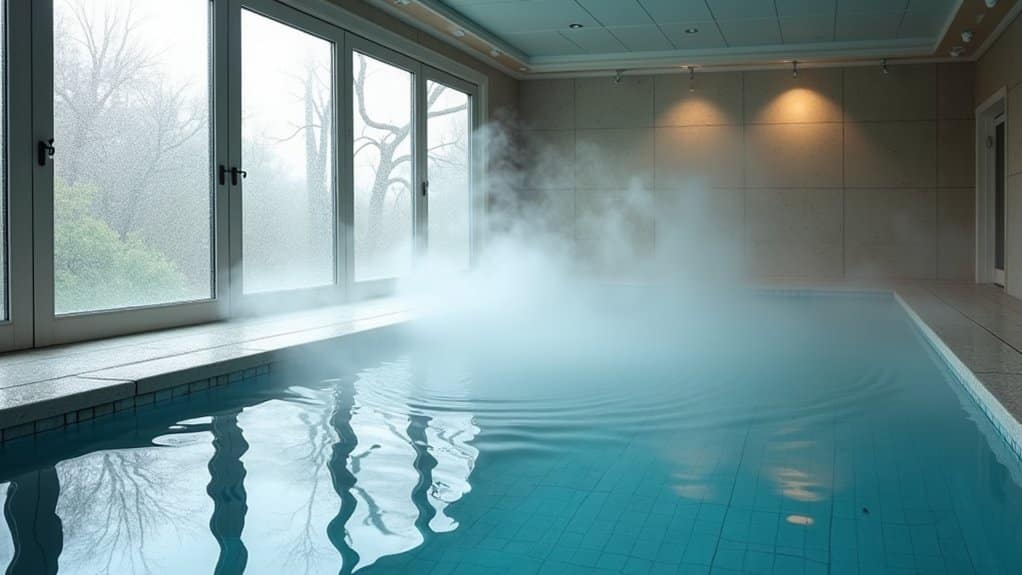
Because condensation is ultimately a symptom of environmental imbalance, correcting it starts with dialing in three interdependent set points: relative humidity, air temperature, and water temperature. The best humidity and temperature settings for indoor pools typically target 50, 60% RH, with air temperature maintained 2, 4°F above water temperature, capped at 86°F. A common baseline is 84°F air, 82°F water, and 60% RH.
These values aren’t arbitrary. Dropping space temperature just 2°F can increase humidity load by 35%, potentially overwhelming your dehumidification system and accelerating indoor pool condensation problems. Surfaces must stay above the dew point, generally 63, 71°F, to prevent moisture accumulation. Without that margin, you’re inviting humidity related structural damage to framing, insulation, and finishes that compounds silently over time.
How Dehumidifiers Fix Indoor Pool Condensation
When humidity levels exceed the dew point of your coldest room surface, condensation forms, and a properly sized dehumidifier is the most direct way to break that cycle. Refrigeration-based units cool air below its dew point on an evaporator coil, drain the collected water, and return reheated, drier air to the space. Desiccant models use adsorption media like silica gel, performing better in colder climates where refrigeration efficiency drops.
Both systems target moisture buildup pool rooms generate continuously through surface evaporation. By extracting water vapor directly from the air, dehumidifiers lower relative humidity below the condensation threshold on windows, walls, and structural components. This reduces corrosion, mold risk, and material degradation. Regular maintenance, cleaning coils, calibrating hygrometers, replacing worn components, keeps extraction rates consistent against your pool’s persistent humidity load.
Ventilation and Airflow Fixes for Pool Condensation
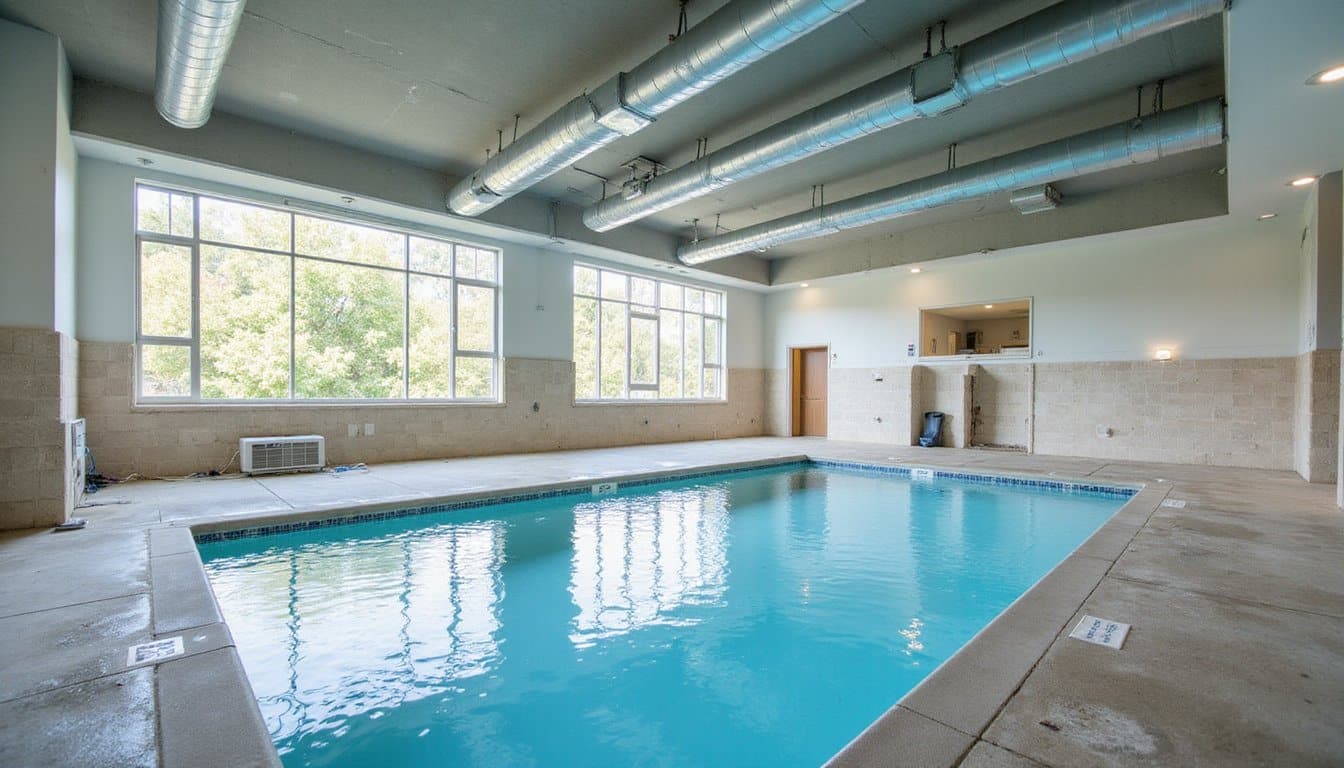
Dehumidifiers extract moisture already in the air, but ventilation tackles the problem upstream, moving humid air out of the space before it reaches condensation-prone surfaces. For effective ventilation and airflow fixes for pool condensation, you’ll need properly sized air exchange systems delivering 4, 6 air changes per hour in standard natatoriums and 6, 8 in spectator areas, per ASHRAE guidance. Properly determining optimal dehumidifier capacity calculations is essential for maintaining a comfortable and healthy environment. Accurate calculations help ensure that the system can handle moisture levels effectively, preventing mold and mildew growth.
Direct supply air across exterior walls and glass surfaces to wash them with warmer, drier air. Position low, source-capture exhaust near the pool surface to remove chloramines before they circulate. Maintain 40, 50% relative humidity through balanced outdoor air introduction, ensuring intakes sit away from exhaust outlets and plumbing vents. In your indoor pool, integrate heat recovery between exhaust and supply streams to optimize energy performance without sacrificing moisture control.
Pool Covers, Insulation, and Vapor Barriers That Help
You can cut evaporation-driven moisture loads by 50, 70% simply by covering your indoor pool during non-use periods, which directly reduces the latent humidity that causes condensation. Continuous insulation on exterior-facing walls and high-performance glazing raise interior surface temperatures above the dew point, eliminating the cold spots where moisture collects. Vapor-retarding membranes rated at ≤0.1 perms, installed on the warm side of wall and ceiling assemblies with fully sealed seams, prevent residual moisture from migrating into concealed framing where it causes rot and corrosion.
Pool Covers Reduce Evaporation
A solid pool cover can reduce evaporation by up to 95%, making it the single most effective tool for controlling moisture in an indoor pool environment. Solar blankets, automatic covers, and hybrid systems all reduce vapor transfer, though solid covers deliver the highest performance. Mesh covers allow more evaporation due to their porous construction.
Cover effectiveness depends on full surface coverage. Gaps leave exposed water that continues producing vapor, directly contributing to pool room moisture issues. You’ll want to trim covers to match irregular shapes and guarantee they lie flat against the water surface. Heated pools benefit further, solid covers can cut heating costs by 50% to 70% by reducing evaporative heat loss. Keep covers on whenever the pool isn’t in use for maximum control.
Insulation Prevents Surface Condensation
While pool covers control evaporation at the water’s surface, insulation controls condensation at the building’s surfaces, and both work together to manage moisture in your pool room. Insulation reduces surface condensation by keeping interior surfaces warmer than moist air, preventing those surfaces from reaching the dew point.
Three critical insulation strategies protect your pool enclosure:
- Continuous exterior insulation eliminates thermal bridges and cold spots where condensation concentrates on walls and ceilings.
- Double- or triple-pane windows raise glass surface temperatures across your largest low-R-value areas.
- Vapor retarders sealed at all seams prevent humid indoor air from migrating into cold assemblies where interstitial condensation forms.
You’ll want to direct 3, 5 CFM of warm supply air per square foot of exterior glass to keep glazing above the condensation point.
Vapor Barriers Protect Walls
Because humid pool air exerts considerably higher vapor pressure than standard occupied spaces, vapor barriers serve as the critical last line of defense, preventing moisture from migrating through wall, ceiling, and floor assemblies where it condenses on cooler surfaces hidden from view.
Understanding the vapor-barrier purpose in indoor pool rooms requires recognizing that uncontrolled moisture infiltration causes rot, corrosion, and finish failure within concealed assemblies. You’ll need membranes rated at 0.10 perm or less, typically 8, 12 mil polyethylene sheeting, installed on the interior/warm side of the enclosure. Every seam, penetration, and overlap must be sealed to maintain a continuous envelope. Avoid recessed can lights; they puncture the barrier. Surface-mounted fixtures preserve continuity. Foil-faced batts don’t qualify as true vapor barriers. Pair your barrier system with pool covers to reduce evaporation-driven moisture loads.
Maintenance That Prevents Indoor Pool Condensation
Staying ahead of condensation requires consistent, systems-level maintenance across four key areas: humidity control, air circulation, temperature management, and equipment upkeep. Effective humidity control through dehumidification means maintaining relative humidity between 40% and 60% while keeping air temperature 2, 4°F above pool water temperature.
Your preventive maintenance schedule should target these three critical systems:
- Filter and coil servicing, Replace return-air and outdoor-air filters quarterly, and inspect evaporator and condenser coils for corrosion or debris buildup.
- Condensate drain clearing, Check drain lines regularly to prevent water backup that reduces dehumidifier performance.
- Air distribution verification, Confirm 4, 6 air changes per hour and guarantee supply grilles blanket windows and exterior surfaces with warm air to prevent localized moisture accumulation.
Long-Term Monitoring to Keep Condensation Away
Routine maintenance keeps your systems performing today, but long-term monitoring reveals whether they’ll hold up across seasons. Track pool-area temperature and relative humidity using BAS trend logging or temporary dataloggers when BAS isn’t available. Time-series plots across seasonal extremes expose control drift, capacity shortfalls, and condensation risk patterns that isolated readings miss.
Verify sensor accuracy before trending begins. Log dehumidification performance to confirm you’re holding 50%, 60% RH consistently. Cross-reference HVAC and pool-heating data to understand system interactions. For indoor pools, monitor whether supply air blankets windows, skylights, and doors, condensation on pool room windows signals airflow gaps. Confirm negative room pressure so moisture doesn’t migrate to adjacent spaces. Long-term monitoring to keep condensation away requires consistent data, not occasional spot checks.
Call Today and Plan a Pool Built for Every Season
Indoor pools deliver year-round enjoyment, but only when built with the right design, ventilation, and finishes. At Cristallo Pools in Jupiter, FL, our skilled team delivers dependable Design and Planning built around your space, lifestyle, and luxury standards. Call +1 (561) 766-0353 today and turn your indoor pool dream into a reality.
Frequently Asked Questions
Can Indoor Pool Condensation Affect Home Resale Value or Insurance Coverage?
Yes, it can affect both. Uncontrolled condensation signals HVAC and envelope failures that damage finishes, framing, and mechanical systems, reducing buyer appeal and suppressing offers. You’ll typically recover only a fraction of your $100,000, $500,000+ build cost at resale, and visible moisture damage narrows your buyer pool further. Insurers often won’t cover gradual condensation damage, and they may increase premiums, add exclusions, or require proof you’re maintaining proper dehumidification and ventilation systems.
Is Condensation Worse With Saltwater Pools Compared to Chlorine Pools?
No, saltwater pools don’t inherently produce more condensation than traditional chlorine pools. Both systems rely on chlorine for sanitation, the difference is delivery method, not moisture output. Your condensation risk depends on water temperature, air temperature differential, dehumidification capacity, and ventilation design. You’ll reduce condensation more effectively by maintaining air temperature slightly above water temperature, sizing your dehumidifier correctly, and using a pool cover than by switching sanitizer types.
How Much Does a Professional Indoor Pool Dehumidification System Typically Cost?
You’ll typically pay $4,000, $20,000 for a mechanical refrigeration dehumidification system, which remains the most common residential indoor-pool option. Ventilation-based systems run $4,000, $10,000, while whole-house dehumidifiers range from $1,300, $8,000 depending on enclosure size. Commercial-grade systems can exceed $50,000. Your final cost depends on water surface area, moisture load capacity (measured in pints per day), mechanical-room constraints, and integration requirements with your existing HVAC system.
Can Indoor Pool Condensation Trigger Health Problems Like Respiratory Issues or Allergies?
Yes, it can, indirectly. Condensation signals excess humidity, which creates conditions for mold growth and airborne spore release. You’re at higher risk for respiratory irritation, asthma flare-ups, and allergy symptoms when relative humidity exceeds 60%. To mitigate this, you should maintain humidity at 50, 60%, use a properly sized dehumidifier, guarantee 4, 6 air changes per hour, and deploy pool covers to cut evaporation by 70, 80%.
Should I Hire an HVAC Specialist or a Pool Contractor to Fix Condensation?
You should hire an HVAC specialist first if condensation appears on windows, walls, or ceilings, that points to humidity control, airflow, or pressure imbalance issues requiring EPA-certified technicians. Bring in a pool contractor if the problem worsens with pool use, uncovered water, or increased water temperatures. In most cases, you’ll need a joint diagnosis, since condensation typically results from both HVAC underperformance and pool-side moisture generation working together.