At $25K, you’re getting a compact swim-spa shell with moderate current output and basic insulation, functional but not optimized for serious training. Push into the $35K, $40K range, and you’ll access proprietary Hydrodrive™ propulsion systems delivering up to 5,000 GPM, upgraded shell rigidity, and all-season cabinet insulation that cuts operating costs. Factor in $5K, $15K for installation, covers, and site prep. The breakdown below covers exactly where each dollar goes.
What an Endless Pool Costs Between $25K and $50K
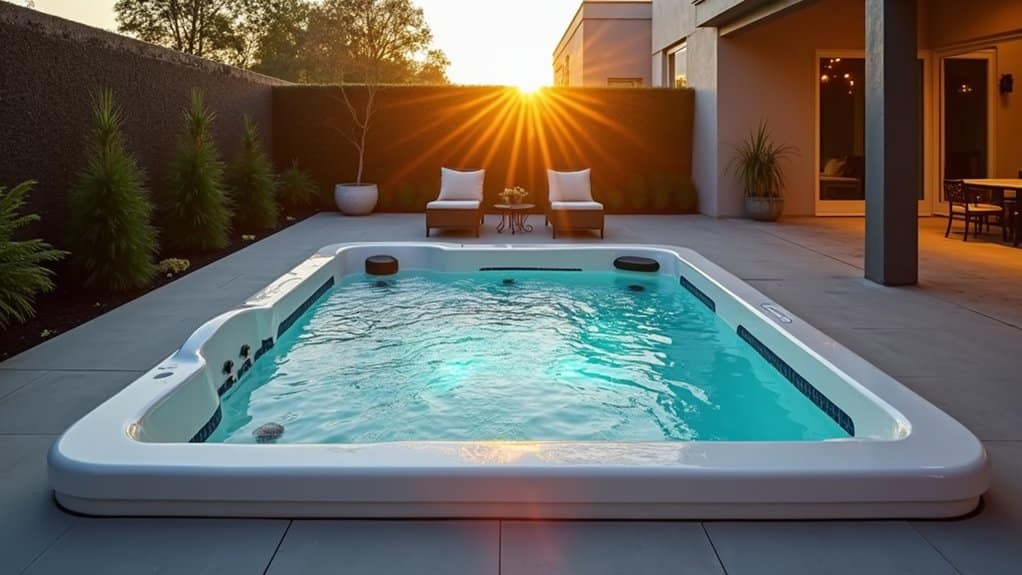
Three distinct price tiers define the $25K, $50K Endless Pool range. At $25K, you’re accessing compact swim-spa packages with core swim functionality, units like the Oasis Platinum that prioritize spa-jet amenities over advanced current hardware. Endless pools pricing climbs considerably at the $35K, $40K threshold, where dedicated swim machines like the Fastlane Swim Spa and Endless Pools acrylic models deliver stronger propulsion systems engineered for serious training. For those looking to invest, price comparison for lap pools can help determine the best value for your needs. By comparing various models and features, you can identify the right balance between functionality and cost.
At $50K, you’ll reach specialized equipment like the SwimEx Triton propeller system with basic inclusions. Swim current pool costs within this band shift considerably once you factor performance upgrades ($3,080+), heating systems ($4,500), electrical work, and site preparation. Treat any quoted figure as a hardware-and-package estimate, your fully installed total will run higher once installation-related expenses are calculated. The Fastlane machine can also be added to an existing pool with sufficient space, with hardware starting from $13,860 incl. GST before installation costs.
Where $25K Falls Short and $40K Gets Real
At $25K, you’re absorbing tradeoffs in propulsion quality, shell construction, and insulation spec before installation costs even hit the ledger. Once you factor site prep, electrical service upgrades, and placement logistics, that base number can blow past budget with no room for current-system performance or durability upgrades. At $40K, you’re crossing the threshold where an Endless Pools acrylic unit becomes a viable fitness investment rather than a compromised swim-spa substitute. For context, standard inground pool installations in Charlotte average $80,746 in cost, making a dedicated Endless Pools unit a comparatively lean capital outlay for homeowners weighing aquatic fitness options.
Budget Reality Check
While $25K technically enters the Endless Pools conversation, it won’t get you much beyond a bare-bones swim spa with a simplified shell, fewer therapy jets, lighter insulation, and a basic cover. At this spec level, you’re also excluding endless pools installation cost, site prep, electrical, plumbing, and permits that can add $5K, $15K to your total outlay.
Push your budget to $35K, $40K, and you’ll access acrylic-grade shells, upgraded hydraulics, and more complete therapy packages. That’s where the question “are endless pools worth the money” starts getting a defensible answer. At $40K+, you’re spec’ing units with meaningful insulation R-values, quieter propulsion systems, and finish quality that supports long-term durability. Below that threshold, expect compromises in operating efficiency, build sophistication, and overall usability. If you encounter issues with your purchase, platforms like AliExpress offer resources such as Buyer Protection to help safeguard your investment.
Worth It At $40K
The $25K price point lands you a functional swim spa, but functional doesn’t mean optimized. At that tier, you’re locked into basic shell construction, limited current output, and minimal finish detailing. Core adjustable resistance swimming pools capabilities exist, but precision control and build depth suffer.
Push to $40K, and the spec sheet changes materially. You gain access to larger footprints, higher-grade components, and refined propulsion systems that deliver smoother, more consistent current flow. Installation logistics, site prep, and accessory integration, covers, lighting, water-care systems, fit within budget without forcing component downgrades.
When evaluating endless pools features and cost, $40K represents the threshold where exercise utility and leisure functionality coexist. You’re purchasing a finished project, not a baseline unit requiring deferred upgrades. Long-term ownership economics favor this tier decisively.
How the Swim Current System Drives Endless Pool Pricing
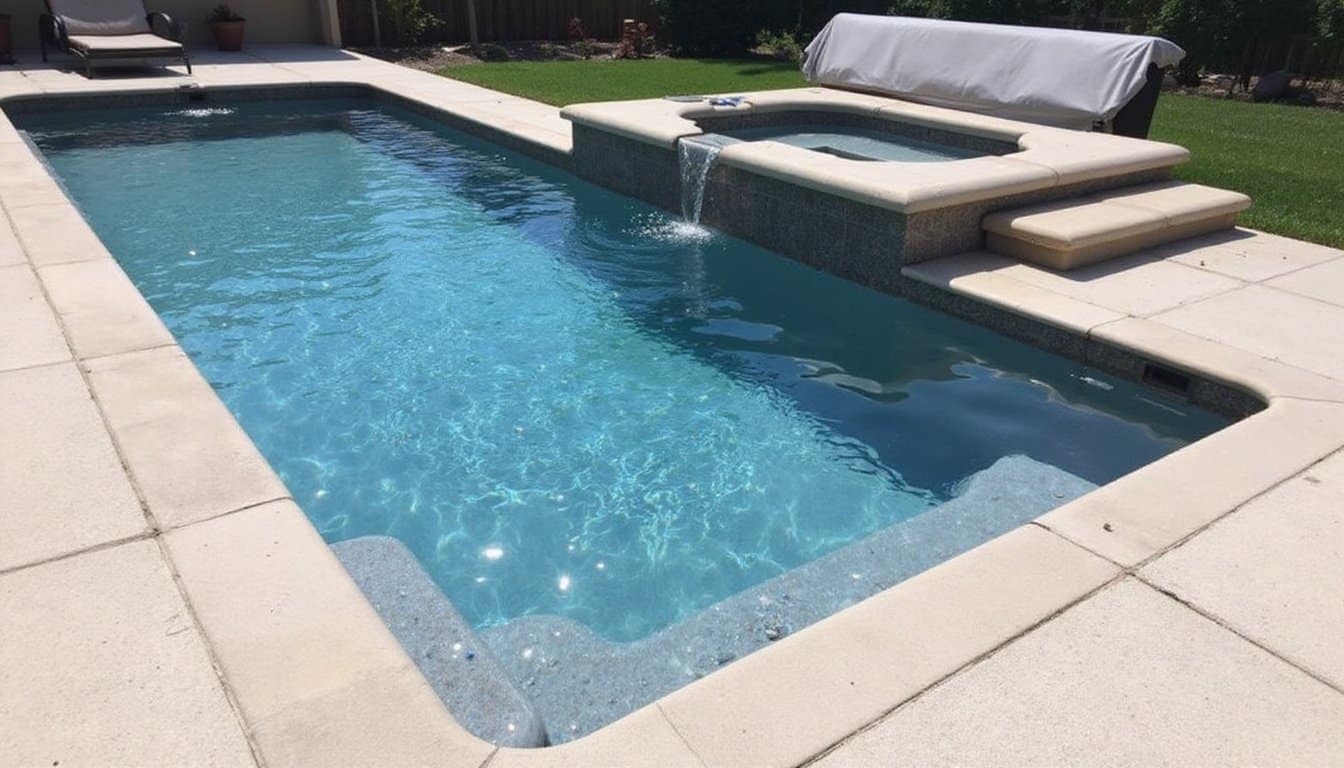
The swim current system is the single largest cost driver in an Endless Pool because it relies on a proprietary propeller-in-housing mechanism powered by an underwater hydraulic motor rather than standard circulation equipment. You’re paying for engineered propulsion technology that generates a smooth, river-flow current at up to 5,000 gallons per minute with endlessly adjustable resistance settings across multiple intensity levels. Higher-tier models command premium pricing because advanced control systems, stronger motors, and wider current lanes increase both manufacturing complexity and per-unit cost.
Current System Complexity
Because Endless Pools engineered their swim current around a proprietary Hydrodrive™ propeller system rather than conventional spa jets, the technology itself becomes the single largest cost driver in the product line. The current system complexity stems from a custom paddlewheel-style mechanism that pushes up to 5,000 gallons per minute into a wide, deep flow pattern, far exceeding standard spa circulation outputs.
This counter current swimming technology requires precision calibration to deliver consistent laminar flow across adjustable speed ranges. You’re paying for remote-control and app-based pace adjustment, variable resistance from therapeutic to competitive intensities, and modular on-site integration of the propulsion hardware. Each specification layer, flow volume, speed granularity, control interface, adds engineering and component costs that separate Endless Pools from simpler jet-driven swim spa alternatives.
Resistance Strength Options
When you move up Endless Pools’ product line, resistance strength is the specification that shifts pricing most dramatically. Entry-level units deliver moderate flow rates suitable for recreational fitness, while premium configurations push up to 5,000 gallons per minute, demanding heavier hydraulic components, reinforced shells, and advanced control electronics that drive costs higher.
Your resistance strength options extend beyond the swim current itself. Endless Pools offers color-coded resistance-band packages rated at 10, 15, and 20 lbs., adding strength-training versatility to the adjustable current system. This multi-modal capability justifies premium pricing because you’re purchasing a thorough training platform, not a single-function pool.
Fine-grained speed increments let you calibrate workout intensity precisely, supporting progressive overload protocols across fitness levels without requiring equipment swaps or mechanical modifications.
Propulsion Technology Costs
Behind every Endless Pool price jump sits one component, the propulsion system. Modular pools start at $19,500 with baseline current hardware, while upgraded Hydrodrive™ configurations push pricing to $39,999. The original model runs approximately $28,000; the Elite variant, equipped with a higher-output motor, hits roughly $40,000.
You’ll find propulsion bundled with digital pace displays and acrylic water-return channels in premium packages, landing between $35,000 and $39,999. Dual-propulsion setups can reach $100,000.
Swim spa units start at $25,999 MSRP, higher than modular entry points, because they integrate stronger current generators into self-contained shells. That propulsion premium reflects the engineering required to deliver 100 speed settings across compact footprints. Whether you’re spec’ing a modular pool or a swim spa, current system selection remains your primary cost variable.
Endless Pool Shell, Jets, and Insulation Worth the Upgrade
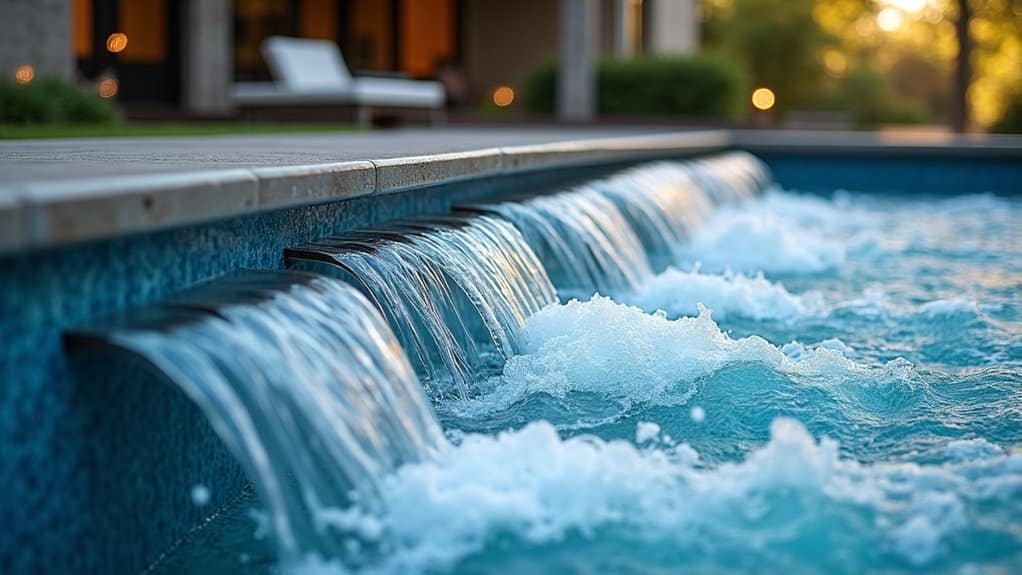
Although the base Endless Pool shell uses galvanized steel construction with a vinyl liner, upgrading to enhanced shell stiffness and structural rigidity pays dividends in long-term durability, particularly for indoor or semi-recessed installations where the cabinet must handle continuous load stress.
You’ll find across endless pools reviews that the propeller-driven current system with 100 speed settings outperforms basic jet configurations by delivering a broad, non-turbulent swim lane wider than your stroke profile. This compact lap pool technology pushes up to 5,000 gallons per minute while maintaining laminar flow consistency.
Insulation upgrades matter most if you’re running year-round. Smaller water volumes, typically 2,000 to 8,000 gallons, already reduce heating and chemical costs versus conventional pools. Pairing that efficiency with an all-season cabinet design minimizes thermal loss and operational overhead across climates.
Delivery, Covers, and Other Costs That Inflate Your Budget
Because Endless Pools’ MSRP excludes shipping, installation, and taxes, your actual landed cost runs markedly higher than the advertised base price. Delivery costs alone range $100, $400, varying by urban versus rural freight logistics. Installation runs $2,000+, while site prep, leveling, concrete slab work, adds $500, $12,000 depending on placement complexity.
| Cost Category | Estimated Range |
|---|---|
| Delivery/Shipping | $100, $400 |
| Installation/Setup | $2,000+ |
| Site Preparation | $500, $12,000 |
| Accessory Add-Ons | Varies by config |
| Monthly Maintenance | $100, $300 |
Accessory add-ons, underwater treadmills, workout equipment, upgraded covers, represent a separate budget category that pushes final spend well beyond base-model quotes. You’ll want to spec these individually rather than assuming they’re bundled. Factor ongoing maintenance at $960, $1,800 annually to capture true ownership cost.
Endless Pools vs. Traditional In-Ground Pools on Cost
Installation further widens the gap. Endless Pools leverage modular architecture, keeping install costs around $2,000+, whereas traditional in-ground pools demand site-specific excavation, structural engineering, and material-dependent labor that escalates unpredictably. Operating costs compound the differential, smaller water volumes mean reduced chemical consumption, lower heating demand, and monthly maintenance running approximately $100 to $200. You’re looking at measurably lower total cost of ownership across the system’s lifecycle.
Fitness, Therapy, or Both: Picking the Right Endless Pool Setup
How you spec your Endless Pool, fitness-driven, therapy-oriented, or a hybrid of both, determines the component package, performance envelope, and final project cost.
| Setup Type | Core Spec Priority |
|---|---|
| Fitness | High-output current generator, adjustable resistance increments, minimal spa add-ons |
| Therapy | Hydrotherapy pool features including targeted jets, warm-water capability, ergonomic seating |
| Hybrid | Dual-zone current control plus integrated recovery jets and temperature management |
A fitness build keeps costs controlled by eliminating comfort extras and prioritizing propulsion output. Therapy-first configurations stack hydrotherapy pool features, jet arrays, lighting, temperature precision, that push pricing toward the upper $25K, $50K band. Hybrid setups deliver maximum versatility but require careful spec balancing. You’ll want adjustable current across all three configurations since it governs both training progression and therapy-friendly intensity control.
Bring Resort-Style Spa Living Home
Whether you’re investing in a lap pool, swim spa, or endless pool, expert design and installation make the difference between good and unforgettable. At Cristallo Pools in Jupiter, FL, our experienced team provides trusted Spa Additions with luxury craftsmanship and a personalized approach. Call +1 (561) 766-0353 today and start designing the perfect addition for your backyard.
Frequently Asked Questions
How Long Does a Typical Endless Pool Last Before Needing Major Repairs?
You can expect a typical Endless Pool to deliver 15, 20 years of reliable service before major repairs become likely. With disciplined maintenance and moderate usage cycles, some units exceed 25 years of operational life. You’ll replace cartridge filters every 3, 6 months and cycle water every 1, 2 years, but pumps, heaters, and circulation components typically don’t require significant intervention until the system approaches its second decade of continuous operation.
Can an Endless Pool Be Installed Indoors in a Basement?
Yes, you can install an Endless Pool in a basement. Modular components fit through standard doorways and stairways, enabling on-site assembly. You’ll need a solid, level concrete floor rated for 200 lbs./sq. ft. load capacity. Choose above-ground, partially in-ground, or fully in-ground configurations, low-ceiling spaces work best with full in-ground builds. Corner placement minimizes your footprint. You’ll also need proper ventilation, humidity control, and dehumidification systems for indoor operation.
How Much Electricity Does an Endless Pool Use Each Month?
You’ll typically consume 200, 450 kWh/month, depending on your heating setpoint, ambient conditions, insulation R-value, and pump runtime. At $0.10/kWh, that translates to roughly $20, $50/month under moderate-use scenarios. The E500 fitness system, for example, draws approximately 432 kWh/month at 30.5°C water temp with six 60-minute sessions weekly. Your biggest load driver is the heater, upgrading to a high-COP heat pump and using a thermal cover greatly reduces consumption.
Do Endless Pools Work Well for Competitive Swim Training?
Yes, Endless Pools support competitive training effectively. You’ll build aerobic capacity and refine stroke mechanics through continuous countercurrent swimming without flip-turn interruptions. The Elite model generates speeds around 0:51/100 yards, suitable for collegiate-level athletes. However, you can’t practice race starts, underwater breakouts, or turn sequences. Within your $25K, $50K budget, you’ll likely access mid-tier configurations offering solid interval and technique work, though peak-performance Elite units typically run closer to $65K.
What Ventilation Is Needed for an Indoor Endless Pool Installation?
You’ll need humidity control targeting 40%, 60% RH and four to six air changes per hour. If you keep a cover on and uncover the pool less than one hour daily, a humidistat-controlled bathroom exhaust fan vented outdoors often suffices. Without consistent cover use, you’ll need a dedicated pool-room dehumidifier. Maintain negative pressure relative to adjacent spaces, install a warm-side vapor barrier, and insulate ceiling assemblies to prevent condensation.