
Swimming laps gives you a full-body cardio workout that strengthens your heart, burns up to 360 calories in 30 minutes, and cuts your risk of heart disease by 41%. Because buoyancy supports up to 90% of your body weight, you’ll train with near-zero joint impact, making it ideal if you’re managing arthritis or recovering from injury. Structured intervals and progressive volume build real endurance safely over time. Below, you’ll find exactly how each benefit works.
What Makes Lap Swimming One of the Best Cardio Workouts?
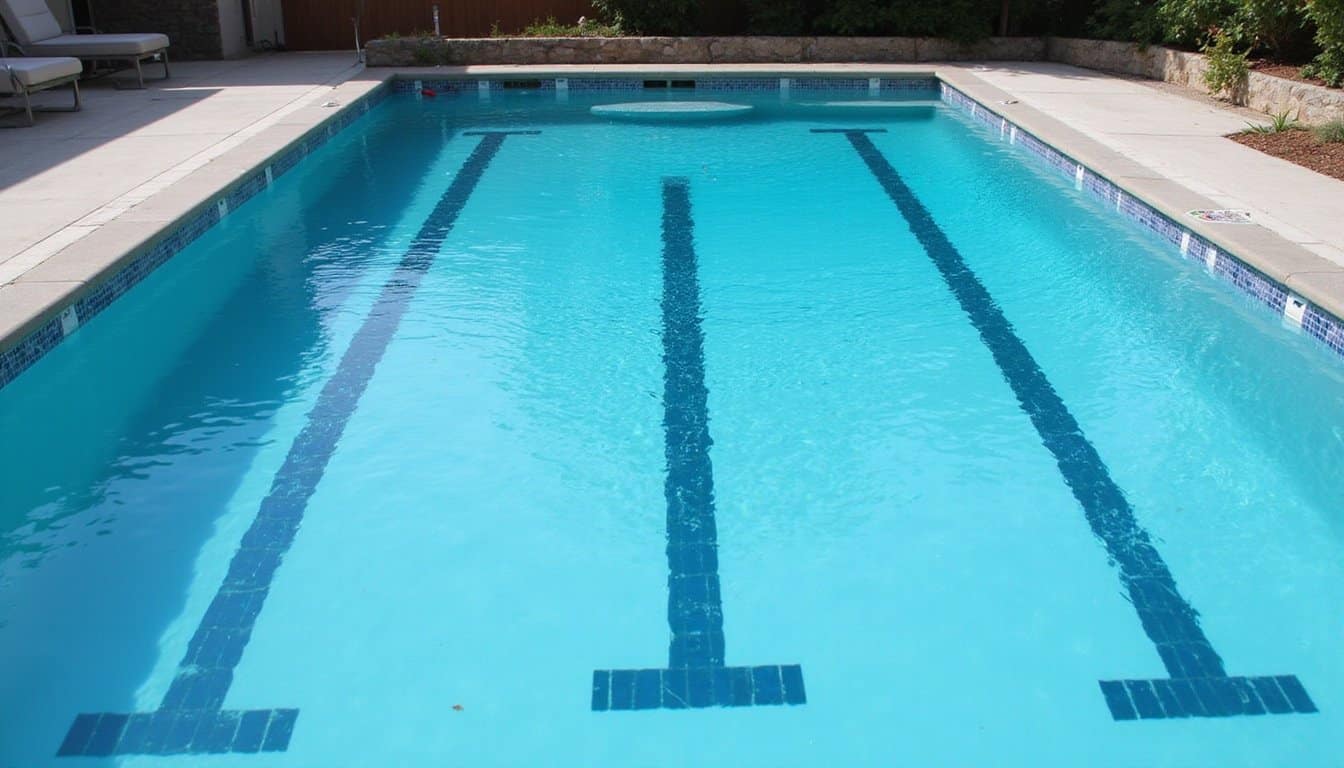
Because lap swimming demands coordinated effort from your arms, shoulders, back, core, hips, and legs simultaneously, it delivers a training stimulus that most land-based cardio can’t match in a single activity. Water resistance forces continuous muscular engagement throughout each stroke cycle, creating high training volume without impact loading.
Among the key lap pool fitness benefits is efficient calorie expenditure. Cleveland Clinic reports a 154-pound person burns roughly 255 calories in just 30 minutes of slow freestyle. Interval formats, like 10 × 25 yards with structured rest, build cardiorespiratory endurance while managing fatigue effectively. You can scale sessions from brief efforts to longer descending sets as your capacity improves. Mixing easy, moderate, and harder intervals also keeps sessions engaging and prevents early burnout. This adaptability, combined with full-body recruitment and low joint stress, makes lap swimming one of the most sustainable cardiovascular training options available.
How Lap Swimming Strengthens Your Heart
When you swim laps consistently, your heart adapts the same way any muscle does under repeated training, it grows stronger and more efficient. Your resting heart rate drops, your circulation improves, and your heart pumps blood more effectively with each beat. These adaptations mean better oxygen and nutrient delivery to working muscles and organs.
The cardiovascular fitness gains from pool training are well supported by research. A study cited by Cleveland Clinic found swimmers had a 41% lower risk of death from heart disease or stroke compared with non-swimmers. Regular swimming also lowers blood pressure and reduces arterial stiffness, particularly in individuals managing hypertension. Your lungs strengthen alongside your heart, improving breathing efficiency and extending how long you can sustain effort before fatigue sets in. Swimming also enhances blood flow and keeps arteries flexible, further supporting long-term cardiovascular health.
Calories Burned Swimming Laps vs Running
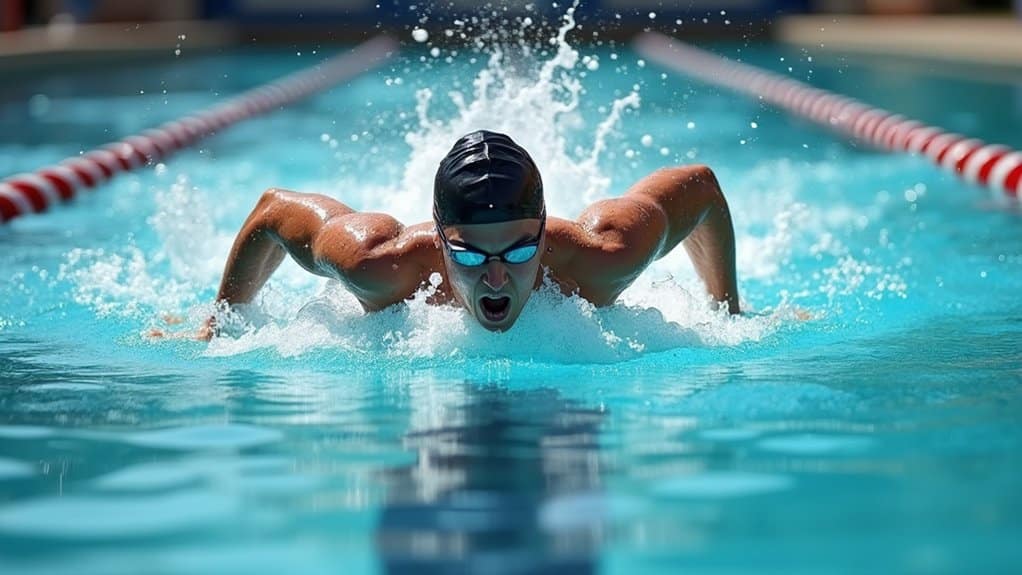
When you’re comparing lap swimming to running, calorie burn depends on your pace, body weight, and workout intensity, with running at moderate to high speeds often edging out swimming in time-based comparisons. However, swimming’s water resistance engages more muscle groups simultaneously and places considerably less stress on your knees, hips, and ankles, making it a safer option if joint protection matters to you. If you increase your stroke intensity and incorporate interval sets, you can close the calorie gap while gaining the efficiency of a full-body, low-impact workout. Research also shows that 30 minutes of daily swimming can reduce coronary heart disease in women by 30-40%, adding long-term health value that goes beyond simple calorie comparisons.
Calorie Burn Comparison
Although both swimming and running rank among the highest-calorie-burning cardio activities, the actual numbers depend heavily on body weight, intensity, and duration.
- A 155-lb person burns roughly 216, 223 calories swimming recreationally for 30 minutes, compared to 298 calories running at 5 mph.
- Vigorous lap swimming at 155 lb reaches 360, 372 calories per 30 minutes, narrowing the gap considerably.
- Running at 7.5 mph pushes to approximately 465 calories in 30 minutes, outpacing most calorie burning swimming workouts.
- Water resistance increases work per distance, meaning swimming can outperform running in equal-distance comparisons.
- Interval-style swimming raises expenditure by alternating hard effort with recovery.
Running typically burns more calories per minute at moderate-to-fast paces. However, you’ll maximize swimming’s calorie output by maintaining vigorous, sustained effort throughout your session.
Joint Impact Differences
Calorie burn matters, but it doesn’t tell the full story, especially if joint stress limits how often you can actually train. Running transfers repeated impact through your knees, hips, and ankles with every stride, concentrating force on weight-bearing joints. Over time, this increases overuse injury risk.
Swimming shifts that equation. Water’s buoyancy supports your body weight, reducing mechanical load on joints while distributing effort across multiple muscle groups. This makes joint impact exercise pools a practical choice if you’re managing arthritis, chronic pain, or recovering from injury.
The tradeoff is straightforward: running often burns more calories per minute, but swimming lets you train more frequently with less recovery demand. If consistency drives results, lower joint stress can matter more than higher per-session calorie output.
Intensity and Efficiency
Because swimming and running demand effort in fundamentally different ways, their calorie-burn profiles don’t line up as neatly as most people assume. Intensity and efficiency depend on stroke selection, pace, body weight, and water resistance.
- A 155-lb person burns approximately 223 calories in 30 minutes of leisurely swimming versus 372 calories swimming vigorously
- Running at 5 mph burns roughly 298 calories in 30 minutes; at 7.5 mph, approximately 465 calories
- Swimming burns more calories over short periods due to full-body water resistance
- Running typically wins for total calories during longer sessions
- Hard lap pool workouts can outperform an easy run, while easy swimming trails brisk running
You’ll maximize intensity and efficiency by incorporating short, vigorous intervals into your lap pool workouts rather than maintaining a steady recreational pace. The typical installation timeframe for lap pools can vary based on several factors, including site preparation and permitting processes. Homeowners should anticipate a few weeks to several months from planning to completion, depending on the complexity of the project.
Every Stroke Works Your Entire Body
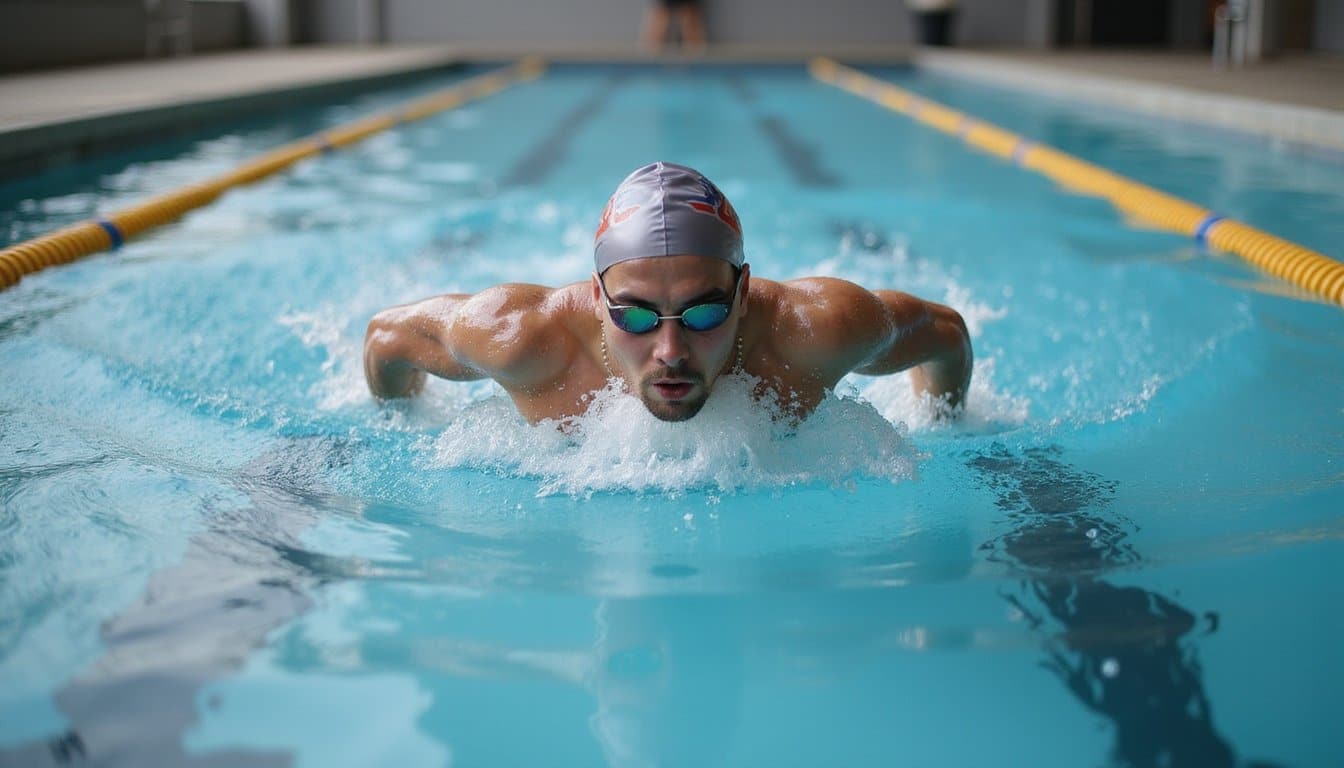
Swimming recruits more muscle groups per stroke than most land-based exercises. Each stroke demands whole-body muscle recruitment, engaging your shoulders, back, core, arms, legs, and glutes simultaneously. Your core stabilizes your trunk during rotation, breathing, and kicking, while your limbs generate propulsion against water’s natural resistance.
| Stroke | Primary Upper Body | Primary Lower Body |
|---|---|---|
| Freestyle | Shoulders, lats, forearms | Glutes, hip flexors |
| Backstroke | Shoulders, upper back | Quads, calves |
| Breaststroke | Chest, deltoids | Hamstrings, hip adductors |
| Butterfly | Shoulders, chest | Glutes, core |
Buoyancy supports roughly 90 percent of your bodyweight, reducing joint stress while maintaining resistance. You’re effectively performing a full-body resistance exercise with every stroke cycle.
How Lap Pool Workouts Build Real Endurance
Endurance in the water doesn’t come from swimming the same comfortable pace day after day, it develops through structured training that challenges your cardiovascular system to adapt.
Effective endurance swim training combines interval work with longer continuous efforts:
Building real endurance in the pool means blending intense intervals with steady, longer swims to push your limits.
- Short-interval repeats like 4 × 50 m sprints with 20, 30 seconds rest push your cardiovascular ceiling higher
- Continuous swims of 30, 45 minutes at moderate pace build sustained aerobic capacity
- Endurance ladders (200 m, 400 m, 600 m) progressively extend working time
- Breathing patterns every 3, 5, or 7 strokes develop rhythm and efficiency under fatigue
- Weekly volume increases of 10, 15% prevent burnout while steadily raising your capacity
Gains develop over weeks to months, not single sessions. Frequent shorter swims outperform occasional long efforts for lasting cardiovascular adaptation.
Why Water Buoyancy Is Easier on Your Joints
When you exercise in a lap pool, buoyancy can reduce your effective body weight by up to 90% at neck depth, dramatically lowering the compression forces on your knees, hips, spine, and ankles. That reduced joint loading makes swimming one of the most arthritis-friendly exercises available, allowing you to move through a fuller range of motion with less pain and stiffness. Over time, consistent low-impact training in water helps minimize cumulative wear on your joints compared with land-based alternatives.
Reduced Joint Impact
Water buoyancy offloads a significant percentage of your body weight, which directly reduces the compressive forces acting on your knees, hips, ankles, and lower back during exercise. This reduced joint impact means you can train longer without the wear associated with land-based activity.
Key mechanisms behind this protection include:
- Water supports your body weight, lowering stress on bones, joints, and muscles
- Even resistance surrounds you in all directions, eliminating sudden jarring movements
- Strengthened muscles from water resistance improve joint stability over time
- Extended sessions become feasible without increased joint or muscle pain
- Full range-of-motion strokes maintain flexibility while minimizing strain
Research confirms aquatic exercise produces measurable reductions in pain and joint dysfunction compared with both control groups and land-based exercise, making lap swimming a evidence-backed, joint-protective training method.
Arthritis-Friendly Movement
Because arthritis restricts comfortable motion on land, a lap pool’s warm-water environment offers a practical alternative that directly addresses the underlying barriers to exercise. Warm-water aquatic therapy uses buoyancy, hydrostatic pressure, and gentle resistance to reduce joint loading, making arthritis-friendly movement accessible even during flare-ups. Chest-high water supports approximately 90% of your body weight, enabling rehabilitation through swimming without harsh impact.
| Factor | Land Exercise | Low Impact Exercise Pools |
|---|---|---|
| Joint Loading | Full body weight | ~10% body weight |
| Resistance Type | External weights | Smooth, multidirectional |
| Muscle Guarding | Common | Reduced |
You’ll find that warm water loosens tight muscles, improves circulation, and reduces stiffness, allowing controlled range-of-motion work across osteoarthritis, rheumatoid arthritis, and spondyloarthritis conditions.
Less Wear Overall
Buoyancy does most of the heavy lifting, literally. When you’re submerged to the waist, water offloads roughly 50% of your body weight. At neck depth, that figure reaches approximately 90%. This dramatic reduction in compressive force is central to the fitness pool benefits swimmers experience daily.
Here’s what less mechanical load means for your joints:
- Reduced stress on knees, hips, spine, and ankles during every stroke
- Smoother resistance that eliminates jarring, high-impact forces
- Lower cumulative wear from repetitive motion over weeks and months
- Safer endurance sessions with minimized injury risk
- Extended training years since joint degradation slows without constant ground-reaction forces
You’re building cardiovascular fitness and muscular endurance without the structural cost that land-based training demands. That’s less wear where it matters most.
Lap Swimming for Arthritis and Injury Recovery
For people managing arthritis or recovering from injuries, a lap pool offers a controlled environment where movement becomes easier and less painful. Water buoyancy supports your body weight, reducing stress on hips, knees, ankles, and your spine. Research on lap swimming for arthritis and injury recovery shows measurable results, a meta-analysis of 20 osteoarthritis studies found aquatic exercise reduced pain by 0.61 points versus control groups.
Warm water relaxes muscles and nerve endings, easing stiffness during movement. Water pressure helps reduce swelling in injured areas while providing controlled resistance that rebuilds strength without high-impact loading. You’ll move through a fuller range of motion than most land-based exercises allow. Start with slow, gentle strokes and avoid forcing painful joints, consistency matters more than intensity during recovery phases.
Breathing Control and Lung Capacity Gains
While most land-based exercises let you breathe freely on demand, lap swimming forces a structured breathing pattern, you can only inhale during specific moments in your stroke cycle. This constraint makes breathing control in lap swimming a built-in respiratory training tool.
Key adaptations from consistent practice include:
- Improved lung capacity through repeated aerobic demand over weeks of training
- Stronger respiratory muscles, with studies showing a mean inspiratory pressure gain of 29.35 cmH₂O after structured training
- Greater breath-holding tolerance as you reduce breathing frequency per length
- Better swimming economy, meaning you’ll use less oxygen at the same effort level
- Enhanced ventilatory timing by coordinating diaphragmatic breathing with stroke mechanics
You can progressively challenge yourself by breathing every 3, 5, or 7 strokes during drill sets.
Mood, Sleep, and Stress Relief From Lap Swimming
Beyond its physical benefits, lap swimming directly influences mood, stress levels, and sleep quality, areas that often determine whether an exercise habit lasts. Research shows aquatic exercise produces a significant mood boost, with a meta-analysis of 18 studies reporting measurable improvement in mental health symptoms (SMD = −0.77, P < 0.01). Even short sessions can trigger endorphin release and shift your emotional state.
For stress reduction, rhythmic strokes and controlled breathing create a meditative effect that interrupts rumination and releases physical tension. You’re forced to focus on the present moment, which quiets mental noise.
Regular lap swimming also provides meaningful sleep support. By lowering stress and expending energy in a low-impact environment, you’ll find it easier to fall asleep and stay asleep, reinforcing the consistency that drives long-term fitness results.
How to Start a Simple Lap Pool Routine
Starting a lap pool routine doesn’t require advanced swim skills or long workouts, just a structured approach that builds gradually. Harvard Health recommends beginning with 5 to 10 minutes per session, a few times per week, then increasing duration as comfort improves. Lap pool depth recommendations for swimmers vary based on skill level and intended use. Beginners may find shallower depths advantageous for building confidence, while more experienced swimmers often prefer deeper water to accommodate various strokes.
Structure each lap pool workout with these fundamentals:
- Warm up with 2 to 4 easy laps and gentle stretches before your main set
- Swim short intervals, 25 to 30 seconds on, 20 to 30 seconds rest
- Keep effort moderate, around 4 to 5 out of 10, to stay repeatable
- Exhale underwater and practice breathing every 3 strokes for rhythm
- Cool down with 1 to 2 slow laps rather than stopping abruptly
Prioritize consistency over intensity. Small weekly progressions in volume produce more sustainable results than occasional hard efforts.
Bring Resort-Style Spa Living Home
Whether you’re investing in a lap pool, swim spa, or endless pool, expert design and installation make the difference between good and unforgettable. At Cristallo Pools in Jupiter, FL, our experienced team provides trusted Spa Additions with luxury craftsmanship and a personalized approach. Call +1 (561) 766-0353 today and start designing the perfect addition for your backyard.
Frequently Asked Questions
What Water Temperature Is Best for Fitness Lap Swimming?
You’ll want to keep your lap pool between 78°F and 84°F for most fitness swimming. If you’re doing faster intervals or competitive-style training, aim for 78°F to 82°F so your body dissipates heat efficiently. If you’re focused on joint comfort or recovery swims, you can raise the temperature to 82°F to 86°F. Staying below 86°F helps you avoid overheating during prolonged sessions and supports safer, more sustainable workouts.
How Wide Does a Residential Lap Pool Need to Be?
You’ll need at least 4 feet of width for single-lane lap swimming, but most residential builds target 2 to 2.5 meters (roughly 6.5 to 8 feet) for comfortable stroke clearance. If you’re planning for two swimmers, aim for 2.5 meters or wider, matching commercial lane spacing. Factor in your primary stroke type and turning needs, butterfly and breaststroke demand more lateral room than freestyle.
Can Lap Swimming Replace Weight Training for Muscle Building?
Lap swimming alone won’t replace weight training for maximal muscle growth. Swimming builds muscular endurance and lean definition because water’s density creates continuous resistance, but it doesn’t provide the progressive overload you need for serious hypertrophy. You’ll develop functional strength and visible tone, especially with higher volume, but for significant size and strength gains, you should supplement your swimming with dryland resistance work like weights or bodyweight exercises.
Is Lap Swimming Effective for Cross-Training With Other Sports?
Yes, lap swimming is highly effective for cross-training. You’ll build cardiovascular fitness across upper and lower body simultaneously while reducing joint stress on your ankles, knees, and hips. One study found runners who added swimming improved their 3.2 km time by 13 seconds over 10 weeks. You can use swim sessions for active recovery, endurance maintenance, and injury prevention, just make sure you’re using proper stroke technique to maximize carryover to your primary sport.
How Long Can Most People Continue Lap Swimming as They Age?
You can typically continue lap swimming well into your seventies and eighties, since water buoyancy protects your joints from the impact stress that limits many land-based activities. Studies show swimmers around 50 maintaining physiological function comparable to people 20 years younger. You’ll want to adjust your stroke selection, pacing, and training volume as you age, and it’s smart to get a medical review before starting or intensifying a program after 70.