An indoor pool gives you year-round, climate-controlled swimming regardless of weather, easier maintenance with no leaves or debris, and added privacy. However, you’re looking at $150,000 to $500,000+ upfront, $80–$260/month in operating costs, and a dedicated dehumidification system to prevent mold and structural damage. You’ll also need to navigate building codes and allocate space for mechanical equipment. The sections below break down each factor so you can decide confidently.
Why an Indoor Pool Gives You Year-Round Access
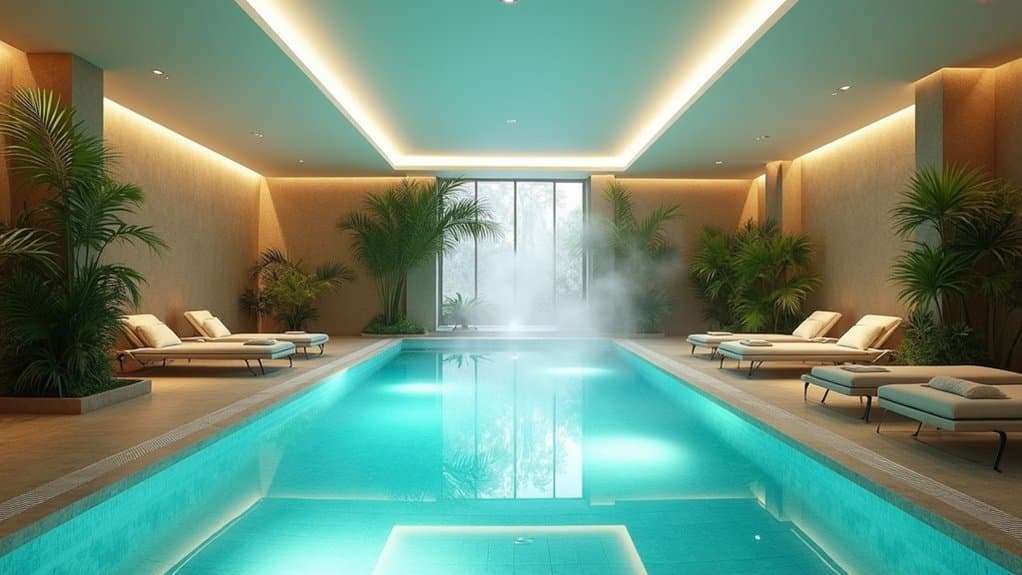
Because an indoor pool operates within a climate-controlled enclosure, it eliminates the seasonal downtime that sidelines most outdoor installations for months at a stretch. You’re not waiting for temperatures to climb or scheduling around storm forecasts. Water and air conditions stay regulated, so January swims feel no different than July sessions.
Year round swimming access means your training plan stays intact regardless of what’s happening outside. You maintain cardiovascular conditioning, strength-endurance work, and recovery routines without gaps. For swimmers using the pool four or five times weekly, that continuity compounds over time. That consistency matters because regular swimming can prevent serious diseases, ultimately offsetting healthcare costs down the line.
You also gain schedule flexibility that outdoor pools can’t match. Early morning laps, late-night recovery sessions, none of it depends on daylight or weather windows. The pool operates on your timeline, not the season’s.
No Leaves, No Bugs: Indoor Pool Cleanup Is Easier
While year-round access is the headline benefit, the reduced maintenance burden is what most owners notice first in daily operation. You won’t deal with leaves, insects, dust, or storm runoff clogging your skimmer baskets. That lower debris load means less skimming, vacuuming, and chemical adjustment between service cycles.
In-floor cleaning systems handle remaining particulate by pushing dirt toward the main drain, with pop-up cleaners operating in groups of 2 to 10 for sequential coverage. This automation cuts manual intervention considerably. A typical pool uses 15+ pop-up heads positioned across the pool surface, sitting flush with the floor when not actively cleaning.
Don’t assume you’re avoiding indoor pool maintenance issues entirely. Bacteria and algae still develop without proper filtration, plan on running filters 8–12 hours daily. Condensation and mold require dedicated ventilation strategies. The workload shifts rather than disappears, but predictable, weather-independent maintenance beats reactive outdoor cleanup every time.
Privacy and Safety Benefits of an Indoor Pool
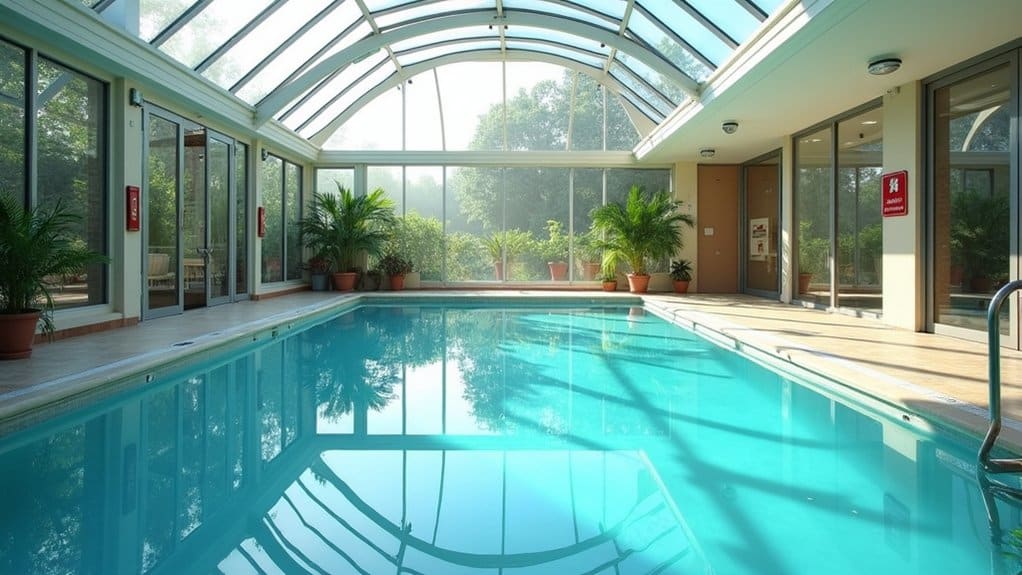
An indoor pool gives you a level of privacy that outdoor installations can’t match, shielding your swim area from neighbors, street traffic, and outside observation. You also gain tighter access control, which is critical if you’ve got young children since the enclosed structure limits unsupervised entry far more effectively than a backyard setup. These safety and privacy advantages depend on proper building design, ventilation planning, and local permit compliance to function as intended. Well-maintained safety and privacy features can also increase property appeal, potentially attracting buyers who value controlled access and seclusion in a home.
Enhanced Home Privacy
Unlike outdoor pools that remain exposed to neighboring properties and street traffic, indoor pools create a fully enclosed swim environment that eliminates external sightlines. This ranks among the most practical indoor pool benefits for homeowners in dense neighborhoods where backyard visibility compromises comfort.
| Privacy Feature | Function | Result |
|---|---|---|
| Enclosed walls and roofing | Blocks visual access from adjacent properties | Complete screening from neighbors |
| Dedicated pool room design | Separates swim space from outdoor zones | Controlled, private environment |
| Interior placement | Removes street-level exposure | Unobserved exercise and recreation |
You’ll find that a purpose-built enclosure supports uninterrupted use without concern about passersby or shared property lines. This physical barrier transforms your pool area into a personal sanctuary suited for exercise, therapy, and family recreation.
Controlled Access Safety
How effectively can you prevent unauthorized pool access? An indoor pool gives you a structural advantage, walls, doors, and a defined entry point you can secure with access control systems using cards, fobs, or keypads. That’s controlled access safety built into the architecture itself.
Install self-closing, self-latching doors with audible alarms rated at 85 dBA or higher at 10 feet. Alarms should activate within seven seconds and sound for at least 30 seconds. For child safety, barriers should reach 48 inches minimum with no more than 4 inches of bottom clearance.
Security cameras at entry points supplement credential-based systems by documenting all activity. Every entry event ties to a specific credential, replacing guesswork with data. You’re not just enclosing a pool, you’re engineering a monitored perimeter.
What an Indoor Pool Actually Costs to Build
You’ll spend between $50,000 and $200,000 on the enclosure alone, foundation, framing, roofing, and moisture-resistant finishes, before the pool shell ever gets installed. Add $20,000 to $60,000 for the HVAC and dehumidification systems that keep the space functional, plus another $10,000 to $40,000 for electrical, plumbing, and permits. When you factor in the pool itself, realistic all-in budgets for a properly built indoor pool typically land between $150,000 and $250,000.
Pool Room Structure Costs
Because the pool itself represents only a fraction of the total investment, understanding where the real money goes matters before you commit to a build. The enclosure structure, foundation, framing, roofing, exterior walls, and glazing, typically runs $50,000–$200,000+, often exceeding the pool shell cost.
Your building footprint must extend beyond the pool dimensions, adding at least 1 m in width, 2 m in length, plus roughly 9 m² for the plant room. Custom builds commonly price out at $100–$300 per square foot installed, while prefab options range $80–$200. Concrete shells alone can hit $50,000–$100,000+.
Factor in that indoor pool maintenance costs remain year-round since dehumidification, HVAC, and ventilation systems run continuously. Full-size residential projects regularly land at $200,000 or more all-in.
Equipment and System Expenses
While the pool room structure eats the largest share of your budget, the mechanical systems inside it aren’t far behind, and they’re what actually make the space functional. HVAC and dehumidification alone typically run $20,000–$60,000, driven largely by indoor pool humidity challenges that demand continuous moisture control. Add pumps, filters, heaters, and automated controls, and equipment costs stack up fast.
| Equipment Category | Typical Cost Range |
|---|---|
| HVAC/Dehumidification | $20,000–$60,000 |
| Pool Equipment Package | $4,000–$12,000+ |
| Automated Controls | $2,500–$5,500 |
You’ll also budget for electrical, plumbing, and permits, commonly $10,000–$40,000 combined. Variable-speed pumps, salt chlorine generators ($1,500–$2,500 installed), and LED lighting ($650–$900 installed) are frequent upgrades. These systems operate year-round, so sizing them correctly at installation directly impacts long-term energy costs.
Monthly Operating Costs: Indoor vs. Outdoor Pools
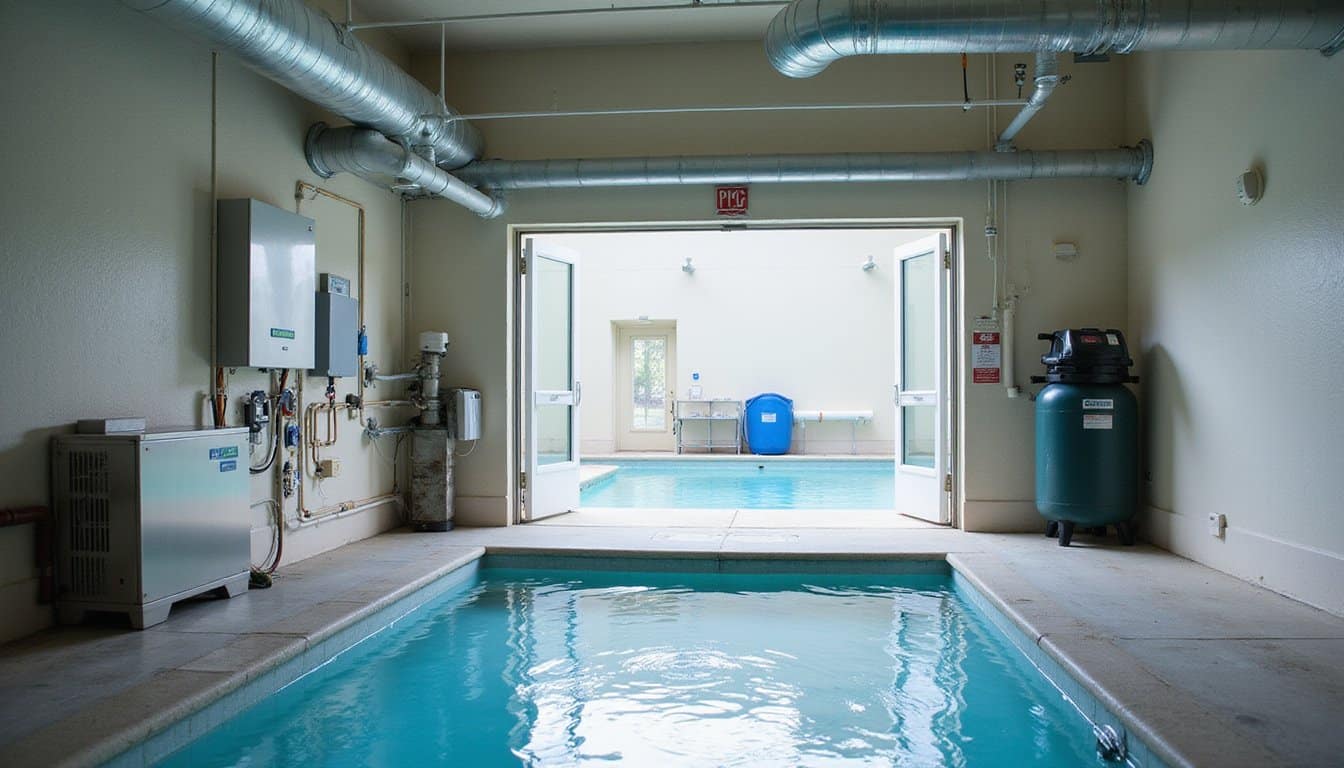
Once the construction dust settles, the real financial picture of an indoor pool reveals itself in monthly utility bills. Understanding monthly operating costs: indoor vs. outdoor pools helps you budget accurately.
Indoor pool costs don’t end at construction, they start at your monthly utility bill.
- Heating and HVAC: Indoor pools run year-round, driving electricity to $65–$100+ monthly before factoring in dehumidification and ventilation systems.
- Cleaning: You’ll spend $20–$100/month DIY or $60–$400/month professionally, though indoor pools typically trend lower due to reduced debris.
- Chemicals: Expect $25–$62.50/month for balancing, with indoor environments reducing algae pressure but not eliminating chemical needs.
- Total baseline maintenance: Many owners report $80–$260/month for combined upkeep costs.
- Seasonal savings gap: Outdoor pools closed 6–8 months annually accumulate zero heating costs during shutdown, lowering their annual average considerably.
How Indoor Pool Humidity Can Damage Your Home
If you don’t manage humidity properly, the moisture your indoor pool generates will attack drywall, framing, insulation, and paint finishes through persistent condensation on cooler surfaces. That same damp air accelerates corrosion of metal hardware, pipes, and fixtures throughout the pool enclosure. You’ll also need to address chloramine buildup, since poor ventilation traps irritating chemical byproducts in the enclosed space, degrading both air quality and occupant comfort.
Moisture Damages Building Materials
Because indoor pools generate far greater vapor pressure than surrounding rooms, moisture constantly pushes outward through walls, ceilings, and structural assemblies. Without a properly placed vapor barrier, water penetrates brick, stone, wood, and most porous materials, often causing hidden damage within wall cavities before you notice any surface symptoms.
Moisture-driven material damage in indoor pool rooms typically manifests as:
- Efflorescence on masonry surfaces from mineral deposit migration
- Peeling finishes and staining on moisture-sensitive materials
- Mold growth that accelerates structural deterioration
- Insulation performance loss from trapped moisture within assemblies
- Shortened service life of framing components and enclosure finishes
You’ll often spot damage first on cooler elements, windows, wall corners, and exterior-facing assemblies where condensation concentrates. Addressing these vulnerabilities requires deliberate enclosure design before construction begins.
Corrosion Risk Increases
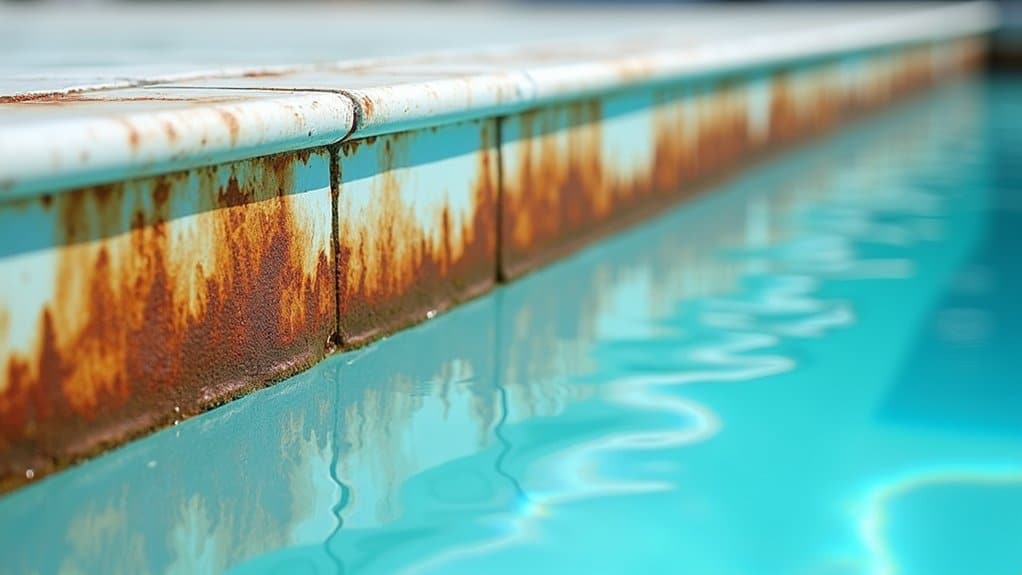
While moisture’s effect on porous building materials is often the first concern, corrosion poses an equally serious threat to metal components throughout and beyond the pool enclosure. When relative humidity exceeds the recommended 50% to 60% range, corrosion risk increases markedly for pipes, fixtures, and hardware near the pool area.
You’ll notice warning signs like rusting on metal surfaces, condensation on windows and skylights, and persistent dampness in surrounding rooms. Poor air movement creates humidity stratification, accelerating deterioration of upper structural elements. Without a dedicated dehumidification system and proper mechanical ventilation, humid air migrates into ceilings, walls, the roof, and even your foundation. Keeping air temperature approximately two degrees above water temperature reduces evaporation, while exhaust fans replace moisture-laden air with drier intake air.
Chloramine Air Quality Issues
Moisture isn’t the only airborne problem an indoor pool creates. Chloramine air quality issues pose a serious health risk you need to address during design. Chloramines form when chlorine reacts with swimmer waste, and the primary airborne compound, nitrogen trichloride, accumulates in enclosed spaces without proper ventilation.
Poor indoor pool air quality produces measurable symptoms:
- Stinging, red eyes during and after swimming
- Persistent coughing or wheezing in the pool room
- Throat and nasal irritation that worsens with exposure
- Aggravated asthma and increased sensitivity to irritants
- “Stale” chemical odors even when water tests clear
Water agitation from swimming, slides, or spray features accelerates off-gassing. You’ll need supply air directed across the water surface and exhaust systems that capture chloramines at the breathing zone.
Ventilation and Dehumidification Systems You’ll Need
Every indoor pool continuously releases moisture into the surrounding air, and without engineered humidity control, that vapor will damage your building’s structure, finishes, and mechanical systems. Understanding the ventilation and dehumidification systems you’ll need is critical when weighing indoor pool advantages and disadvantages.
Your dehumidification system should target 50% to 60% relative humidity and deliver 4 to 6 air changes per hour. ASHRAE 62.1-2022 requires 0.48 cfm per square foot of pool and wetted deck area for outdoor air intake. Supply air should wash exterior walls and glazing to prevent condensation.
Direct airflow across micro-zones, not just above the water surface. Introduce outdoor air downstream of the evaporator to protect dehumidifier capacity. Pool covers reduce evaporation loads during off-hours, and automatic chemical feed systems minimize ventilation demands tied to odor control.
Space Requirements and Permits for an Indoor Pool
Three major planning layers, pool-bowl dimensions, mechanical infrastructure, and local code compliance, must align before you break ground on an indoor pool. Understanding space requirements and permits for an indoor pool prevents costly redesigns mid-project.
Key planning considerations include:
- Perimeter clearance: Maintain minimum 3-foot-wide walkways around the pool for safety and code compliance.
- Room isolation: Separate the pool enclosure from living spaces to control moisture migration at 50–60% relative humidity.
- Mechanical space: Allocate room for dehumidification, air handling, heating, and water treatment equipment supporting 4–6 air changes per hour.
- Vapor retarder installation: Integrate a vapor barrier on the warm side of walls and ceilings to protect structural components.
- Local permits: Verify building codes, health regulations, and occupancy standards before finalizing designs.
Who Should Actually Buy an Indoor Pool?
How clearly does an indoor pool align with your actual lifestyle? When evaluating who should actually buy an indoor pool, match your usage frequency, budget tolerance, and ownership timeline against real requirements.
| Strong Fit | Moderate Fit | Poor Fit |
|---|---|---|
| Year-round swimmers logging 4+ sessions weekly | Occasional entertainers wanting all-weather hosting | Short-term owners unlikely to recoup construction costs |
| Fitness-focused households replacing gym memberships | Privacy-conscious buyers with viable mechanical infrastructure | Budget-constrained buyers unprepared for $200K+ investment |
| Cold-climate owners seeking 12-month access | Families needing controlled learn-to-swim environments | Sunbathing-focused users who’ll miss open-air exposure |
You’ll need strong mechanical capacity, tolerance for ongoing HVAC demands, and a long-term ownership horizon. If your swimming pattern is seasonal or casual, an outdoor pool delivers better cost efficiency.
Is an Indoor Pool Worth It for Your Budget?
Once you’ve confirmed that your usage pattern justifies an indoor pool, the next question is whether your finances can actually support one. Indoor pools typically require $150,000–$500,000+ upfront, with annual operating costs of $8,000–$20,000.
Are indoor pools worth it? That depends on your full-cost picture:
- Pool shell: $30,000–$100,000+
- Enclosure structure: $50,000–$200,000+
- HVAC and dehumidification: $20,000–$60,000
- Electrical, plumbing, permits: $10,000–$40,000
- Monthly energy costs: $500–$1,500
Converting an existing structure reduces upfront costs considerably compared to building from scratch. The financial case strengthens when you’ll swim year-round, spreading that investment across twelve months of active use rather than three or four. Budget for both construction and long-term operating expenses before committing.
Call Today and Plan a Pool Built for Every Season
Indoor pools deliver year-round enjoyment, but only when built with the right design, ventilation, and finishes. At Cristallo Pools in Jupiter, FL, our skilled team delivers dependable Design and Planning built around your space, lifestyle, and luxury standards. Call +1 (561) 766-0353 today and turn your indoor pool dream into a reality.
Frequently Asked Questions
Does an Indoor Pool Affect Your Homeowner’s Insurance Premiums?
Yes, an indoor pool can increase your homeowners insurance premiums. Insurers typically charge more because you’re raising your property’s rebuild cost and expanding liability exposure. You may need to boost liability coverage from $100,000 to $500,000. Installing safety features like fencing, alarms, non-slip surfaces, and safety covers can help moderate increases. Premium adjustments vary by insurer and location, so you’ll want to shop around and compare quotes before finalizing your project budget.
How Does an Indoor Pool Impact Home Resale Value?
An indoor pool typically adds 1% to 8% to your home’s resale value, though you’ll rarely recoup the full installation cost, expect roughly 40% to 60% ROI. Your actual return depends heavily on market positioning: luxury properties in colder climates see stronger premiums because year-round swim access appeals to high-end buyers. Pool condition, design quality, and neighborhood comps also drive the number. You’ll want realistic appraisal expectations before breaking ground.
How Loud Are Indoor Pool Mechanical Systems Near Living Spaces?
Pool pumps, filtration equipment, and HVAC systems can be noticeably audible in nearby bedrooms, family rooms, and kitchens, especially when vibration transfers through concrete and structural members. You’ll want to listen from primary living spaces during actual operation before buying. Soundproof pump enclosures, anti-vibration pads, and mass-loaded vinyl barriers can greatly reduce transmission. Floating floor systems alone can cut impact noise by up to 25 decibels.
Can You Convert an Existing Room Into an Indoor Pool Area?
Yes, you can convert an existing room into an indoor pool area, but it’s a major undertaking. You’ll need to evaluate load-bearing capacity, reinforce framing, excavate for the pool shell, and install waterproofing and drainage systems. You’ll also need dedicated dehumidification, a vapor barrier meeting ASTM-E-1475, and moisture-resistant finishes throughout. Expect considerably higher costs than a standard remodel because you’re integrating structural, mechanical, and waterproofing systems simultaneously.
How Long Does Indoor Pool Construction Typically Take From Start to Finish?
You’re typically looking at 3 to 6 months from start to finish, though the actual construction phase usually runs 8 to 16 weeks once you’ve cleared permitting. Design and planning add 1 to 4 weeks upfront, and permitting alone can take 2 to 8 weeks depending on your municipality. Custom features, site complications, or material delays can push timelines further. Budget your schedule for delay risk, not best-case estimates.